Luthic: Difference between revisions
Lëtzelúcia (talk | contribs) |
Lëtzelúcia (talk | contribs) m →Nouns |
||
| Line 629: | Line 629: | ||
* 5. masculine, feminine and neuter, ending in -u. | * 5. masculine, feminine and neuter, ending in -u. | ||
{| class="wikitable" style="text-align:center; width: | {| class="wikitable" style="text-align:center; width:20%; table-layout:fixed;" | ||
|+ Class 1 | |+ Class 1 | ||
! style="width:33%;" | Case | ! style="width:33%;" | Case | ||
| Line 650: | Line 650: | ||
* Examples: domnu “lord, sir” m, figliu “son” m. | * Examples: domnu “lord, sir” m, figliu “son” m. | ||
{| class="wikitable" style="text-align:center; width: | {| class="wikitable" style="text-align:center; width:20%; table-layout:fixed;" | ||
|+ Class 2 | |+ Class 2 | ||
! style="width:33%;" | Case | ! style="width:33%;" | Case | ||
| Line 671: | Line 671: | ||
* Examples: geva “gift” f, mesa “table” f. | * Examples: geva “gift” f, mesa “table” f. | ||
{| class="wikitable" style="text-align:center; width: | {| class="wikitable" style="text-align:center; width:20%; table-layout:fixed;" | ||
|+ Class 3 | |+ Class 3 | ||
! style="width:33%;" | Case | ! style="width:33%;" | Case | ||
| Line 692: | Line 692: | ||
* Examples: agrano “fruit” n, bello “war” n. | * Examples: agrano “fruit” n, bello “war” n. | ||
{| class="wikitable" style="text-align:center; width: | {| class="wikitable" style="text-align:center; width:20%; table-layout:fixed;" | ||
|+ Class 4m. | |+ Class 4m. | ||
! style="width:33%;" | Case | ! style="width:33%;" | Case | ||
| Line 713: | Line 713: | ||
* Examples: staþe “place” m, amore “love m. | * Examples: staþe “place” m, amore “love m. | ||
{| class="wikitable" style="text-align:center; width: | {| class="wikitable" style="text-align:center; width:20%; table-layout:fixed;" | ||
|+ Class 4f. | |+ Class 4f. | ||
! style="width:33%;" | Case | ! style="width:33%;" | Case | ||
| Line 734: | Line 734: | ||
* Examples: qene “wife” f, ette “property” f | * Examples: qene “wife” f, ette “property” f | ||
{| class="wikitable" style="text-align:center; width: | {| class="wikitable" style="text-align:center; width:20%; table-layout:fixed;" | ||
|+ Class 5m. | |+ Class 5m. | ||
! style="width:33%;" | Case | ! style="width:33%;" | Case | ||
| Line 755: | Line 755: | ||
* Examples: þornu “thorn” m, portu “port, harbor” m. | * Examples: þornu “thorn” m, portu “port, harbor” m. | ||
{| class="wikitable" style="text-align:center; width: | {| class="wikitable" style="text-align:center; width:20%; table-layout:fixed;" | ||
|+ Class 5f. | |+ Class 5f. | ||
! style="width:33%;" | Case | ! style="width:33%;" | Case | ||
| Line 776: | Line 776: | ||
* Examples; andu “hand” f, ieþu “manner” f. | * Examples; andu “hand” f, ieþu “manner” f. | ||
{| class="wikitable" style="text-align:center; width: | {| class="wikitable" style="text-align:center; width:20%; table-layout:fixed;" | ||
|+ Class 5n. | |+ Class 5n. | ||
! style="width:33%;" | Case | ! style="width:33%;" | Case | ||
| Line 805: | Line 805: | ||
* 1r. masculine and feminine, ending in -ar. | * 1r. masculine and feminine, ending in -ar. | ||
{| class="wikitable" style="text-align:center; width: | {| class="wikitable" style="text-align:center; width:20%; table-layout:fixed;" | ||
|+ Class 1n. | |+ Class 1n. | ||
! style="width:33%;" | Case | ! style="width:33%;" | Case | ||
| Line 826: | Line 826: | ||
* Examples: biomo “flower” m, gomo “man” m. | * Examples: biomo “flower” m, gomo “man” m. | ||
{| class="wikitable" style="text-align:center; width: | {| class="wikitable" style="text-align:center; width:20%; table-layout:fixed;" | ||
|+ Class 2n. | |+ Class 2n. | ||
! style="width:33%;" | Case | ! style="width:33%;" | Case | ||
| Line 847: | Line 847: | ||
* Examples: toggo “tongue” f, aglo “trouble” f. | * Examples: toggo “tongue” f, aglo “trouble” f. | ||
{| class="wikitable" style="text-align:center; width: | {| class="wikitable" style="text-align:center; width:20%; table-layout:fixed;" | ||
|+ Class 3n. | |+ Class 3n. | ||
! style="width:33%;" | Case | ! style="width:33%;" | Case | ||
| Line 868: | Line 868: | ||
* Examples: uogo “eye” n, erto “heart” n. | * Examples: uogo “eye” n, erto “heart” n. | ||
{| class="wikitable" style="text-align:center; width: | {| class="wikitable" style="text-align:center; width:20%; table-layout:fixed;" | ||
|+ Class 4n. | |+ Class 4n. | ||
! style="width:33%;" | Case | ! style="width:33%;" | Case | ||
| Line 889: | Line 889: | ||
* Examples: froþi “wisdom” f, ieþi “mother” f. | * Examples: froþi “wisdom” f, ieþi “mother” f. | ||
{| class="wikitable" style="text-align:center; width: | {| class="wikitable" style="text-align:center; width:20%; table-layout:fixed;" | ||
|+ 1r.m. | |+ 1r.m. | ||
! style="width:33%;" | Case | ! style="width:33%;" | Case | ||
| Line 910: | Line 910: | ||
* Examples: faþar “father” m, broþar “brother” m. | * Examples: faþar “father” m, broþar “brother” m. | ||
{| class="wikitable" style="text-align:center; width: | {| class="wikitable" style="text-align:center; width:20%; table-layout:fixed;" | ||
|+ 1r.f. | |+ 1r.f. | ||
! style="width:33%;" | Case | ! style="width:33%;" | Case | ||
| Line 933: | Line 933: | ||
A last irregular class is derived from Latin, namely the suffix -tās, which is classified as Class 4d. | A last irregular class is derived from Latin, namely the suffix -tās, which is classified as Class 4d. | ||
{| class="wikitable" style="text-align:center; width: | {| class="wikitable" style="text-align:center; width:20%; table-layout:fixed;" | ||
|+ Class 4d | |+ Class 4d | ||
! style="width:33%;" | Case | ! style="width:33%;" | Case | ||
Revision as of 18:15, 8 January 2026
 | This article is a featured language. It was voted featured thanks to its level of quality, plausibility and usage capabilities.
Esto arteghio è ‘na rasda ascritta. Grazze þamma sina livella qaletadi, piosevoletadi gio capacitadi utilizza, fú gia ascritta votata. |
 | This article is a construction site. This project is currently undergoing significant construction and/or revamp. By all means, take a look around, thank you. |
 | This article is private. The author requests that you do not make changes to this project without approval. By all means, please help fix spelling, grammar and organisation problems, thank you. |
| Luthic | |
|---|---|
| Lúthica | |
 Flag of the Luthic-speaking Ravenna | |
| Pronunciation | [ˈluː.ti.kɐ] |
| Created by | Lëtzelúcia |
| Date | 2023 |
| Setting | Alternative history Italy |
| Native to | Ravenna; Ferrara and Bologna |
| Ethnicity | Luths |
| Native speakers | 249,500 (2020) |
Indo-European
| |
Early forms | Proto-Luthic
|
Standard form | Standard Ravennese Luthic (Lúthica)
|
| Official status | |
Recognised minority language in | |
| Regulated by | Council for the Luthic Language |
| Language codes | |
| CLCR | qlu |
| BRCL | luth |
 The areas where Luthic (red and orange) is spoken. | |
Luthic
Luthic (/ˈluːθ.ɪk/ LOOTH-ik, less often (/ˈlʌθ.ɪk/ LUTH-ik; also Luthish; endonym: Lúthica [ˈluː.ti.kɐ] or Rasda Lúthica [ˈraz.dɐ ˈluː.ti.kɐ]) is an Italic language spoken by the Luths, with significant East Germanic influence. Unlike other Romance languages, such as Portuguese, Spanish, Catalan, Occitan, and French, Luthic preserves a substantial inherited vocabulary from East Germanic, instead of only proper names that survived in historical accounts, and loanwords. About 250,000 people speak Luthic worldwide.
The emergence of Luthic was shaped by prolonged contact between Latin speakers and East Germanic groups, particularly during the Gothic raids towards the Roman Empire and the emanation of Romano-Germanic culture following the Visigothic control over the Italian Peninsula. Later, sustained interactions with West Germanic merchants and the influence of Germanic dynasties ruling over former Roman territories and the Papal States further contributed to its development. This continuous linguistic exchange led to the formation of an interethnic koiné—a common tongue facilitating communication between Romance and Germanic speakers—which eventually evolved into what is now recognised as Luthic. Despite its clear Latin heritage, Luthic remains the subject of linguistic controversy. Some philologists classify it as essentially Romance with heavy Germanic adstrate influence, while others argue for its status as a mixed Italo-Germanic language. Within the Romance family, it is often placed in the Italo-Dalmatian group, under a proposed Gotho-Romance branch, reflecting its distinctive development.
The earliest waves of Goths who entered Italy and took part in the sack of Rome, later remembered as the Luths, created a brief context of bilingualism, the Vulgar Latin ethnolect (named Proto-Luthic by Lúcia Yamane) spoken by the early Luths bridged communication gaps and proved instrumental during the Gothic advance. Favoured by their military contribution, they briefly formed an elite under the first Ostrogothic reign, which granted their speech a status uncommon among non-Roman groups. This early prestige, combined with its flexibility in interethnic contexts, allowed Luthic to persist for centuries as a regional koiné in Ravenna. It was only with Þiuþaricu Biagchi’s Luthicæ (1657) that the language acquired a fully standardised form, securing its survival thereafter as a marker of Ravennate tradition, culture, and identity.
Structurally, Luthic shares core features with Italo-Dalmatian, Western Romance, and Sardinian, but diverges markedly from its relatives in phonology, morphology, and lexicon due to its Germanic inheritance. Its status as the regional language of Ravenna, reinforced by a language academy, has strengthened its autonomy vis-à-vis Standard Italian, its traditional Dachsprache. While sharing some typological traits with central and northern Italian dialects, Luthic maintains a distinct character shaped by centuries of sustained Germanic contact.
Luthic is an inflected fusional language, with four/five cases for nouns, pronouns (comitative forms), and adjectives (nominative, accusative, genitive, dative); three genders (masculine, feminine, neuter); and three numbers (singular, dual in personal pronouns, and plural).
Etymology
The ethnonym Luths remains one of the most debated issues in both Germanic and Romance philology. The earliest attestation appears in Greco-Roman authors of the 6th century, who mention the Lūthae (alternatively Lūthī) as one of the new barbaric peoples of Ravenna. This is usually traced back to a Gotho-Luthic lūþiks—although many scholars consider this to be a scribal error, a “correction” of *lūhtiks after influence from Latin lūthicus.
In the Gotho-Luthic language, the Luths referred to themselves collectively as the *Lūþiþiuþa “Luth people”—likely a compound of an unattested *Lūþus and þiuþa, attested as genitive plural Lūþiþiuþārum.
It is generally accepted that the Gothic letter ⟨𐌸⟩ (romanised as ⟨þ⟩) used in Gotho-Luthic represented a range of sounds, most likely both /θ/ and /tʰ/. Such ambiguity in transcription helps explain the divergent traditions in later manuscripts. A consensus has emerged that this orthographic uncertainty persisted until the so-called Luthic Reform (riforma lúthica), when spelling was standardised and the Gothic script itself gradually gave way to the Greek alphabet.
The ethnonym Lūthus appears to derive from the Gothic liuts, meaning “hypocritical” or “dishonest,” likely reflecting the disdain the Greco-Romans felt toward the barbarian kingdom and its plebeian rulers. Among the Luths themselves, however, a folk etymology emerged. They associated the name with Latin lūx, adding the common augmentative suffix -cus/-ticus to form lūcticus. This was later misinterpreted and spirantised by Gothic scribes as *lūhtiks, giving rise to the attested forms lūþiks, lūthicus and Lūthae. This folk etymology may have emerged alongside the Roman use of the term vespertīnī to describe the barbarian peoples living west of Rome—literally “toward the setting sun.” The latter, being a relational adjective to the evening, semantically changed to mean “people of the sunset” or “sunset people,” was subsequently associated with the notion of “light,” further reinforcing the Luths’ own reinterpretation of their ethnonym.
The study of Luthic
The earliest varieties of Luthic, collectively known as the Gotho-Luthic Continuum (continuo gotholúthico), emerged from sustained contact between Vulgar Latin dialects—those that would later develop into Italo-Romance varieties—and the East Germanic languages. Over the course of roughly five centuries, a significant amount of East Germanic vocabulary was absorbed into Luthic. Comparative linguistic analysis and historical records suggest that approximately 1,200 uncompounded words can be traced back to Gothic, and ultimately to Proto-Indo-European. These borrowings predominantly consist of nouns (~700), verbs (~300), and adjectives (~200), showing how East Germanic influence reached the core lexical categories. In addition, Luthic incorporated numerous loanwords from West Germanic languages during the Early Middle Ages.
The philologist Aþalphonsu Silva divided the history of Luthic into three chronological phases, collectively termed Old Luthic (500–1740):
- Gotho-Luthic — Gotholúthica (500–1100)
- Mediaeval Luthic — Lúthica mezzevale (1100–1600)
- Late Mediaeval Luthic — Lúthica siþumezzevale (1600–1740)
Later, Lúcia Yamane proposed an even earlier stage, Proto-Luthic (oslúthica), dated to c. 325–500 AD. She argued that Proto-Luthic was not yet a distinct language, but rather a Vulgar Latin ethnolect spoken by Roman and Gothic communities during their prolonged coexistence in the Empire. No texts from this phase survive—if they ever existed, they were likely lost during the Gothic War (376–382) and the sack of Rome (410). As a linguistic construct, Proto-Luthic highlights the role of sociohistorical contact in shaping Luthic, moving beyond a model of simple divergence from Latin.
The surviving Gotho-Luthic corpus is very limited and fragmentary, insufficient for a full reconstruction. Most of the extant material consists of translations or glosses of Latin and Greek texts, and thus carries the imprint of foreign linguistic influence. Even so, Gotho-Luthic was likely very close to Gothic itself, the best-documented East Germanic language, preserved most extensively in the Codex Argenteus (a 6th-century copy of a 4th-century Bible translation). For Gotho-Luthic, these are the primary sources:
- Codex Luthicus (Ravenna), two parts: 87 leaves
Contains scattered passages from the New Testament (including portions of the Gospels and the Epistles), selections from the Old Testament (Nehemiah), and several commentaries. Later copyists almost certainly modified parts of the text. It was written in the Gothic alphabet, originally devised in the 4th century AD by Ulfilas (*𐍅𐌿𐌻𐍆𐌹𐌻𐌰, *Wulfila), a Gothic preacher of Cappadocian Greek descent, specifically for the purpose of translating the Bible.
- Codex Ravennas (Ravenna), four parts: 140 leaves
A civil code enacted under Theodoric the Great. While nominally covering the entire Ostrogothic Kingdom of Italy, its focus was Ravenna, Theodoric’s favored capital. The Codex Ravennas was also written in the Gothic alphabet and, like the Codex Luthicus, shows signs of later scribal modification. It includes four additional leaves containing fragments of Romans 11–15, presented as a Luthic–Latin diglot.
During the mediaeval period, Luthic gradually diverged from both Latin and Gothic, taking shape as a distinct language. Latin remained the dominant written medium, but the limited Luthic texts that survive from this era were already transcribed in the Latin alphabet. Between the 7th and 16th centuries, Luthic underwent profound change under sustained contact with Old Italian, Langobardic, and Frankish.
The Carolingian conquest of the Langobards (773–774) brought northern Italy under Frankish rule, cementing Frankish influence. Charlemagne’s renewal of the Donation of the Papal States further bound the region to the papacy, reinforcing Frankish as a prestige language. Yet, as Middle Francia fragmented, the authority of Lothair I became largely nominal, and the Middle Frankish Kingdom declined in importance.
Following this collapse and the rise of the Holy Roman Empire, the conquest of Bari by Louis II in 871 strained relations with the Byzantine Empire. Consequently, Greek influence on Luthic diminished. Around this same time, the Gothic alphabet was abandoned in favor of the Latin script. However, the Latin alphabet of the 9th century lacked several symbols present in the Gothic system—such as ⟨j⟩ and ⟨w⟩—and did not yet differentiate ⟨v⟩ from ⟨u⟩. By the early 9th century, Luthic orthography began to shift. Around the 810s, the character ⟨þ⟩ was introduced, largely through contact with Old Norse and Old English, and replaced earlier symbols ⟨θ⟩ and ⟨ψ⟩, previously used interchangeably for /θ/. Some manuscripts of this era also attest to the use of ⟨y⟩ for both /v/ and /β/, likely under the influence of the Gothic letter ⟨𐍅⟩. These innovations continue to shape modern Luthic orthography, which still lacks ⟨j⟩, ⟨k⟩, and ⟨w⟩.
The first complete Luthic Bible translation marked a turning point: Luthic became a language of religion, administration, and public discourse. By the late 17th century, scholars began to codify its grammar. The most influential work was Þiuþaricu Biagchi’s De studio linguæ luthicæ (1657), a two-volume grammar written in Neo-Latin. It was granted imprimatur by Pope Alexander VII in 1656 and published on 9 September 1657.
Biagchi’s Luthicæ is widely regarded as foundational in Luthic linguistics. Beyond grammar, it addressed the relationship between Latin and the vernacular languages of Italy—an uncommon theme at the time—and introduced innovations such as diglot lemmata, enabling direct comparison of Latin and Luthic. His perspective was deeply influenced by Dante Alighieri, particularly Dante’s rejection of language as a fixed entity. Like Dante, Biagchi argued for a historical and evolutionary view of language, a principle that shaped both his scholarship and the subsequent development of Luthic.
By the early 18th century, Luthic had undergone substantial changes in vocabulary, grammar, pronunciation, and orthography. Around 1730, a standardised written form began to emerge, enriched by abstract vocabulary borrowed directly from Mediaeval Latin. This process culminated in the 1750s with the spread of printed prayer books and liturgical texts, which cemented Standard Ravennese Luthic as the prestige variety.
The study of the Luthic language as an academic discipline can be traced back to Þiuþaricu’s pioneering work. Before Luthicæ, there had been no systematic attempt to analyse the language’s structure, history, and relationship with Latin and the Germanic languages. His writings laid the foundation for future scholarship, shaping the way Luthic was understood both in linguistic and cultural contexts.
In the decades following the publication of Luthicæ, scholars and clerics expanded upon Þiuþaricu’s framework, producing additional grammars, lexicons, and comparative studies. By the late 18th century, Luthic philology had become a recognised field, with academic circles debating its classification within the broader Indo-European family. Early scholars such as Marco Vegliano and Otfrid von Harenburg sought to reconcile its Romance and Germanic elements, leading to competing theories regarding its origins and evolution.
Throughout the 19th century, the formalisation of historical linguistics provided new tools for analysing Luthic. Comparative methodologies, inspired by the works of philologists such as Franz Bopp and August Schleicher, were applied to Luthic studies, further refining the understanding of its phonological and morphological shifts. By the early 20th century, Luthic linguistics had matured into a structured academic field, with dedicated university departments, linguistic societies, and journals exploring its diachronic development.
Place within the Indo-European languages

The precise classification of Luthic within the Indo-European family has long been contested. While its earliest stages display strong Gothic influence, particularly in phonology and orthography, its vocabulary and syntax reveal deep affinities with Romance, especially the Italo-Dalmatian branch. As a result, Luthic is generally regarded as a transitional language, straddling the boundary between the Gallo-Romance and East Germanic groups.
In the genealogical diagram above, Luthic is placed under the Italo-Western subgroup of Romance, alongside Italo-Dalmatian, but with a distinct Gotho-Romance layer, reflecting its mixed heritage. Some scholars, however, argue for a separate Gotho-Romance clade, encompassing both Luthic and certain extinct Gothicised dialects of northern Italy.
This hybrid status reflects the unique historical environment of Ravenna and the Po Valley: centuries of Ostrogothic rule, continued Byzantine presence, and sustained contact with both Langobardic and Frankish settlers. The resulting linguistic amalgam produced a language that cannot be reduced to either branch alone. Modern scholarship tends to describe Luthic as a Romance language with a Germanic superstratum, though a minority position still views it as a relic East Germanic tongue with heavy Romance relexification.

within the East Germanic languages, which also include The map above situates Luthic within the geographical framework of the Germanic languages, highlighting it as a possible survival of the East Germanic branch. Although this hypothesis is minor compared to the Gotho-Romance interpretation defended throughout this work, it is relevant because it suggests that Luthic might represent a missing link between Gothic and the other eastern dialects, whose early extinction left significant gaps in the reconstruction of early Germanic.
This Germanic map should not be read as a categorical definition, but as an alternative representation: a way of visualizing how different classificatory frameworks can shed light on distinct aspects of European linguistic history.

The Romance chart illustrates the general Romance linguistic landscape, foregrounding Gotho-Romance as a distinct group, though still closely related to Western Romance. Lexical differentiation, however, played a crucial role in the emergence of an independent regulatory framework for Luthic. Historically, multiple attempts were made to assimilate Luthic into the Italian dialect continuum, particularly as intermediate dialects between major Romance languages have declined over the past centuries. This shift was largely driven by speakers adopting varieties closer to prestigious national standards, contributing to the near-extinction of many regional languages.
This phenomenon has been particularly pronounced in France, where the government’s refusal to recognize minority languages has accelerated their disappearance. For decades following Italy’s unification, the Italian state adopted a similar approach toward its own ethnolinguistic minorities. Among the most notable efforts to assimilate Luthic was the so-called “Italianised Luthic Movement” (Luthic: Muovimento Lúthice Italianeggiate; Italian: Movimento per il Lutico Italianeggiato). This movement aimed to italianise Luthic’s vocabulary, systematically replacing inherited Germanic lexicon with Italic equivalents in an attempt to reinforce Luthic’s classification as an Italian-derived language. Consequently, modern Luthic orthography was significantly shaped by this initiative.
Nearly all Romance languages spoken in Italy are native to their respective regions. Apart from Standard Italian, these languages are commonly referred to as dialetti (“dialects”), both in colloquial and scholarly contexts, although alternative labels such as “minority languages” or “vernaculars” are also used in certain classifications. Italian was officially declared the national language during the Fascist period, specifically through the R.D.L. decree of 15 October 1925, Sull'Obbligo della lingua italiana in tutti gli uffici giudiziari del Regno, salvo le eccezioni stabilite nei trattati internazionali per la città di Fiume. According to UNESCO’s Atlas of the World’s Languages in Danger, Italy is currently home to 32 endangered languages.
Lexis

It is generally estimated that Luthic comprises around 260,000 words—or about 380,000 when obsolete forms are included—and roughly 4 million if declined and conjugated variants are taken into account. Nevertheless, 98% of contemporary Luthic usage relies on only 3,600 words. A 2016 study by Lúcia Yamane, based on a corpus of 2,581 words selected according to frequency, semantic richness, and productivity, also incorporates lexical items formed within the Luthic territory. This study provides the following percentages:
- 723 words inherited from Gothic;
- 594 words inherited from Latin (those are not limited to the Italic lexis, including Etruscan, Greek and Celtic loanwords present in Latin);
- 335 words borrowed from Neo Latin for academic reasons (which may also include Greek loanwords);
- 310 words borrowed from Italian (which are not limited to the Italian lexicon, including also other Romance loanwords within the Italian language, such as French);
- 233 words borrowed from West Germanic languages, such as Langobardic, Frankish, Old High German, modern include Standard High German, Austrian High German and English;
- 206 words of uncertain or other origins;
- 103 words formed in Luthic;
- 77 words borrowed from Greek.
Luthic has approximately 1,300 uncompounded words inherited from Proto-Indo-European. These were inherited via:
- 44% Italic, Romance;
- 41% Germanic
- 7% Celtic;
- 2% Hellenic;
- 6% Uncertain.
A single etymological root appears in Luthic in a native form, inherited from Vulgar Latin, and a learned form, borrowed later from Classical Latin. The following pairs consist of a native noun and a learned adjective:
- finger: ditu / digitale from Latin digitus / digitālis;
- faith: fé (stem fed-) / fidele from Latin fidēs / fidēlis;
- foot: pié (stem pied-) / pedale from pēs / pedālis.
There are also noun-noun and adjective-adjective pairs with slightly different meanings:
- thing / cause: cosa / causa from Latin causa;
- bull / calf: toru / tauru from Latin taurus;
- chilled / frozen: freddu / frigidu from Latin frīgidus.
Highly preserved Germanic lexis is also visible in Luthic:
| Gothic | Old Norse | Old High German | Crimean Gothic | Luthic | English |
|---|---|---|---|---|---|
| ahtau | átta | ahto | athe | attuo | eight |
| augō | auga | ouga | oeghene | uogo | eye |
| barn | barn | barn | baar | barno | ba(i)rn |
| brōþar | bróðir | bruoder | bruder | broþar | brother |
| handus | hǫnd | hant | handa | andu | hand |
| haubiþ | hǫfuð | houbit | hoef (*hoeft) | uoveþo | head |
| hlahjan | hlæja | hlahhēn | lachen | chiaire | laugh |
| qiman | koma | quëman | kommen | qemare | come |
| wair | verr | wer | fers | veru | wer |
Discussions address the different versions of Busbecq’s account, noting scribal alterations, printing errors, and subsequent corrections. His transcription and interpretation of Crimean Gothic were likely shaped by his Flemish linguistic background and perhaps also by his knowledge of German. Busbecq’s information came from a Crimean Greek informant proficient in Crimean Gothic, who was either ethnically Greek or more comfortable in Greek than in his native Gothic, though still competent in the latter. In either case, the pronunciation conveyed to Busbecq was probably influenced, at least in part, by the phonetics of contemporary Greek spoken in the region. For more, vd. Stearns Jr 1978, which is my main resource for Crimean Gothic and its corpora displayed here.
Luthic also inherited a few words, likely from Frankish, Langobardic and Old High German, which are mostly archaic, although still used in literally Luthic:
| Old High German | Old English | Modern German | Modern English | Luthic |
|---|---|---|---|---|
| Adalheid | *Æþelhæþ | Adelheid | Adelheid | Adelaida |
| amara | amore | Ammer | ammer | amara |
| amsala | ōsle | Amsel | ouzel | asala |
| blāo | blāw | blau | blow | biau |
| ecka | ecġ | Ecke | edge | ecca |
| eiscōn | āscian | heischen | ask | aiscore |
| kamb | camb | Kamm | comb | cambu |
| mahhōn | macian | machen | make | maccore |
| swert | sweord | Schwert | sword | sverta |
From a historical perspective, the lexical evolution of Luthic reflects the dynamics of contact-induced change. Its early development, shaped by the interaction between Vulgar Latin, Gothic, and other local varieties, produced a highly permeable vocabulary, with significant borrowing and substrate influence. Over time, however, the language underwent a process of stabilisation, whereby external input decreased and internal mechanisms of lexical renewal (such as derivation and compounding) became dominant. Thus, contemporary Luthic is characterised not by openness to extensive borrowing, but by the consolidation of a relatively stable lexicon, which nonetheless bears the traces of its interethnic koiné origins.
The tables below present the lexical similarity coefficients of Luthic with both Germanic and Romance languages. The analysis was carried out by Lúcia Yamane in collaboration with the Department of Linguistics of Ravenna University, drawing on a comparative study of the 110-item Swadesh list. Each item was examined according to semantic equivalence, etymological cognacy, and phonological correspondence.
| English | Icelandic | German | Norwegian | Gothic | |
|---|---|---|---|---|---|
| Luthic | 50,45% | 51,13% | 53,15% | 54,05% | 62,16% |
These findings align with the hypothesis that Luthic occupies an intermediate position between the Romance and Germanic spheres, preserving features of both while maintaining a distinct lexicon. The relatively high affinity with Gothic is particularly noteworthy, as it reinforces the interpretation of Luthic as either a remnant of the East Germanic continuum or a contact-induced hybrid closely aligned with it.
| French | Latin | Spanish | Romanian | Portuguese | Sardinian | Italian | |
|---|---|---|---|---|---|---|---|
| Luthic | 43,24% | 44,14% | 46,84% | 47,74% | 47,74% | 48,64% | 53,13% |
Based on the 110-word list provided by the Global Lexicostatistical Database (cf. Starostin 2016a, 2016b, 2019; Kassian, Starostin, Dybo, Chernov 2010); German Swadesh list adapted from Wunderlich 2015. Adapted for the purposes of the Ravenna University project.
Comparison
| Language | Text |
|---|---|
| English | The cold winter is near, a snowstorm will come. Come in my warm house, my friend. Welcome! Come here, sing and dance, eat and drink. That is my plan. We have water, beer, and milk fresh from the cow. Oh, and warm soup! |
| Dutch | De koude winter is nabij, een sneeuwstorm zal komen, Kom in mijn warme huis, mijn vriend. Welkom! Kom hier, zing en dans, eet en drink. Dat is mijn plan. We hebben water, bier, en melk vers van de koe. Oh, en warme soep! |
| German | Der kalte Winter ist nahe, ein Schneesturm wird kommen. Komm in mein warmes Haus, mein Freund, Willkommen! Komm her, sing und tanz, iss und trink. Das ist mein Plan. Wir haben Wasser, Bier und Milch frisch von der Kuh. Oh, und warme Suppe! |
| Frisian | De kâlde winter is nei, in sniestoarm sil komme. Kom yn myn waarme hûs, myn freon. Wolkom! Kom hjir, sjong en dänsje, yt en drink. Dat is myn plan. Wy ha wetter, bier, en molke farsk fan de ko. Och, en waarme sop! |
| Norwegian | Den kalde vinteren er nær, en snøstorm vil komme. Kom inn i mitt varme hus, min venn. Velkommen! Kom her, syng og dans, et og drikk. Dette er min plan. Vi har vann, øl og melk fersk fra kua. Åh, og varm suppe! |
| Icelandic | Kaldi veturinn nálgast, snjóstormur mun koma. Komdu inn í hlýja húsið mitt, vinur minn. Velkominn! Komdu hingað, syngdu og dansaðu, borðaðu og drekktu. Það er planið mitt. Við höfum vatn, bjór, og mjólk ferska úr kúnni. Ó, og volga súpu! |
| Luthic | So caldo ventru è vicinu, iena snievosturma qemerà. Qema þa mina rasna varma, fregiondu minu! Bieneqemutu, ar qema, seggua gio danza, mangia gio dregca. Esso è so minu pianu. Vi abbiamu vato, biure, gio melucu frescu þamma vacce. Oh, gio zuppa varma! |
| Language | Text |
|---|---|
| Portuguese | Este é um magnífico palácio real. Parti, peão ignorante! Somente os elites respeitáveis em política, ciência, cultura e arte são autorizados a entrar. Retornai imediatamente à vossa fazenda miserável, e pagai a taxa, ou os guardas exterminarão a vossa família. |
| Italian | Questo è un magnifico palazzo reale. Partite, pedone ignorante! Solo le élite rispettabili in politica, scienza, cultura e arte sono autorizzate a entrare. Tornate immediatamente alla vostra misera fattoria e pagate la tassa, o le guardie stermineranno la vostra famiglia. |
| Spanish | Este es un magnífico palacio real. ¡Partí, peón ignorante! Sólo las élites respetables de la política, la ciencia, la cultura y el arte están autorizadas a entrar. Regresá inmediatamente a vuestra miserable hacienda y pagá la tasa, o los guardias exterminarán a vuestra familia. |
| French | C'est un magnifique palais royal. Partez, paysan ignorant ! Seules les élites respectables en politique, science, culture et art sont autorisées à entrer. Retournez immédiatement à votre misérable ferme. Et payez la taxe, ou les gardes extermineront votre famille. |
| Romanian | Acesta este un palat regal magnific. Îndepărtați-vă, țăranule ignorant! Doar elitele respectabile din politică, știință, cultură și artă sunt autorizate să intre. Întoarceți-vă imediat la ferma voastră mizerabilă. Și plătiți taxele, altfel gărzile vă vor extermina familia. |
| English | This is a magnificent royal palace. Depart, ignorant peasant! Only respectable elites in politics, science, culture and art are authorised to enter. Return immediately to your miserable farm. And pay the tax, or the guards will exterminate your family. |
| Luthic | Esto è ‘no magnifico palazzo reale. Partite, pedone ignorante! Sole þi eliti rispettavoli in politica, scienza, coltura gio cratte autorizzanda entrare. Tornate immediatamente aþþana vostro misero gardo gio pagate þa tassa, eþþuo sterminerano þe vargie þa vostra famiglia. |
| Language | Text |
|---|---|
| PIE | *kʷós túH h₁ési? h₁ésmi swépnos téwe témHesi nékʷti. h₁n̥gʷním dédeh₃mi téwe ḱrdéy, todéh₂ h₁wikwoph₂tḗr deywós túH h₁ési. |
| Sanskrit | Kaḥ tvám ási? Ásmi svápnaḥ táva támasvatyām náktau. Agním dadaú táva hṛdé, tadā́ viśvapitā́ deváḥ tvám ási. |
| Lithuanian | Kàs tù esì? Esù sãpnas tàvo tamsiojè naktyjè. Ùgnį daviaũ tàvo širdyjè, tadà visatė́vas diẽvas tù esì. |
| Greek | Tís sú eî? Eimí húpnos seî skoteinêi nŭktí. Pûr dídōmĭ sōî kêri, tóte păntós patḗr zeús sú eî. |
| Gothic | ƕas þū is? Im slēps riqizeinai naht þeinai. Fōn gaf hairtin þeinamma, þan allis fadar teiws þū is. |
| Latin | Quī tū es? Sum somnus tenebrosā nocte tuā. Ignem dedī cordī tuō, tum omnis pater deus tū es. |
| Luthic | Vo þú bii? Bio somnu tenebrose natte þine. Egne gevai erti þina, þan alli faþar tivu þú bii. |
| English | Who thou art? (I) am (a) sweven (in) thy dark night. (I the) fire gave (to) thy heart, then (the) father (of) all, tiw, thou art. |
Distribution

Luthic is spoken mainly in Emilia-Romagna, Italy, where it is primarily spoken in Ravenna and its adjacent communes. Although Luthic is spoken almost exclusively in Emilia-Romagna, it has also been spoken outside of Italy. Luth and general Italian emigrant communities (the largest of which are to be found in the Americas) sometimes employ Luthic as their primary language. The largest concentrations of Luthic speakers are found in the provinces of Ravenna, Ferrara and Bologna (Metropolitan City of Bologna). The people of Ravenna live in tetraglossia, as Romagnol, Emilian and Italian are spoken in those provinces alongside Luthic.

According to a census by ISTAT (The Italian National Institute of Statistics), Luthic is spoken by an estimated 250,000 people, however only 149,500 are considered de facto natives, and approximately 50,000 are monolinguals.
It is also spoken in South America by the descendants of Italian immigrants, specifically in Brazil, in a census by IBGE in collaboration with ISTAT, Luthic is spoken in São Paulo by roughly 5,000 people and some 45 of whom are monolinguals, the largest concentrations are found in the municipalities of São Paulo and the ABCD Region.

As in most European countries, the minority languages are defined by legislation or constitutional documents and afforded some form of official support. In 1992, the Council of Europe adopted the European Charter for Regional or Minority Languages to protect and promote historical regional and minority languages in Europe.
Luthic is regulated by the Council for the Luthic Language (Luthic: Gaforþe folla Rasda Lúthica) and the Luthic Community of Ravenna (Luthic: Gamenescape Lúthica Ravenne). The existence of a regulatory body has removed Luthic, at least in part, from the domain of Standard Italian, its traditional Dachsprache, Luthic was considered an Italian dialect like many others until about World War II, but then it underwent ausbau.
Luthic is recognised as a minor language in Ravenna. Italy’s official language is Italian, as stated by the framework law no. 482/1999 and Trentino Alto-Adige’s special Statute, which is adopted with a constitutional law. Around the world there are an estimated 64 million native Italian speakers and another 21 million who use it as a second language. Italian is often natively spoken in a regional variety, not to be confused with Italy’s regional and minority languages; however, the establishment of a national education system led to a decrease in variation in the languages spoken across the country during the 20th century. Standardisation was further expanded in the 1950s and 1960s due to economic growth and the rise of mass media and television (the state broadcaster RAI helped set a standard Italian).
Code-switching between Luthic, Emilian dialects and Italian is frequent among Luthic speakers, in both informal and formal settings (such as on television).
Luthic lexicon is discrepant from those of other Romance languages, since most of the words present in Modern Luthic are ultimately of Germanic origin. The lexical differentiation was a big factor for the creation of an independent regulatory body. There were many attempts to assimilate Luthic into the Italian dialect continuum, as in recent centuries, the intermediate dialects between the major Romance languages have been moving toward extinction, as their speakers have switched to varieties closer to the more prestigious national standards. That has been most notable in France, owing to the French government’s refusal to recognise minority languages. For many decades since Italy’s unification, the attitude of the French government towards the ethnolinguistic minorities was copied by the Italian government. A movement called “Italianised Luthic Movement” (Luthic: Muovimento Lúthice Italianeggiate; Italian: Movimento per il Lutico Italianeggiato) tried to italianase Luthic’s vocabulary and reduce the inherited Germanic vocabulary, in order to assimilate Luthic as an Italian derived language; modern Luthic orthography was affected by this movement. Almost all of the Romance languages spoken in Italy are native to the area in which they are spoken. Apart from Standard Italian, these languages are often referred to as dialetti “dialects”, both colloquially and in scholarly usage; however, the term may coexist with other labels like “minority languages” or “vernaculars” for some of them. Italian was first declared to be Italy's official language during the Fascist period, more specifically through the R.D.l., adopted on 15 October 1925, with the name of Sull'Obbligo della lingua italiana in tutti gli uffici giudiziari del Regno, salvo le eccezioni stabilite nei trattati internazionali per la città di Fiume. According to UNESCO's Atlas of the World's Languages in Danger, there are 31 endangered languages in Italy.


Most of the Luths also speak Italian, this is commoner for Luth elders, and most of the Luth elders may speak only Italian because of the influence from the Fascist period, as the Fascist government endorsed a stringent education policy in Italy aiming at eliminating illiteracy, which was a serious problem in Italy at the time, as well as improving the allegiance of Italians to the state. The Fascist government’s first minister of education from 1922 to 1924 Giovanni Gentile recommended that education policy should focus on indoctrination of students into Fascism and to educate youth to respect and be obedient to authority. In 1929, education policy took a major step towards being completely taken over by the agenda of indoctrination.> In that year, the Fascist government took control of the authorization of all textbooks, all secondary school teachers were required to take an oath of loyalty to Fascism and children began to be taught that they owed the same loyalty to Fascism as they did to God. In 1933, all university teachers were required to be members of the National Fascist Party. From the 1930s to 1940s, Italy’s education focused on the history of Italy, displaying Italy as a force of civilization during the Roman era, displaying the rebirth of Italian nationalism and the struggle for Italian independence and unity during the Risorgimento. In the late 1930s, the Fascist government copied Nazi Germany’s education system on the issue of physical fitness and began an agenda that demanded that Italians become physically healthy. Intellectual talent in Italy was rewarded and promoted by the Fascist government through the Royal Academy of Italy which was created in 1926 to promote and coordinate Italy’s intellectual activity.
Phonology
Luthic phonology is defined by a comparatively simple vocalic system and a consonantal inventory that varies across regional varieties. The standard form, in its most complete form, counts up to eight oral vowels, five nasal vowels, two semivowels, and twenty-six consonants, though certain dialects show a more reduced consonant set alongside an expanded vowel space. Vowels are regularly lowered and retracted before /w/ (e.g. [ë̞, o̞, æ̈, ʌ, ɒ, ɑ]) and raised and fronted before /j/ (e.g. [u, e̟, o̟, ɛ̝, ɐ̝, ɔ̝, ä̝]). In areas under strong Gallo-Italic influence, particularly Lombard and Piedmontese, rounding before /w/ produces additional allophonic series ([ø, o, œ, ɐ͗, ɔ, a͗] → [ø̞̈, o̞, æ̹̈, ɔ, ɒ, ɒ]). These patterns account for the perception of “more vowels and fewer consonants” in some varieties. Historically, this phonological profile crystallised in Ravenna, where Gothic, Frankish, Langobardic, Lepontic, and Cisalpine Gaulish elements were absorbed into the local Vulgar Latin. By the 6th century, Luthic had already become the vernacular of Ravenna, its conservative base providing the foundation for the modern system described below.
| Labial | Dental/ alveolar |
Post- alveolar/ palatal |
Velar | |
|---|---|---|---|---|
| Nasal | m | n | ɲ | |
| Stop | p b | t d | k g | |
| Affricate | t͡s d͡z | t͡ʃ d͡ʒ | ||
| Fricative | f v | s z | ʃ | |
| Approximant | j | w | ||
| Lateral | l | ʎ | ||
| Trill | r |
Nasals:
- /n/ is laminal alveolar [n̻]. Some dialects register a palatalised laminal postalveolar [n̠ʲ] before /t͡ʃ, d͡ʒ/.
- /ɲ/ is alveolo-palatal and always geminate when intervocalic.
- /ŋ/ is pre-velar [ŋ˖] before [k̟, ɡ̟] and post-velar [ŋ˗] before [k̠, ɡ˗]; it may also be described as an uvular [ɴ].
Plosives:
- /p/ /b/ are purely bilabial.
- /t/ and /d/ are laminal denti-alveolar [t̻, d̻].
- /k/ and /ɡ/ are pre-velar [k̟, ɡ̟] before /i, e, ɛ, j/ and post-velar [k̠, ɡ˗] before /o, ɔ, u/; which may also be described as uvulars [q, ɢ].
Affricates:
- /t͡s/ and /d͡z/ are dentalised laminal alveolar [t̻͡s̪, d̻͡z̪].
- /t͡ʃ/ and /d͡ʒ/ are strongly labialised palato-alveolar [t͡ʃʷ, d͡ʒʷ].
Fricatives:
- /f/ and /v/ are labiodental.
- /s/ and /z/ are laminal alveolar [s̻, z̻].
- /ʃ/ is strongly labialised palato-alveolar [ʃʷ] and geminate when intervocalic.
Approximants, trill and laterals:
- /r/ is alveolar [r].
- /l/ is laminal alveolar [l̻], some dialects register a palatalised laminal postalveolar [l̠ʲ] before /t͡ʃ, d͡ʒ/.
- /ʎ/ is alveolo-palatal and always geminate when intervocalic; in many accents, it is realised as a fricative [ʎ̝].


| Front | Central | Back | ||||
|---|---|---|---|---|---|---|
| oral | nasal | oral | nasal | oral | nasal | |
| Close | i | ĩ | u | ũ | ||
| Close-mid | e | ẽ | o | õ | ||
| Open-mid | ɛ | ɐ | ɐ̃ | ɔ | ||
| Open | a | |||||
- Vowels are lengthened under primary stress in open syllables, though vowel length is not phonemically distinctive. Under secondary stress in open syllables, vowels are often realised as half-long. Vowels in auslaut and nasal vowels are not affected.
- When the mid vowels /ɛ, ɔ/ precede a geminate nasal or a nasal followed by a fricative, they are realised as closer nasal vowels [ẽ] and [õ], rather than [ɛ̃] and [ɔ̃].
- All vowels tend to be lowered and retracted before /w/, yielding variants such as [ɪ, u̞, ë̞, o̞, æ̈, ʌ, ɒ, ɑ].
- Before /j/, vowels are generally raised and advanced, producing [u, e̟, o̟, ɛ̝, ɐ̝, ɔ̝, ä̝].
- In areas under stronger Gallo-Italic influence (e.g. Lombard and Piedmontese), vowels may also undergo rounding before /w/, resulting in forms like [ø̞̈, o̞, æ̹̈, ɔ, ɒ, ɒ].
- /i/ is close front unrounded [i]. F1 = 300 Hz, F2 = 2500 Hz.
- /ĩ/ is close front unrounded nasal [ĩ]. F1 = 320 Hz, F2 = 2450 Hz.
- /e/ is close-mid front unrounded [e]. F1 = 500 Hz, F2 = 2200 Hz; before /j/: F1 = 480 Hz, F2 = 2300 Hz; before /w/: F1 = 520 Hz, F2 = 2100 Hz.
- /ẽ/ is close-mid front unrounded nasal [ẽ]. F1 = 520 Hz, F2 = 2150 Hz.
- /ɛ/ is open-mid front unrounded [ɛ̝]. F1 = 600 Hz, F2 = 2000 Hz; before /j/: F1 = 580 Hz, F2 = 2100 Hz; before /w/: F1 = 620 Hz, F2 = 1900 Hz.
- /u/ is close back rounded [u]. F1 = 300 Hz, F2 = 900 Hz; before /j/: F1 = 280 Hz, F2 = 950 Hz.
- /ũ/ is close back rounded nasal [ũ]. F1 = 320 Hz, F2 = 880 Hz.
- /o/ is close-mid back rounded [o]. F1 = 500 Hz, F2 = 1100 Hz; before /j/: F1 = 480 Hz, F2 = 1150 Hz; before /w/: F1 = 520 Hz, F2 = 1050 Hz.
- /õ/ is close-mid back rounded nasal [õ]. F1 = 520 Hz, F2 = 1080 Hz.
- /ɔ/ is open-mid back rounded (slightly fronted) [ɔ̟]. F1 = 600 Hz, F2 = 1200 Hz; before /j/: F1 = 580 Hz, F2 = 1250 Hz; before /w/: F1 = 620 Hz, F2 = 1150 Hz.
- /ɐ/ is near-open central unrounded [ɐ]. F1 = 650 Hz, F2 = 1600 Hz; before /j/: F1 = 630 Hz, F2 = 1650 Hz; before /w/: F1 = 670 Hz, F2 = 1550 Hz.
- /ɐ̃/ is near-open central unrounded nasal [ɐ̃]. F1 = 670 Hz, F2 = 1550 Hz.
- /a/ is open front/central unrounded [a~ä]. F1 = 700 Hz, F2 = 1700 Hz; before /j/: F1 = 680 Hz, F2 = 1750 Hz; before /w/: F1 = 720 Hz, F2 = 1650 Hz.
It has been observed that word-final /i, u/ are raised and end in a voiceless vowel: [ii̥, uu̥]. These voiceless vowels may sound almost like [ç] and [x], particularly around Lugo, and are sometimes transcribed as [ii̥ᶜ̧, uu̥ˣ] or [iᶜ̧, uˣ]. In the same region, interconsonantal lax variants [i̽, u̽] are common, often accompanied by a schwa-like off-glide [i̽ə̯, u̽ə̯], which can be further described as an extra-short schwa-like off-glide [ə̯̆] ([i̽ə̯̆, u̽ə̯̆] or [i̽ᵊ, u̽ᵊ]). The status of [ɛ] and [ɔ] remains debated. It is often suggested that the long vowel phonemes present in Gothic developed into schwa-glides [ɛə̯̆, ɔə̯̆], or even into quasi-diphthongs [ɛæ̯̆, ɔɒ̯̆]. For simplicity, these are henceforth written as ⟨[ɛ, ɔ]⟩ due to their uncertain phonemic status.
In addition to monophthongs, Luthic has diphthongs. Phonemically and phonetically, these are simply combinations of other vowels. None of the diphthongs are considered to have distinct phonemic status, as their constituents behave the same as when occurring in isolation—unlike diphthongs in languages such as English or German. While grammatical tradition distinguishes “falling” from “rising” diphthongs, rising diphthongs consist of a semiconsonantal sound [j] or [w] followed by a vowel and therefore do not constitute true diphthongs.
| Vowel | /j/ | /w/ |
|---|---|---|
| /a/ | /aj/ /ja/ | /aw/ /wa/ |
| /ɐ/ | /ɐj/ /jɐ/ | /ɐw/ /wɐ/ |
| /ɛ/ | /ɛj/ /jɛ/ | /ɛw/ /wɛ/ |
| /e/ | /ej/ /je/ | /ew/ /we/ |
| /i/ | Ø | /wi/ |
| /ɔ/ | /ɔj/ /jɔ/ | /ɔw/ /wɔ/ |
| /o/ | /oj/ /jo/ | /ow/ /wo/ |
| /u/ | /uj/ /ju/ | Ø |
- /uj/ and /wi/ are largely in free variation. However, /wi/ occurs primarily in auslaut and inlaut positions, while /uj/ is generally found in anlaut position. The sequence /iw/ is no longer productive.
| j | o | ɔ | |||
|---|---|---|---|---|---|
| j | jaj~jɐj | jej~jɛj | joj~jɔj | jwo | jwɔ |
| w | waj~wɐj | wej~wɛj | woj~wɔj | ||
- Within triphthongs, vowel quality is mostly in free variation, except in /jwo/ and /jwɔ/, where the quality is more stable. In regions influenced by Gallo-Italic languages, these clusters in /jw/ may also be reduced to [ɥ].
Phonotactics
Luthic allows up to three consonants in syllable-initial position, although there are some restrictions. Its syllable structure can be represented as (C)(C)(C)V(C)(C)(C). As in English, many words begin with three consonants. Luthic lacks true bimoraic vowels; what appear as diphthongs are actually sequences of a semiconsonantal glide [j] or [w] plus a vowel.
| C1 | C2 | C3 |
|---|---|---|
| s | p k | r j |
| s | f t | r |
| z | b | r j |
| z | d g | r |
| z | m v n d͡ʒ r l | — |
| p b f v k g | r j | — |
| t d p g | r | — |
| m n ɲ r l ʎ t͡s d͡z t͡ʃ d͡ʒ ʃ | — | — |
CC
- /s/ + any voiceless stop or /f/;
- /z/ + any voiced stop, /v d͡ʒ m n l r/;
- /f v/, or any stop + /r/;
- /f v/, or any stop except /t d/ + /j/;
- /f v s z/, or any stop or nasal + /j w/;
CCC
- /s/ + voiceless stop or /f/ + /r/;
- /s/ + /p k/ + /j/;
- /z/ + /b/ + /j/;
- /f v/ or any stop + /r/ + /j w/;
- /f v/ or any stop or nasal + /w/ + /j/.
| V1 | V2 | V3 |
|---|---|---|
| a ɐ e ɛ | i [j] u [w] | — |
| o ɔ | i [j] | — |
| i [j] | e o | — |
| i [j] | ɐ ɛ ɔ | i [j] |
| i [j] | u [w] | o |
| u [w] | ɐ ɛ ɔ | i [j] |
| u [w] | e o | — |
| u [w] | i [j] | — |
Prosody
Luthic is quasi-paroxytonic, meaning that most words receive stress on the penultimate syllable. Monosyllabic words generally lack stress unless emphasised or accentuated. Enclitic and other unstressed personal pronouns do not affect stress patterns. Some monosyllabic words may carry natural stress, though it is weaker than the stress found in polysyllabic words.
- rasda [ˈraz.dɐ];
- approssimativamente [ɐp.pros.si.mɐ.ti.vɐˈmen.te].
Compound words have secondary stress on their penultimate syllable. Some suffixes also maintain the suffixed word secondary stress.
- panzar + campu + vagnu > panzarcampovagnu [ˌpan.t͡sɐrˌkam.poˈvaɲ.ɲu];
- broþar + -scape > broþarscape [ˌbroˑ.dɐrˈska.pe].
Orthography
Luthic has a shallow orthography, meaning that spelling is highly regular and corresponds almost one-to-one with sounds. In linguistic terms, the writing system is close to a phonemic orthography. The most important exceptions are the following:
- ⟨ph, th, ch⟩ are Greco-Roman digraphs that remain productive, irregularly corresponding to /f, t, k/.
- ⟨c⟩ corresponds to /k/ in auslaut and before ⟨a, o, u⟩; before ⟨e, i⟩, it represents /t͡ʃ/.
- ⟨ch⟩ is used to represent /k/ before ⟨e, i⟩.
- ⟨g⟩ corresponds to /ɡ/ in auslaut and before ⟨a, o, u⟩; before ⟨e, i⟩, it represents /d͡ʒ/. Furthermore, before ⟨c, g, q⟩, it corresponds to /ŋ/.
- ⟨gh⟩ is used to represent /ɡ/ before ⟨e, i⟩.
- ⟨n⟩ is inserted before ⟨c, g⟩ when those consonants are palatalised, as in ogghia [ˈoŋ˖.ɡ̟jɐ] vs angio [ˈan̠ʲ.d͡ʒo].
- ⟨sc⟩ is realised as /sk/ before ⟨a, o, u⟩ and as /ʃ/ before ⟨e, i⟩; in intervocalic position, it is always geminate.
- ⟨ci, gi⟩ are realised as /t͡ʃ/ and /d͡ʒ/ before ⟨a, o, u⟩, without any /i~j/ glide. For /t͡ʃi.V/ and /d͡ʒi.V/, ⟨cï, gï⟩ are used, e.g., pharmacïa [fɐr.mɐˈt͡ʃiː.ɐ] and biologïa [bjo.loˈd͡ʒiː.ɐ].
- ⟨gl, gn⟩ correspond to /ʎ, ɲ/. In some cases, due to historical spelling, ⟨gli, gni⟩ are used instead, e.g. pugnu [ˈpuɲ.ɲu] (from Latin pugnus) and meraviglia [me.rɐˈviʎ.ʎɐ] (from Latin mī̆rābilia).
- ⟨s⟩ corresponds to /s/ at the onset of a syllable before a vowel, when clustered with a voiceless consonant (⟨p, f, c, q⟩), or when geminate (⟨ss⟩). It corresponds to /z/ when occurring between vowels or when clustered with voiced consonants.
- ⟨þ⟩ behaves like ⟨s⟩, corresponding to both /t d/ and voicing to /d/ in the same contexts.
- ⟨z⟩ undergoes irregular voicing due to historical phonological processes, as in mezzu [ˈmɛd.d͡zu] (from Latin medius), ziu [ˈt͡siː.u] (from Latin thius), and -zzone [-tˈt͡soː.ne] (from Latin -tiōnem).
- Length is distinctive for all consonants except for /d͡z/, /ʎ/, /ɲ/, which are always geminate intervocalically; and /z/, which is always single.
- Both acute and grave accents are used over a vowel to indicate irregular stress. ⟨á, é, í, ó, ú⟩ are realised as [ˈa ˈe ˈi ˈo ˈu], and ⟨è, ò⟩ are realised as [ˈɛ ˈɔ].
The Luthic alphabet is considered to consist of 22 letters; j, k, w, x, y are excluded, and often avoided in loanwords, as tassi vs taxi, cenophobo vs xenofobo, gine vs jeans, Giorche vs York, Valsar vs Walsar. Loanwords are also changed to fit into regular declension patterns, as seen in gine.
| Letter | Name | Historical name | IPA | Diacritics |
|---|---|---|---|---|
| A, a | a [ˈa] | asgo [ˈaz.go] | /ɐ/ or /a/ | á |
| B, b | bi [ˈbi] | berca [ˈbɛr.ke] | /b/ | — |
| C, c | ci [ˈt͡ʃi] | cosmo [ˈkoz.mo] | /k/, /t͡ʃ/ | — |
| D, d | di [ˈdi] | dagu [ˈdaː.g-u] | /d/ | — |
| E, e | e [ˈɛ] | ievu [ˈjɛː.vu] | /e/ or /ɛ/ | é, è |
| F, f | effe [ˈɛf.fe] | fièu [ˈfjɛː.u] | /f/ | — |
| G, g | gi [ˈd͡ʒi] | geva [ˈd͡ʒeː.ve] | /g/, /d͡ʒ/ or /ŋ/ | — |
| H, h | acca [ˈak.ke] | aghiu [ˈaː.gju] | Ø | — |
| I, i | i [ˈi] | issu [ˈis.su] | /i/ or /j/ | í, ï |
| L, l | elle [ˈɛl.le] | lagu [ˈlaː.g-u] | /l/ | — |
| M, m | emme [ˈẽ.me] | manno [ˈmẽ.no] | /m/ | — |
| N, n | enne [ˈẽ.ne] | nuoþu [ˈnwoː.du] | /n/ | — |
| O, o | o [ˈɔ] | oþalo [oˈdaː.lo] | /o/ or /ɔ/ | ó, ò |
| P, p | pi [ˈpi] | perþa [ˈpɛr.te] | /p/ | — |
| Q, q | qi [ˈkwi] | qoppa [ˈkwɔp.pe] | /kw/ | — |
| R, r | erre [ˈɛr.re] | rieþa [ˈrjɛː.de] | /r/ | — |
| S, s | esse [ˈɛs.se] | sòila [ˈsɔj.le] | /s/ or /z/ | — |
| T, t | ti [ˈti] | tivu [ˈtiː.vu] | /t/ | — |
| Þ, þ | eþþe [ˈɛt.te] | þornu [ˈtɔr.nu] | /t/ or /d/ | — |
| U, u | u [ˈu] | uru [ˈuː.ru] | /u/ or /w/ | ú |
| V, v | vi [ˈvi] | vugnia [ˈvuɲ.ɲe] | /v/ | — |
| Z, z | zi [ˈt͡si] | zetta [ˈt͡sɛt.te] | /t͡s/ or /d͡z/ | — |
Letters not used in Luthic have a conventional name in modern Luthic.
| J, j | K, k | W, w | X, x | Y, y |
|---|---|---|---|---|
| giotta | cappa | doppiu vi | isse | i grieca |
| [ˈd͡ʒɔt.te] | [ˈkap.pe] | [ˌdop.pju ˈvi] | [ˈis.se] | [ˌi ˈgrjɛ.ke] |
Grammar
This section provides a concise introduction to Luthic grammar, outlining the fundamental features that shape its structure. It is not intended as an exhaustive treatment, but rather as a summary of the most salient aspects of morphology and syntax. Readers without prior knowledge of Luthic may find this overview a useful foundation. Those already familiar with these concepts may consider the section optional, as its purpose is to establish the essentials before addressing the historical and etymological developments of Luthic morphophonology in later chapters.
Nouns
Nouns inflect for case—ordered as nominative, genitive, dative, and accusative in Luthic grammar—, as well as for number, and are classified into three grammatical genders (masculine, feminine, and neuter). Number is expressed through singular and plural in nouns, while the dual survives only in the personal pronominal system. Luthic nouns are grouped into five main declensional classes:
- 1. masculine, ending in -u;
- 2. feminine, ending in -a;
- 3. neuter, ending in -o;
- 4. masculine and feminine, ending in -e;
- 5. masculine, feminine and neuter, ending in -u.
| Case | sg. | pl. |
|---|---|---|
| nom. | -u | -i |
| gen. | -i | -i |
| acc. | -o | -e |
| dat. | -a | -a |
- Examples: domnu “lord, sir” m, figliu “son” m.
| Case | sg. | pl. |
|---|---|---|
| nom. | -a | -e |
| gen. | -e | -o |
| acc. | -a | -i |
| dat. | -e | -o |
- Examples: geva “gift” f, mesa “table” f.
| Case | sg. | pl. |
|---|---|---|
| nom. | -o | -a |
| gen. | -i | -i |
| acc. | -o | -a |
| dat. | -a | -a |
- Examples: agrano “fruit” n, bello “war” n.
| Case | sg. | pl. |
|---|---|---|
| nom. | -e | -i |
| gen. | -i | -i |
| acc. | -e | -i |
| dat. | -a | -i |
- Examples: staþe “place” m, amore “love m.
| Case | sg. | pl. |
|---|---|---|
| nom. | -e | -i |
| gen. | -e | -o |
| acc. | -e | -i |
| dat. | -e | -i |
- Examples: qene “wife” f, ette “property” f
| Case | sg. | pl. |
|---|---|---|
| nom. | -u | -iu |
| gen. | -i | -evi |
| acc. | -u | -i |
| dat. | -uo | -o |
- Examples: þornu “thorn” m, portu “port, harbor” m.
| Case | sg. | pl. |
|---|---|---|
| nom. | -u | -iu |
| gen. | -i | -evo |
| acc. | -u | -i |
| dat. | -uo | -o |
- Examples; andu “hand” f, ieþu “manner” f.
| Case | sg. | pl. |
|---|---|---|
| nom. | -u | -ua |
| gen. | -i | -evi |
| acc. | -u | -ua |
| dat. | -uo | -o |
- Examples: fièu “wealth” n, cornu “horn (musical instrument)” n
There are a few minor classes, inherited directly from Gothic, called n-stems, which have four regular classes
- 1n. masculine, ending in -o;
- 2n. feminine, ending in -o;
- 3n. neuter, ending in -o;
- 4n. feminine, ending in -i;
- 1r. masculine and feminine, ending in -ar.
| Case | sg. | pl. |
|---|---|---|
| nom. | -o | -e |
| gen. | -i | -ani |
| acc. | -a | -e |
| dat. | -i | -a |
- Examples: biomo “flower” m, gomo “man” m.
| Case | sg. | pl. |
|---|---|---|
| nom. | -o | -i |
| gen. | -i | -ono |
| acc. | -o | -i |
| dat. | -o | -o |
- Examples: toggo “tongue” f, aglo “trouble” f.
| Case | sg. | pl. |
|---|---|---|
| nom. | -o | -ona |
| gen. | -i | -ani |
| acc. | -o | -ona |
| dat. | -i | -a |
- Examples: uogo “eye” n, erto “heart” n.
| Case | sg. | pl. |
|---|---|---|
| nom. | -i | -i |
| gen. | -i | -ino |
| acc. | -i | -i |
| dat. | -i | -i |
- Examples: froþi “wisdom” f, ieþi “mother” f.
| Case | sg. | pl. |
|---|---|---|
| nom. | -ar | -riu |
| gen. | -ri | -ri |
| acc. | -re | -ri |
| dat. | -er | -ro |
- Examples: faþar “father” m, broþar “brother” m.
| Case | sg. | pl. |
|---|---|---|
| nom. | -ar | -riu |
| gen. | -ri | -ro |
| acc. | -re | -ri |
| dat. | -er | -ro |
- Examples: dottar “daughter” f, svestar “sister” f.
A last irregular class is derived from Latin, namely the suffix -tās, which is classified as Class 4d.
| Case | sg. | pl. |
|---|---|---|
| nom. | -tá | -tadi |
| gen. | -tadi | -tado |
| acc. | -tade | -tadi |
| dat. | -tada | -tadi |
- Examples: fregiatá “freedom” f, magetá “ability” f.
Adjectives
Adjectives may occur either before or after the noun. The default, unmarked position is postnominal. In prenominal, the adjective can also convey nuances of meaning, such as restrictiveness or contrastive emphasis.
- Unmarked: ienu buocu rossu “a red book”;
- Marked: ienu rossu buocu “a book that is red”.
Adjectives inflect for case, gender, and number, following paradigms that are formally identical to those of nouns. They are distributed across Classes 1, 2, 3 and 4.
Luthic marks comparison through two grammatical constructions: comparative and superlative, typically formed with the suffixes -esu and -íssimu (declined in Classes 1, 2 and 3 according to the gender), respectively. A number of irregular forms also occur, mostly due to suppletion.
- Comparative: ienu buonu dagu “a good day” > ienu bateso dagu “a better day”;
- Superlative: rasna varma “warm house” > sa rasna varnissima “the warmest house”.
Superlative forms always take a definite article. Furthermore, Luthic adjectives have a weak declension inherited from Gothic, which occurs after a demonstrative or a definite article, and is identical to Classes 1n, 2n and 3n. There are no weak forms equivalent to comparative and superlative. Comparative is also declined like Classes 1n, 2n and 3n.
Pronouns
Pronouns in Luthic form a distinct subsystem of the grammar, preserving both archaisms inherited from Indo-European and introducing unique innovations. They inflect for case, number, and (in most forms) gender. Unlike nouns and adjectives, however, the first- and second-person personal pronouns retain the dual number, which otherwise survives only in this domain. The pronominal system comprises personal, possessive, demonstrative, relative, interrogative, and indefinite forms, each with its own declensional patterns and functions. First and second personal pronouns also have a special comitative form.
Personal pronouns
The subject pronoun is typically omitted, since distinctive verb conjugations make it redundant. When expressed, subject pronouns carry emphatic force.
| Case | sg. | du. | pl. |
|---|---|---|---|
| nom. | ec | ve | vi |
| gen. | mina | ogcara | nostra |
| acc. | mec | ogche | noi |
| dat. | me | ogche | noi |
| com. | meco | usco | nosco |
The dual number in Luthic, as mentioned before, is restricted to first- and second-person pronouns. It specifically denotes “we two” or “you two,” contrasting with the plural forms that refer to three or more. The following examples illustrate the difference between omitted and emphatic subject pronouns, as well as the special addressee function of the dual:
- (no pronoun) rogio. → I speak.
- (emphatic) ec rogio. → I speak (indeed) / It is I who speak.
- (no pronoun) qeþi. → We two (without clusivity distinction) talk.
- (emphatic) ve qeþi. → We two (inclusive pronoun) talk.
- (no pronoun) andiamu. → We all go.
- (emphatic) vi andiamu. → We (restricted to our group, not others) go.
| Case | sg. | du. | pl. |
|---|---|---|---|
| nom. | þú | gio | giu |
| gen. | þina | egqara | vostra |
| acc. | þuc | egqe | voi |
| dat. | þu | egqe | voi |
| com. | þuco | isco | vosco |
| Case | m. | f. | n. |
|---|---|---|---|
| nom. | e | gia | eta |
| gen. | e | esi | e |
| acc. | ena | gia | eta |
| dat. | emma | emma | emma |
| Case | m. | f. | n. |
|---|---|---|---|
| nom. | i | gi | gia |
| gen. | esi | eso | esi |
| acc. | i | gi | gia |
| dat. | i | i | i |
See also
- Geats
- Gutes
- Gutones
- List of Germanic languages
- Romance languages
- Modern Gutnish
- Name of the Goths
- Old Gutnish
- Grimm’s law
- Verner’s law
- Thurneysen’s law
- Runic epigraphy
- Latin epigraphy
- Gothic runic inscriptions
- Gothic Bible
Bibliography
Adams, D.Q.
- 1984 The Position of Tocharian among the Other Indo-European Languages. Journal of the American Oriental Society 104: 395-402.
- 1988 Tocharian Historical Phonology and Morphology. (American Oriental Series, 71.) New Haven, American Oriental Society.
- 2013 A Dictionary of Tocharian B.: Revised and Greatly Enlarged. Amsterdam-New York: Rodopi.
Adams, D.Q. & Mallory, J.P.
- 1997 Encyclopedia of Indo-European Culture. London: Fitzroy Dearborn Publishers.
- 2006 The Oxford Introduction to Proto-Indo-European and the Proto-Indo-European World. Oxford: Oxford University Press.
Alkire, T. & Rosen, C.
- 2010 Romance Languages: A Historical Introduction. Cambridge: Cambridge University Press.
Allen, W.S.
- 1978 Vox Latina: A Guide to the Pronunciation of Classical Latin (2nd ed.). Cambridge: Cambridge University Press.
- 1987 Vox Graeca: The Pronunciation of Classical Greek. Cambridge: Cambridge University Press.
Alquen, R.J. de
- 1974 Gothic ai and au: A Possible Solution. In Volume 151 of Janua Linguarum. Series Practica. Berlin, Boston: De Gruyter Mouton.
Anthony, D.W.
- 2013 Two IE Phylogenies, Three PIE Migrations, and Four Kinds of Steppe Pastoralism. Journal of Language Relationship 9.
Antonsen, E.
- 1975. A Concise Grammar of the Older Runic Inscriptions. Heidelberg: Carl Winter.
Arndt, W.W.
- 1959 The performance of glottochronology in Germanic. Language, 35, 180–192.
Balg, G.H.
- 1889 A comparative glossary of the Gothic language with especial reference to English and German. New York: Westermann & Company.
Batllori, M. & Roca, F.
- 2011 Grammaticalization of ser and estar in romance. Oxford: Oxford Scholarship Online.
Beech Stave Press
- 2018 Farnah: Indo-Iranian and Indo-European Studies, in Honor of Sasha Lubotsky. Beech Stave Press.
Beekes, R.S.P.
- 1969 The development of the Proto-Indo-European laryngeals in Greek. The Hague.
- 1972 Germanic Verschärfung and no laryngeals. Orbis 21.327–36
- 1985 The Origins of the Indo-European Nominal Inflection, Innsbruck.
- 1988a A Grammar of Gatha-Avestan. Leiden—Boston: Brill.
- 1988b PIE RHC- in Greek and other languages. Indogermanische Forschungen 22-45.
- 1995 Comparative Indo-European Linguistics, An Introduction, Amsterdam – Philadelphia.
- 1998 The origin of Lat. aqua and of *teutā ‘people’, Journal of Indo-European Studies 26, 459-466.
- 2003 Historical Phonology of Classical Armenian. In: F. Kortlandt, Armeniaca: comparative notes. With an appendix on the historical phonology of Classical Armenian by Robert S.P. Beekes, 133-2 11. Ann Arbor.
- 2010 Etymological Dictionary of Greek. Leiden—Boston: Brill.
- 2011 Comparative Indo-European Linguistics: An Introduction, 2nd edition, revised and corrected by Michiel de Vaan, Amsterdam, Philadelphia: John Benjamins Publishing Company.
Bennett, W.H.
- 1980 An Introduction to the Gothic Language. New York: Modern Language Association of America.
Bergsland, K. & Vogt, H.
- 1962 On the validity of glottochronology. Current Anthropology, 3, 115–153.
Bomhard, A.
- 2019 The Origins of Proto-Indo-European: The Caucasian Substrate Hypothesis. Journal of Indo-European Studies, 47.
Boutkan, D.F.H.
- 1995 The Germanic ‘Auslautgesetze’. Amsterdam.
Boutkan, D.F.H. & Siebinga, S.M.
- 2005 Old Frisian Etymological Dictionary. Leiden—Boston: Brill.
Brotle, C.D.
- 2011 The role of mnemonic acronyms in clinical emergency medicine: A grounded theory study (EdD thesis).
Bruckner, W.
- 1895 Die Sprache der Langobarden. Quellen und Forschungen zur Sprach- und Culturgeschichte der germanischen Völker. Vol. LXXV. Strassburg: Trübner.
Buck. C.D.
- 1904 A grammar of Oscan and Umbrian, Ginn & Co.
- 1933 Comparative Grammar of Greek and Latin. Chicago: University of Chicago.
Burney, C.A.
- 2004 Historical Dictionary of the Hittites. Scarecrow Press.
Bussche, H. van den
- 1985 Proto-Romance inflectional morphology. Review of Proto-Romance morphology by Robert Hall. Lingua. 66.
Calabrese, A.
- 1998 Some remarks on the Latin case system and its development in Romance, in J. Lema & E. Trevino, (eds.), Theoretical Advances on Romance Languages. Amsterdam: John Benjamins.
- 1999 Metaphony Revisited. In Rivista di Linguistica.
- 2005 On the Feature and the Evolution of the Short High Vowels of Latin into Romance. Connecticut: University of Connecticut
- 2011 Metaphony in Romance. In C. Ewen; M. & Oostendorp; B. Hume (eds.). The Blackwell Companion to Phonology. Wiley-Blackwell.
Carling, G. & Pinault, GJ.
- 2023 Dictionary and Thesaurus of Tocharian A. Wiesbaden: Harrassowitz Verlag.
Carlson, N.
- 2010 Psychology the Science of Behavior. Pearson Canada, United States of America.
Cercignani, F.
- 1979 The Development of the Gothic Short/Lax Subsystem. Zeitschrift für vergleichende Sprachforschung. 93 (2): 272–278.
- 1986 The Development of the Gothic Vocalic System. In Brogyanyi, Bela; Krömmelbein, Thomas (eds.). Germanic Dialects: Linguistic and Philological Investigations. Amsterdam and Philadelphia: Benjamins. pp. 121–151.
Cheung, J.
- 2007 Etymological Dictionary of the Iranian Verb. Leiden—Boston: Brill.
Contini, M.
- 1987 Etude de géographie phonétique et de phonétique instrumentale du sarde. Alessandria: Edizioni dell'Orso.
Cowgill, W.
- 1965 EVIDENCE IN GREEK. Evidence for laryngeals, edited by Werner Winter, Berlin, Boston: De Gruyter Mouton, pp. 142-180.
Crawford, J.
- 2012 Old Norse-Icelandic (þú) est and (þú) ert. Los Angeles: University of California.
Crystal, D.
- 2008 A Dictionary of Linguistics and Phonetics. Wales: Bangor.
Danilevitch, O.
- 2019 Logical Semantics Approach for Data Modeling in XBRL Taxonomies. Minsk: Belarusian State Economic University.
Davis, J.C.M.
- 2017 The Semantic Difference Between Italian vi and ci. CUNY City College of New York.
Delbrück, B.
- 1909 Zu den germanischen Relativsätzen. Abhandlungen der Königlich-Sächsischen Gesellschaft der Wissenschaften 19. Leipzig: Teubner.
Demiraj, B.
- 1997 Albanische Etymologien: Untersuchungen zum albanischen Erbwortschatz. Amsterdam-New York: Rodopi.
Derksen, R.
- 2008 Etymological Dictionary of the Slavic Inherited Lexicon. Leiden—Boston: Brill.
- 2011 The relative chronology of East Baltic accentual developments. In: Roman Sukač (ed.), Papers on Baltic and Slavic accentology (Potsdamer Linguistic Investigations 7), 17-22. Frankfurt am Main: Lang.
- 2015 Etymological Dictionary of the Baltic Inherited Lexicon. Leiden—Boston: Brill.
Dickhoff, E.
- 1913 Der Unterschied im Gebrauch von gotisch uns und unsis. Zeitschrift für deutsches Altertum und deutsche Literatur 54.466–74.
Dobrovolsky, M.; Katamba, F. & O'Grady, W.
- 1996 Contemporary Linguistics: An Introduction. Harlow, Essex: Longman.
Dybo, Y.A.
- 2002 Balto-Slavic accentology and Winter's law. Studia Linguarum 3/2, 295-515.
Ebbinghaus, E.A.
- 1976 THE FIRST ENTRY OF THE GOTHIC CALENDAR. The Journal of Theological Studies, 27, 140–145. Oxford: Oxford University Press.
Ernout, A. & Meillet, A.
- 1985 Dictionnaire étymologique de la langue latine: histoire des mots. Paris: Klincksieck.
Feist, S.
- 1939 Vergleichendes Wörterbuch der gotischen Sprache. Mit Einschluss des Krimgotischen und sonstiger zerstreuter überreste des Gotischen. Leiden—Boston: Brill.
Ferguson, T.
- 1976 A history of the Romance vowel systems through paradigmatic reconstruction. Berlin: De Gruyter.
Fortson, B.W.
- 2004 Indo-European Language and Culture : An Introduction. Malden, Massachusetts: Blackwell Textbooks in Linguistics.
Fritz, M. & Meier-Brügger, M.
- 2021 Indogermanische Sprachwissenschaft, Berlin, Boston: De Gruyter.
Fulk, R. D.
- 2018 A Comparative Grammar of Early Germanic Languages. Amsterdam/Philadelphia: John Benjamins Publishing Company.
Gamillscheg, E.
- 2017 Die Ostgoten. Die Langobarden. Die altgermanischen Bestandteile des Ostromanischen. Altgermanisches im Alpenromanischen. Romania Germanica. Vol. 2. Berlin: De Gruyter.
Goebl, H.
- 1984 Dialectology. Quantitative Linguistics, Vol. 21. Bochum: Brockmeyer.
Grandgent, C.H.
- 1907 An introduction to Vulgar Latin. Boston: D.C. Heath & Co.
- 1927 From Latin to Italian: An Historical Outline of the Phonology and Morphology of the Italian Language. Harvard: Harvard University Press.
Grekyan, Y. H.
- 2023 By God's Grace: Ancient Anatolian Studies Presented to Aram Kosyan on the Occasion of his 65th Birthday.
Guitel, G.
- 1975 Histoire comparée des numérations écrites. Paris: Flammarion.
Gumperz, J.J. & Cook-Gumperz, J.
- 2008 Studying language, culture, and society: Sociolinguistics or linguistic anthropology?. Journal of Sociolinguistics.
Gusmani, R.
- 1980 Lydisches Wörterbuch. Ergänzungsband, Lieferung 2. Heidelberg: Carl Winter.
Gvozdanović, J.
- 1991 Indo-European Numerals. Berlin: De Gruyter.
Hall, R.A. Jr.
- 1983 Proto-Romance Morphology. Amsterdam, Philadelphia: John Benjamins Publishing Company.
Haller, H.W.
- 1999 The other Italy: the literary canon in dialect. Toronto: University of Toronto Press.
Hamp, E.P.
- 1965a EVIDENCE IN ALBANIAN. Evidence for laryngeals, edited by Werner Winter, Berlin, Boston: De Gruyter Mouton, pp. 123-141.
- 1965b EVIDENCE IN KELTIC. Evidence for laryngeals, edited by Werner Winter, Berlin, Boston: De Gruyter Mouton, 1965, pp. 224-235.
Hockett, C.F.
- 1958 A Course in Modern Linguistics. New York: Macmillan.
Hoenigswald, H.M.
- 1965 INDO-IRANIAN EVIDENCE. Evidence for laryngeals, edited by Werner Winter, Berlin, Boston: De Gruyter Mouton, pp. 93-99.
Hoff, E. & Wagner, L.
- 2009 Language development. Boston, MA: Wadsworth/Cengage Learning.
Hogg, R.M.
- 1992. A grammar of Old English, I: phonology. Oxford: Blackwell.
Hogg, R.M. & Fulk, R.D.
- 2011 A grammar of Old English, II: morphology. Chichester: Wiley Blackwell.
Holt, D.E.
- 2003 The emergence of palatal sonorants and alternating diphthongs in Hispano-Romance. In D.E. Holt (ed.), Optimality Theory and Language Change. Dordrecht, the Netherlands: Kluwer Academic Publishers, pp. 285–305.
- 2016 From Latin to Portuguese: Main Phonological Changes. John Wiley & Sons, Ltd.
Irslinger, B.; Schneider, C. & Wodko D.S.
- 2008 Nomina im Indogermanischen Lexikon. Heidelberg: Universitätsverlag Winter.
Jasanoff, J.
- 1978a Stative and middle in Indo-European. Innsbruck.
- 1978b Observations on the Germanic Verschärfung. MSS 37.77–90
- 1989 Language and gender in the Tarim Basin: the Tocharian 1 sg. pronoun. Tocharian and Indo-European Studies 3, 125-148.
- 2003 Hittite and the Indo-European Verb. Oxford: Oxford University Press.
- 2022 The Origin of the Latin Gerund and Gerundive: A New Proposal. Harvard: Harvard University Press.
Kapović, M.
- 2017 Proto-Indo-European Morphology from: The Indo-European Languages Routledge.
Klein, J.; Joseph, B.; Fritz, M. & Wenthe, M.
- 2017a Handbook of Comparative and Historical Indo-European Linguistics (Vol. 1). Berlin: De Gruyter.
- 2017b Handbook of Comparative and Historical Indo-European Linguistics (Vol. 2). Berlin: De Gruyter.
- 2018 Handbook of Comparative and Historical Indo-European Linguistics (Vol. 3). Berlin: De Gruyter.
Kloekhorst, A.
- 2004 The Preservation of *h₁ in Hieroglyphic Luwian: Two Separate a-Signs, Historische Sprachforschung 117, 26-49.
- 2006 Initial Laryngeals in Anatolian, Historische Sprachforschung 119, 77-108.
- 2008 Etymological Dictionary of the Hittite Inherited Lexicon. Leiden—Boston: Brill.
- 2009 Studies in Lycian and Carian Phonology and Morphology. Kadmos: Zeitschrift für vor- und frühgriechische Epigraphik, 47, 117-146.
- 2012 The Phonological Interpretation of Plene and Non-Plene Spelled e in Hittite, The Sound of Indo-European. Phonetics, Phonemics, and Morphophonemics (edd. B. Nielsen Whitehead et al.), 243-261.
- 2018 Anatolian evidence suggests that the Indo-European laryngeals *h₂ and *h₃ were uvular stops. Indo-European Linguistics 6, 69-94.
- 2019 Kanišite Hittite: The Earliest Attested Record of Indo-European. Leiden—Boston: Brill.
- 2022 Evidence for a phonemic glottal stop in Hittite: a reassessment. Historische Sprachforschung / Historical Linguistics 133 (2020), 111-143.
- 2023 New interpretations in Lydian phonology, New approaches on Anatolian linguistics (eds. J.V. García Trabazo, I.-X. Adiego, M., B. Obrador-Cursach, S. Soler) (= Barcino. Monographica Orientalia 22; Series Anatolica et Indogermanica 4), 115-133.
Kloekhorst, A. & Pronk, T.
- 2019 The Precursors of Proto-Indo-European: The Indo-Anatolian and Indo-Uralic Hypotheses. Leiden—Boston: Brill.
Kortlandt, F.
- 1979 Three problems of Balto-Slavic phonology. Zbornik za Filologiju i Lingvistiku 22/2, 5 7-63.
- 1980 More evidence for Italo-Celtic. Ériu 32,1-22.
- 1985 Long vowels in Balto-Slavic, Baltistica 21, 112-124.
- 1991 Kluge’s Jaw and the rise of Proto-Germanic geminates. Amsterdamer Beiträge zur älteren Germanistik 34, 1–4.
- 1994 From Proto-Indo-European to Slavic. Journal of Indo-European Studies 22, 91-112.
- 1997 Labials, velars and labiovelars in Germanic. North-Western European Language Evolution 30.45–50.
- 2001 The origin of the Goths. Amsterdamer Beiträge zur älteren Germanistik 55.21–5.
- 2003 Indo-Uralic consonant gradation. Etymologie, Entlehnungen und Entwicklungen [Fs. Koivulehto] (Helsinki: Société Néophilologique, 2004), 163-170.
- 2004 Initial Laryngeals in Anatolian, Orpheus 13-14, Memorial Volume to Georgi Rikov, 9-12.
- 2006 Germanic *ē₁ and *ē₂ North-Western European Language Evolution 49, 51-54.
- 2007 Gothic gen. pl. -e. Historische Sprachforschung 120.237–40.
- 2012 Proto-Indo-European glottalic stops: The evidence revisited. Münchener Studien zur Sprachwissenschaft 71/1 (2018), 147-153.
- 2016 More evidence for Proto-Indo-European glottalic stops. Münchener Studien zur Sprachwissenschaft 71/1 (2018), 153-158.
Koryakov, Y.B.
- 2001 Atlas of Romance languages. Moscow: Moscow State University.
Krahe, H.
- 1957 Die althochdeutsche Personalendung -mēs. Indogermanische Forschungen 63. 55-60.
Krahe, H. & Meid, W.
- 1969 Germanische Sprachwissenschaft. 3 vols. Berlin.
Kristiansen, K. & Kroonen, G. & Willerslev, E.
- 2023 The Indo-European Puzzle Revisited: Integrating Archaeology, Genetics, and Linguistics. Cambridge: Cambridge University Press.
Kroonen, G.
- 2013 Etymological Dictionary of Proto-Germanic. Leiden—Boston: Brill.
Kurzová, H.
- 1993 From Indo-European to Latin. Amsterdam/Philadelphia: John Benjamins Publishing Company.
Lass, R.
- 1998 Phonology: An Introduction to Basic Concepts. Cambridge, UK; New York; Melbourne, Australia: Cambridge University Press.
Lauttamus, T.
- 1992 Grimm’s law: a functional-structuralist approach to the first German consonant shift. In Studia linguistica Careliana, ed. J. Niemi, 51–78. Joensuu
Lehmann, R. & Lehmann, W.P.
- 1975 An Introduction to Old Irish. New York: Modern Language Association of America.
Lehmann, W.P.
- 1952 Proto-Indo-European phonology. Austin.
- 1965 GERMANIC EVIDENCE. Evidence for laryngeals, edited by Werner Winter, Berlin, Boston: De Gruyter Mouton, 1965, pp. 212-223.
- 1986 A GOTHIC ETYMOLOGICAL DICTIONARY, Based on the third edition of Vergleichendes Wörterbuch der Gotischen Sprache by Sigmund Feist, with Bibliography Prepared Under the Direction of H.-J.J. Hewitt, BRILL.
Leumann, M.
- 1977 Lateinische Laut- und Formenlehre. München: C.H. Beck.
Lloyd, P.M.
- 1987 From Latin to Spanish. Volume I: Historical Phonology and Morphology of the Spanish Language. Philadelphia: The American Philosophical Society.
Lubotsky, A.M.
- 1988 The System of Nominal Accentuation in Sanskrit and Proto-Indo-European. Leiden—Boston: Brill.
Lühr, R.
- 1978 Die Kontinuante der urindogermanischen Medialflexion im Germanischen. Münchener Studien zur Sprachwissenschaft 37, 109–20.
Maiden, M.
- 1995 A linguistic history of Italian. London: Longman.
Mallory, J.P.
- 2010 Bronze Age Languages of the Tarim Basin. Expedition Magazine. Vol. 52, no. 3. Penn Museum. pp. 44–53.
Martirosyan. H.K.
- 2009 Etymological dictionary of the Armenian inherited lexicon. Leiden—Boston: Brill.
Matasović, R.
- 2009 Etymological Dictionary of Proto-Celtic. Leiden—Boston: Brill.
- 2011 Addenda et corrigenda to Ranko Matasović's Etymological Dictionary of Proto-Celtic (Brill, Leiden 2009).
Mayrhofer, M.
- 1898 Kurzgefasstes etymologisches Wörterbuch des Altindischen (A concise etymological Sanskrit Dictionary). Amsterdam.
McGregor, W.B.
- 2015 Linguistics: An Introduction (2nd ed.). London: Bloomsbury Academic.
McManus, D.
- 1983 "A chronology of the Latin loan-words in Early Irish", Ériu, 34, Dublin: Royal Irish Academy: 21–71.
- 1991 "A Guide to Ogam", Maynooth Monographs, no. 4, Maynooth: An Sagart.
Melchert, H.C.
- 1983 Pudenda Hethitica. Journal of Cuneiform Studies 35, 137-145.
- 1989 New Luvo-Lycian isoglosses. Historische Sprachforschung 102.23–45.
- 1993a Lycian Lexicon. Lexica Anatolica Volume 2. Chapel Hill, N.C.
- 1993b Cuneiform Luvian Lexicon. Lexica Anatolica Volume 2. Chapel Hill, N.C.
- 1994 Anatolian Historical Phonology (Leiden Studies in Indo-European 3). Amsterdam – Atlanta.
- 2003a Prehistory, The Luwians (Handbook of Oriental Studies, Section One, Near and Middle East Volume 68) (ed. H.C. Melchert), Leiden—Boston, 8-26.
- 2003b Language, The Luwians (Handbook of Oriental Studies, Section One, Near and Middle East Volume 68) (ed. H.C. Melchert), Leiden—Boston, 170-210.
- 2004 A Dictionary of the Lycian Language, Ann Arbor – New York
- 2008a "Luvian". In Roger D. Woodard (ed.). The Ancient Languages of Asia Minor. Cambridge University Press. pp 31-40.
- 2008b "Palaic". In Roger D. Woodard (ed.). The Ancient Languages of Asia Minor. Cambridge University Press. pp 40-46.
- 2008c "Lycian". In Roger D. Woodard (ed.). The Ancient Languages of Asia Minor. Cambridge University Press. pp 46-56.
- 2008d "Lydian". In Roger D. Woodard (ed.). The Ancient Languages of Asia Minor. Cambridge University Press. pp 56-64.
- 2008e "Carian". In Roger D. Woodard (ed.). The Ancient Languages of Asia Minor. Cambridge University Press. pp 64-69.
- 2012 The Indo-European Verb: Proceedings of the Conference of the Society for Indo-European Studies, Los Angeles, 13-15 September 2010. Reichert, Wiesbaden.
Miller, D.G.
- 2019 The Oxford Gothic Grammar. Oxford: Oxford University Press.
Müller, S.
- 2007 Zum Germanischen aus laryngaltheoretischer Sicht: mit einer Einführung in die Grundlagen der Laryngaltheorie. Berlin.
Nair, R.D. & Lincoln, N.B.
- 2007 Cognitive rehabilitation for memory deficits following stroke. The Cochrane Database of Systematic Reviews.
Noreen, A.
- 1894 Abriss der urgermanische Laulehre. Strassburg.
- 1913 Geschichte der nordischen Sprachen. Trübner: Straßburg. Altisländische und altnorwegische Grammatik (Laut- und Flexionslehre) unter Berücksichtigung des Urnordischen. Halle (Saale): Max Niemeyer.
- 1970 Altnordische Grammatik, I: Altisländische und altnorwegische Grammatik. 5th, unrev. ed. (rpt. of 4th ed. of 1923). University, Ala.
Olander, T.
- 2022 The Indo-European Language Family - A Phylogenetic Perspective. Cambridge: Cambridge University Press.
Onishi, T.
- 2022 Pronominal Clitics in Tocharian: A Study in the Morphology-Syntax Interface. Los Angeles: University of California.
Osthoff, H.
- 1884 Zur Geschichte des Perfects im Indogermanischen. Strassburg.
Orel, V.
- 1998 Albanian Etymological Dictionary. Leiden—Boston: Brill.
- 2000 A concise historical grammar of the Albanian language. Leiden—Boston: Brill.
- 2003 A Handbook of Germanic Etymology. Leiden—Boston: Brill.
Ottenheimer, H.J.
- 2006 The Anthropology of Language. Belmont, CA: Wadsworth, Cengage Learning.
Payne, A.
- 2012 Iron Age Hieroglyphic Luwian Inscriptions. Society of Biblical Literature.
Pellegrino, F. & Coupé, C. & Marsico, E.
- 2011 Across-language perspective on speech information rate. Paris: French National Centre for Scientific Research.
Peyrot, M.
- 2008a Variation and Change in Tocharian B. (Leiden Studies in Indo-European, 15.). Amsterdam: Rodopi.
- 2008b More Sanskrit-Tocharian bilingual Udānavarga fragments. Indogermanische Forschungen, 113: 83-125.
Pinault, G.J.
- 2002 “Tocharian and Indo-Iranian: Relations between two linguistic areas.” In Indo-Iranian Languages and Peoples, pp. 243-284, ed. Nicholas Sims-William (Proceedings of the British Academy, 116.). Oxford: Oxford University Press.
2020 New material extracted from revised Tocharian A texts. Leiden University, CIEL, EPHE, PSL.
Piqueron, O.
- 2015 Yextis Keltikā: Précis de Gaulois Classique. Société Belge d’Études Celtiques.
Pokorny, J.
- 1959 Indogermanisches etymologisches Wörterbuch, I. Band, Tübingen – Basel.
Polomé, E.C.
- 1968 The Indo-European Numeral for ‘five’ and Hittite panku- ‘all’, Pratidānam, Indian, Iranian and Indo-European Studies Presented to Franciscus Bernardus Jacobus Kuiper on his Sixtieth Birthday (edd. J.C. Heesterman e.a.), The Hague – Paris, 98-101.
Prokosch, E.
- 1939 A Comparative Germanic Grammar. Connecticut: The Linguistic Society of America for Yale University.
Puhvel, J.
- 1965 EVIDENCE IN ANATOLIAN. Evidence for laryngeals, edited by Werner Winter, Berlin, Boston: De Gruyter Mouton, 1965, pp. 79-92.
- 1984a Hittite Etymological Dictionary: Words beginning with A, Volume 1, Mouton, Foreign Language Study.
- 1984b Hittite Etymological Dictionary: Words beginning with E and I, Volume 2, Mouton, Foreign Language Study.
- 1984c Hittite Etymological Dictionary: Words beginning with H, Volume 3, Mouton, Foreign Language Study.
- 1984d Hittite Etymological Dictionary: Words beginning with K, Volume 4, Mouton, Foreign Language Study.
- 1984e Hittite Etymological Dictionary: Words beginning with L, Volume 5, Mouton, Foreign Language Study.
- 1984f Hittite Etymological Dictionary: Words beginning with M, Volume 6, Mouton, Foreign Language Study.
- 1984g Hittite Etymological Dictionary: Words beginning with N, Volume 7, Mouton, Foreign Language Study.
- 1984h Hittite Etymological Dictionary: Words beginning with PA, Volume 8, Mouton, Foreign Language Study.
- 1984i Hittite Etymological Dictionary: Words beginning with PE, PI, PU, Volume 9, Mouton, Foreign Language Study.
- 1984j Hittite Etymological Dictionary: Words beginning with SA, Volume 10, Mouton, Foreign Language Study.
- 1984k Hittite Etymological Dictionary: Words beginning with SE, SI, SU, Volume 11, Mouton, Foreign Language Study.
Rasmussen, J.E.
- 1999 Determining Proto-Phonetics by Circumstantial Evidence: The case of the Indo-European laryngeals. Selected Papers on Indo-European Linguistics. Copenhagen: Museum of Tusculanum Press.
Renzi, L.
- 1994 Nuova introduzione alla filologia romanza. Bologna: Il Mulino.
Ringe, D.A.
- 1996 On the Chronology of Sound Changes in Tocharian: From Proto-Indo-European to Proto-Tocharian. University of Virginia - American Oriental Society.
- 2006a From Proto-Indo-European to Proto-Germanic. Linguistic history of English, v. 1. Oxford: Oxford University Press.
- 2006b A sociolinguistically informed solution to an old historical problem: the Gothic genitive plural. Transactions of the Philological Society.
Risch, E.
- 1984 Gerundivum und Gerundium. Berlin: De Gruyter.
Schaffner, S.
- 2001 Das Vernersche Gesetz und der innerparadigmatische grammatische Wechsel des Urgermanischen im Nominalbereich. Innsbruck.
Schmidt, G.
- 1978 Stammbildung und Flexion der indogermanischen Personalpronomina. Wiesbaden.
Schrijver, P.
- 1991 The Reflexes of the Proto-Indo-European Laryngeals in Latin, in Leiden Studies in Indo-European, Volume: 2.
- 1997 Studies in British Celtic historical phonology. Amsterdam - Atlanta. Schrijver, P. 1997.
- 1999 Vowel rounding by primitive Irish labiovelars. Ériu 50, 133-137.
Seebold, E.
- 1984 Das System der Personalpronomina in den frühgermanischen Sprachen. Göttingen.
Sheila, E.
- 1992 Historical Linguistics: Mathematical concepts. In W. Bright (Ed.), International Encyclopedia of Linguistics.
Sihler, A.L.
- 1995 New Comparative Grammar of Greek and Latin. Oxford: Oxford University Press.
Smith, H.L. Jr.
- 1941 The Verschärfung in Germanic. Language 17, 93-9.
Snædal, M.
- 2011 "Gothic <ggw>". Studia Linguistica Universitatis Iagellonicae Cracoviensis. 128: 145–154.
- 2015a Gothic contact with Greek: Loan translations and a translation problem. Amsterdam/Philadelphia: John Benjamins Publishing Company.
- 2015b Gothic contact with Latin: Gotica Parisina and Wulfila's Alphabet. Amsterdam/Philadelphia: John Benjamins Publishing Company.
Staaij, R. van der
- 1995 A Reconstruction of Proto-Italic. PhD dissertation, Leiden University.
Stearns Jr, M.D.
- 1978 Crimean Gothic: Analysis and Etymology of the Corpus. Stanford: Anma Libri.
Stewart, W.A.
- 1968 A Sociolinguistic Typology for Describing National Multilingualism. In Fishman, Joshua A (ed.), Readings in the Sociology of Language. The Hague, Paris: Mouton.
Sturtevant, E.H.
- 1932 The Ablative in Indo-European and Hittite. Language 8, 1 - 10. Linguistic Society of America.
- 1944 Hittite verbal nouns in -ātar and the Latin gerund. Language 20. 206-211.
Sütterlin, L.
- 1894 Etymologisches Allerlei. Indogermanische Forschungen 4, 1. Berlin: De Gruyter.
Swadesh, M.
- 1950 Salish Internal Relations. International Journal of American Linguistics. 16: 157–167.
Tagliavini, C.
- 1948 Le origini delle lingue Neolatine: corso introduttivo di filologia romanza. Bologna: Pàtron.
Thurneysen, R.
- 1883 Urspr. dn tn en im lateinischen. Zeitschrift für vergleichende Sprachforschung 26, 301-314.
- 1946 A Grammar of Old Irish, Dublin: Dublin Institute for Advanced Studies.
Torp, A.
- 1888 Beiträge zur Lehre von den geschlechtlosen Pronomen in den indogermanischen Sprachen. (Christiania Videnskabs-Selskabs Forhandlinger 1888,11. Christiania).
Trask, R.L.
- 2007 Language and Linguistics: The Key Concepts. Taylor & Francis.
Treffers-Daller, J.
- 2009 Code-switching and transfer: An exploration of similarities and differences. The Cambridge Handbook of Linguistic Code-switching. Cambridge: Cambrigde University Press.
Uhlenbeck, C.C.
- 1906 Aanteekeningen bij Gotische etymologieën. Tijdschrift voor Nederlandse Taal- en Letterkunde 25. Amsterdam University Press.
Vaan, M.A.C. de
- 2003 The Avestan Vowels. Amsterdam.
- 2004 ‘Narten’ roots from the Avestan point of view, Per Aspera Ad Asteriscos, Studia Indogermanica in honorem Jens Elmegård Rasmussen sexagenarii Idibus Martiis anno MMIV (edd. A. Hyllested e.a.), Innsbruck, 591-599.
- 2008 Etymological Dictionary of Latin and the other Italic Languages. Leiden—Boston: Brill.
Vine, B.
- 2012 “PIE mobile accent in Italic: Further evidence”, in Benedicte Nielsen Whitehead, Thomas Olander, Birgit Anette Olsen, and Jens Elmegård Rasmussen, editors, The Sound of Indo-European: Phonetics, phonemics, and morphophonemics, Museum Tusculanum Press.
Voyles, J.B.
- 1992 Early Germanic Grammar. San Diego: Academic Press.
Vries, J. de
- 1977 Altnordisches etymologisches Wörterbuch. Leiden: E. J. Brill.
Wagner, M.L.
- 1951 La lingua sarda: Storia, spirito e forma. Berne: Francke.
Watkins, C.
- 1965a EVIDENCE IN BALTO-SLAVIC. Evidence for laryngeals, edited by Werner Winter, Berlin, Boston: De Gruyter Mouton, pp. 116-122.
- 1965b EVIDENCE IN ITALIC. Evidence for laryngeals, edited by Werner Winter, Berlin, Boston: De Gruyter Mouton, pp. 181-189.
Weiss, M.L.
- 2009 Outline of the Historical and Comparative Grammar of Latin. Beech Stave Press.
Wiener, L.
- 1915 Commentary to the Germanic laws and mediaeval documents. Cambridge: Harvard University Press.
Winter, W.
- 1965a ARMENIAN EVIDENCE. Evidence for laryngeals, edited by Werner Winter, Berlin, Boston: De Gruyter Mouton, pp. 100-115.
- 1965b TOCHARIAN EVIDENCE. Evidence for laryngeals, edited by Werner Winter, Berlin, Boston: De Gruyter Mouton, 1965, pp. 190-211
Wright, J.
- 1910 Grammar of the Gothic Language. Oxford: Clarendon Press.
Zoëga, G.T.
- 1910 A Concise Dictionary of Old Icelandic. Oxford: Clarendon Press.
External links
- Wulfila Bible (full text)
- Gotica (Gothic) (small fragments)
- The latin library, ancient Latin books and writings (without translations) ordered by author
- LacusCurtius, a small collection of Greek and Roman authors along with their books and writings (original texts are in Latin and Greek, translations in English and occasionally in a few other languages are available)
- Eu Rune Pietroassa
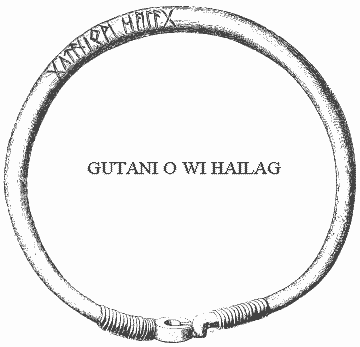
Conlang status
| Luthic Lûthica | |||||||||||||||||||||||||||||||||||||||||||||||||||||
|---|---|---|---|---|---|---|---|---|---|---|---|---|---|---|---|---|---|---|---|---|---|---|---|---|---|---|---|---|---|---|---|---|---|---|---|---|---|---|---|---|---|---|---|---|---|---|---|---|---|---|---|---|---|
| Progress: 96% | |||||||||||||||||||||||||||||||||||||||||||||||||||||
|
| |||||||||||||||||||||||||||||||||||||||||||||||||||||
| Type | |||||||||||||||||||||||||||||||||||||||||||||||||||||
| Fusional | |||||||||||||||||||||||||||||||||||||||||||||||||||||
| Alignment | |||||||||||||||||||||||||||||||||||||||||||||||||||||
| Nominative–accusative | |||||||||||||||||||||||||||||||||||||||||||||||||||||
| Head direction | |||||||||||||||||||||||||||||||||||||||||||||||||||||
| Initial | Mixed | Final | |||||||||||||||||||||||||||||||||||||||||||||||||||
|
| |||||||||||||||||||||||||||||||||||||||||||||||||||||
| Primary word order | |||||||||||||||||||||||||||||||||||||||||||||||||||||
| Verb-second | |||||||||||||||||||||||||||||||||||||||||||||||||||||
| Tonal | |||||||||||||||||||||||||||||||||||||||||||||||||||||
| No | |||||||||||||||||||||||||||||||||||||||||||||||||||||
| Declensions | |||||||||||||||||||||||||||||||||||||||||||||||||||||
| Yes | |||||||||||||||||||||||||||||||||||||||||||||||||||||
| Conjugations | |||||||||||||||||||||||||||||||||||||||||||||||||||||
| Yes | |||||||||||||||||||||||||||||||||||||||||||||||||||||
| Genders | |||||||||||||||||||||||||||||||||||||||||||||||||||||
| 3 | |||||||||||||||||||||||||||||||||||||||||||||||||||||
| Nouns decline according to... | |||||||||||||||||||||||||||||||||||||||||||||||||||||
| Case | Number | ||||||||||||||||||||||||||||||||||||||||||||||||||||
| Definiteness | Gender | ||||||||||||||||||||||||||||||||||||||||||||||||||||
| Verbs conjugate according to... | |||||||||||||||||||||||||||||||||||||||||||||||||||||
| Voice | Mood | ||||||||||||||||||||||||||||||||||||||||||||||||||||
| Person | Number | ||||||||||||||||||||||||||||||||||||||||||||||||||||
| Tense | Aspect | ||||||||||||||||||||||||||||||||||||||||||||||||||||