Faiten: Difference between revisions
Jump to navigation
Jump to search
| Line 16: | Line 16: | ||
'''Faiten Language''' (also known as '''Tan Language''') is a constructed language with its roots in the Sino-Tibetan language family. It is primarily spoken in the region of Faitonia and holds a community of 4 million speakers (4.5 million including in Faitonian diaspora). While Faiten initially gained popularity as a tool to circumvent government censorship on the internet, it has also evolved into a fully-fledged spoken language. Faiten's linguistic structure draws influences from mainly Chinese and in some cases Vietnamese. | '''Faiten Language''' (also known as '''Tan Language''') is a constructed language with its roots in the Sino-Tibetan language family. It is primarily spoken in the region of Faitonia and holds a community of 4 million speakers (4.5 million including in Faitonian diaspora). While Faiten initially gained popularity as a tool to circumvent government censorship on the internet, it has also evolved into a fully-fledged spoken language. Faiten's linguistic structure draws influences from mainly Chinese and in some cases Vietnamese. | ||
==Phonology== | |||
==Phonology== | ==Phonology== | ||
| Line 23: | Line 25: | ||
|+ | |+ | ||
! | ! | ||
! colspan="2" | ! colspan="2" |Front | ||
! colspan="2" |Back | ! colspan="2" |Back | ||
|- | |- | ||
| Line 43: | Line 45: | ||
| style="text-align:center;" | ᴀ | | style="text-align:center;" | ᴀ | ||
| style="text-align:center;" | ɔ | | style="text-align:center;" | ɔ | ||
|} | |||
=== Diphthongs === | |||
{| class="wikitable" | |||
|+ | |||
! colspan="2" |Palatal | |||
! colspan="2" |Labial | |||
|- | |||
| style="text-align:center;" | i̯a | |||
| style="text-align:center;" | ai̯ | |||
| style="text-align:center;" | u̯a | |||
| style="text-align:center;" | au̯ | |||
|- | |||
| style="text-align:center;" | i̯e | |||
| style="text-align:center;" | ei̯ | |||
| style="text-align:center;" | u̯e | |||
| style="text-align:center;" | eu̯ | |||
|- | |||
| style="text-align:center;" | ɨ̯ə | |||
| style="text-align:center;" | əi̯ | |||
| style="text-align:center;" | u̯ə | |||
| | |||
|- | |||
| style="text-align:center;" | i̯o | |||
| | |||
| style="text-align:center;" | u̯o | |||
| style="text-align:center;" | ou̯ | |||
|- | |||
| style="text-align:center;" | y̯ø | |||
| style="text-align:center;" | øy̯ | |||
| | |||
| | |||
|- | |||
| style="text-align:center;" | i̯u | |||
| | |||
| | |||
| | |||
|} | |} | ||
Revision as of 05:39, 29 June 2023
| Faiten | |
|---|---|
| Fae Tan Fah or 飛談話 | |
| Pronunciation | [fᴀi̯ tᴀn fᴀ] |
| Created by | Nathan Xu |
| Date | 2009 |
| Native to | Faitonia |
Sino-Tibetan
| |
| Official status | |
Official language in | Faitonia |
| Regulated by | 共產媈唐人民共和國政府 or Kaung Shan Fai Tang Hnin Bin Gong Var Quoc Jieng Fu |
Introduction
Faiten Language (also known as Tan Language) is a constructed language with its roots in the Sino-Tibetan language family. It is primarily spoken in the region of Faitonia and holds a community of 4 million speakers (4.5 million including in Faitonian diaspora). While Faiten initially gained popularity as a tool to circumvent government censorship on the internet, it has also evolved into a fully-fledged spoken language. Faiten's linguistic structure draws influences from mainly Chinese and in some cases Vietnamese.
Phonology
Phonology
Vowel inventory
| Front | Back | |||
|---|---|---|---|---|
| Close | i | y | ɨ | u |
| Middle | e | ø | ə | o |
| Open | ɛ | œ | ᴀ | ɔ |
Diphthongs
| Palatal | Labial | ||
|---|---|---|---|
| i̯a | ai̯ | u̯a | au̯ |
| i̯e | ei̯ | u̯e | eu̯ |
| ɨ̯ə | əi̯ | u̯ə | |
| i̯o | u̯o | ou̯ | |
| y̯ø | øy̯ | ||
| i̯u | |||
Consonant inventory
| Labial | Dental | Velar | Alveolar | Retroflex | Palatal | ||
|---|---|---|---|---|---|---|---|
| Stop | Aspirated | pʰ | tʰ | kʰ | t͡sʰ | ʈ͡ʂʰ | t͡ɕʰ |
| Tenuis | p | t | k | t͡s | ʈ͡ʂ | t͡ɕ | |
| Voiced | b | d | g | ||||
| Fricative | Tenuis | f | h | s | ʂ | ɕ | |
| Voiced | v | z | ʐ | ʑ | |||
| Resonant | Nasal | m | n | ŋ | |||
| Liquid | w | l | j |
Correspondences From Middle Chinese
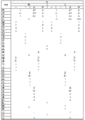
Faiten Initials
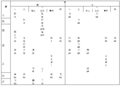
Faiten Open Rimes
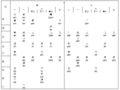
Faiten Nasal Rimes


Notes:
- Labialisation of initials 幫 滂 並 明 only occur in independent rimes 嚴 元 殷 庚 凡 文 廢 微 幽 as well as Chongniu-B rimes 祭 支 脂 宵 鹽 侵 仙 真 清 as well as Closed mouth III rimes 戈 陽 蒸.
- Rimes 魚 虞 are realized as back vowels /u o/ in initials 知 徹 澄 娘 莊 初 崇 生 俟 and front /y ø/ for the rest.
- Before initials 知 徹 澄 娘 莊 初 崇 生 俟 the mixed III finals lose their palatal glide as they merge with division II.
- The initials 曉 匣 are both realized as /h/. But in closed mouth syllables they labiodentalise into /f v/ which lose their -u̯- glide.
- Before initials 端 透 定 泥 精 清 從 心 邪 they lose their palatal glide while retaining their vowels.
- In initials 知 徹 澄 娘 莊 初 崇 生 俟 the vowels /e i/ become /ə ɨ/.
- In initials 見 溪 羣 疑, Chongniu-B rimes loses it’s palatal glide while Chongniu-A rimes retains the -i- glide.