Nidâri: Difference between revisions
| (21 intermediate revisions by the same user not shown) | |||
| Line 15: | Line 15: | ||
<!-- Design goals, inspiration, ideas, who speaks it?, when was it created?, where does it come from?, any peculiarities? --> | <!-- Design goals, inspiration, ideas, who speaks it?, when was it created?, where does it come from?, any peculiarities? --> | ||
Nidâri is one of two extant members of the Duaric language family. The language is spoken by roughly 1,200 people in Sašvân ("refuge"), a volcanic island approximately 1100 km southeast of Minhay. Unlike its relative, Ín Duári, more than 90% of its inhabitants claim Nidâri as their first language. The language's survival and relative health compared to Ín Duári, considered a moribund language, can be attributed to the physical separation of its speakers from the Minhast mainland. | Nidâri is one of two extant members of the Duaric language family. The language is spoken by roughly 1,200 people in Sašvân ("refuge"), a volcanic island approximately 1100 km southeast of Minhay. Unlike its relative, [[Ín_Duári| Ín Duári]], more than 90% of its inhabitants claim Nidâri as their first language. The language's survival and relative health compared to Ín Duári, considered a moribund language, can be attributed to the physical separation of its speakers from the Minhast mainland. | ||
Because of this separation, various phonemic and morphological changes have rendered Nidâri and Ín Duári mutually unintelligible. While more innovations have occurred in Nidâri, it nevertheless has retained more of the original Duaric lexicon, as loanwords from the [[Minhast]] and Peshpeg languages have had a significant impact on the Ín Duári lexicon. | Because of this separation, various phonemic and morphological changes have rendered Nidâri and Ín Duári mutually unintelligible. Ín Duári is considered the more conservative of the two languages, as it has preserved most of the protolanguage's noun class system and more archaic verb system. While more innovations have indeed occurred in Nidâri, it nevertheless has retained more of the original Duaric lexicon, as loanwords from the [[Minhast]] and [[Peshpeg]] languages have had a significant impact on the Ín Duári lexicon. Moreover, while it is the case that the Nidâri noun class system has been reduced to four classes, as opposed to Ín Duári's eight classes, the number of irregularities' in Nidâri's noun class system paradoxically reveals that it has preserved remnants of an even more extensive system from the protolanguage. | ||
<!-- Example categories/headings: | <!-- Example categories/headings: | ||
| Line 220: | Line 220: | ||
--> | --> | ||
===Nouns=== | ===Nouns=== | ||
Nouns inflect for gender, number and case. The original Proto-Duaric gender system consisted of at least eight noun classes, perhaps even up to eleven< | Nouns inflect for gender, number and case. The original Proto-Duaric gender system consisted of at least eight noun classes, perhaps even up to eleven<ref>The putative eleven cases are based on the Nidâri suffixes ''-šni'', ''-jan'', and ''-qan'', which have no cognate forms in Ín Duári.</ref>, descended from an earlier system that distinguished animacy through noun classifiers. Of this complex noun class system, Nidâri preserved four of them. | ||
Animacy has some correlation amongst the surviving noun classes, with animacy tending to decrease from left to right across the noun classes. However, the animacy distinctions have blurred, with some of the nouns in the protolanguage being reassigned to another class due to syncretism, as can be seen in the Class III and IV nouns, where both the singular and plural nominative and genitive forms are wildly irregular. Across all noun classes, including the irregular paradigms, there is always an infixed ''-h-'' in the plural, reflecting an earlier ''-θ-'' in the Proto-language. | Animacy has some correlation amongst the surviving noun classes, with animacy tending to decrease from left to right across the noun classes. However, the animacy distinctions have blurred, with some of the nouns in the protolanguage being reassigned to another class due to syncretism, as can be seen in the Class III and IV nouns, where both the singular and plural nominative and genitive forms are wildly irregular. Across all noun classes, including the irregular paradigms, there is always an infixed ''-h-'' in the plural, reflecting an earlier ''-θ-'' in the Proto-language that is still preserved in Ín Duári. | ||
| Line 313: | Line 313: | ||
|- | |- | ||
|} | |} | ||
<!-- Note: "rinázi" one who speaks, "riná" speech, "rinásse" he speaks, to speak --> | <!-- Note: "rinázi" one who speaks, "riná" speech, "rinásse" he speaks, to speak --> | ||
| Line 346: | Line 343: | ||
|- | |- | ||
! Nominative | ! Nominative | ||
| | | šuda | ||
| | | šuha | ||
| | | gardaš | ||
| | | gardân | ||
| | | nia | ||
| | | nihâ | ||
| | | ni | ||
| | | niah | ||
| | | nešq | ||
| | | nâhe | ||
| | | niškâr | ||
| | | našin | ||
|- | |- | ||
! Genitive | ! Genitive | ||
| | | šudâni | ||
| | | šuhân | ||
| | | gardaq | ||
| | | garâdi | ||
| | | niani | ||
| | | nihâni | ||
| | | niar | ||
| | | nihâr | ||
| | | nešqân | ||
| | | na’i | ||
| | | nin | ||
| | | našvâz | ||
|- | |- | ||
! Instrumental | ! Instrumental | ||
| Line 443: | Line 440: | ||
|- | |- | ||
! Present | ! Present | ||
| bâz << bey-ân-z, biy-ân-z | | bâz <!-- << bey-ân-z, biy-ân-z --> | ||
| bâš, bâšq << bey-ân-z-g, biy-ân-z-g | | bâš, bâšq <!-- << bey-ân-z-g, biy-ân-z-g --> | ||
|- | |- | ||
! Future/Irrealis | ! Future/Irrealis | ||
| bidâz << biy-ad-ân-z | | bidâz <!-- << biy-ad-ân-z --> | ||
| bidâšq << biy-ad-ân-z-g | | bidâšq <!-- << biy-ad-ân-z-g --> | ||
|- | |- | ||
! Past | ! Past | ||
| baštân << ba-š-t-ân | | baštân <!-- << ba-š-t-ân--> | ||
| baštâq << ba-št-ân-g | | baštâq <!-- << ba-št-ân-g --> | ||
|- | |- | ||
! Imperative | ! Imperative | ||
| baš << ba-š | | baš <!-- << ba-š --> | ||
| bašqân, bašgân << ba-š-g-ân | | bašqân, bašgân <!-- << ba-š-g-ân --> | ||
|- | |- | ||
|} | |} | ||
<!-- | |||
{| class="bluetable lightbluebg" | |||
|+ | |||
|- | |||
! rowspan="3"| Tense-Aspect | |||
! colspan="12" | Person | |||
|- | |||
! colspan="2" | 1st | |||
! colspan="2" | 2nd | |||
! colspan="2" | Class I | |||
! colspan="2" | Class II | |||
! colspan="2" | Class III | |||
! colspan="2" | Class IV | |||
|- | |||
! Singular | |||
! Plural | |||
! Singular | |||
! Plural | |||
! Singular | |||
! Plural | |||
! Singular | |||
! Plural | |||
! Singular | |||
! Plural | |||
! Singular | |||
! Plural | |||
|- | |||
! Present | |||
| šubâz | |||
| šubâzan | |||
| garbâz | |||
| garbâzan | |||
| bâz | |||
| bâzan | |||
| nebâz | |||
| nehbâzan | |||
| nibâz | |||
| nehbâzan | |||
| | |||
| | |||
|- | |||
! Future/Irrealis | |||
| šubidâz | |||
| šubidâzan | |||
| | |||
| | |||
| bidâz | |||
| bidâzan | |||
| | |||
| | |||
| | |||
| | |||
| | |||
| | |||
|- | |||
! Perfective | |||
| šubaštân | |||
| šubaštânan | |||
| | |||
| | |||
| baštân | |||
| baštânan | |||
| | |||
| | |||
| | |||
| | |||
| | |||
| | |||
|- | |||
! Imperfective | |||
| šušbaš | |||
| šušbâšan | |||
| | |||
| | |||
| bibaš | |||
| bibašan | |||
| | |||
| | |||
| | |||
| | |||
| | |||
| | |||
|- | |||
! Purposive | |||
| šubâšaniš //c.f. Ín Duári suffix "-iţ" (e.g. varánu-iţ "in order to see"// | |||
| šubâšananiš | |||
| | |||
| | |||
| bâšaniš | |||
| bâšananiš | |||
| | |||
| | |||
| | |||
| | |||
| | |||
| | |||
|- | |||
! Imperative | |||
| | |||
| | |||
| | |||
| | |||
| baš | |||
| bašan | |||
| | |||
| | |||
| | |||
| | |||
| | |||
| | |||
|} | |||
--> | |||
The copula originates from two roots, ''ba-'' and ''biy-''. The root ''bi-'' is used to form the Future/Irrealis stem, whilst ''ba-'' forms the rest of the TAM stems. Both ''ba-'' and ''biy-'' are cognate with Ín Duári ''bean'', “to sit, be in a sitting position” | The copula originates from two roots, ''ba-'' and ''biy-''. The root ''bi-'' is used to form the Future/Irrealis stem, whilst ''ba-'' forms the rest of the TAM stems. Both ''ba-'' and ''biy-'' are cognate with Ín Duári ''bean'', “to sit, be in a sitting position” | ||
| Line 471: | Line 581: | ||
|phrase = Birân bagdaman baštân. | |phrase = Birân bagdaman baštân. | ||
| IPA = /bi'rɒ:n bagda'man baʃ'tɒn/ | | IPA = /bi'rɒ:n bagda'man baʃ'tɒn/ | ||
| morphemes = | | morphemes = bir-ân bagda-man baštân | ||
| gloss = to.house running-CL1.NOM was | | gloss = to.house-CL4.NOM running-CL1.NOM was | ||
| translation = He ran home. | | translation = He ran home. | ||
}} | }} | ||
| Line 479: | Line 589: | ||
|phrase = Han gabagdaman baštâq gureh birân. | |phrase = Han gabagdaman baštâq gureh birân. | ||
| IPA = /han gabagda'man baʃ'taɣ gu'rɛh bi'rɒ:n / | | IPA = /han gabagda'man baʃ'taɣ gu'rɛh bi'rɒ:n / | ||
| morphemes = han ga=bagdam-an baštaq gureh | | morphemes = han ga=bagdam-an baštaq gureh bir-ân | ||
| gloss = NEG NEG=running-CL1.NOM was.NEG try to.house | | gloss = NEG NEG=running-CL1.NOM was.NEG try to.house-CL4.NOM | ||
| translation = He did not try to run home. | | translation = He did not try to run home. | ||
}} | }} | ||
| Line 487: | Line 597: | ||
{{Gloss | {{Gloss | ||
|phrase = Han gatâqivan birânen baštâqešan gureh. | |phrase = Han gatâqivan birânen baštâqešan gureh. | ||
| IPA = /han | | IPA = /han gatɒɣi'van birɒ'nɛn baʃtaɣe'ʃan gu'rɛh/ | ||
| morphemes = han ga=tâqiv-an | | morphemes = han ga=tâqiv-an bir-ânen baštâq-ešan gureh | ||
| gloss = NEG NEG=burning-CL1.NOM house-GEN was.NEG | | gloss = NEG NEG=burning-CL1.NOM house-CL4.GEN was.NEG-CAUS try | ||
| translation = He did not try to burn down the house. | | translation = He did not try to burn down the house. | ||
}} | }} | ||
<!-- "bir-" ("house, home"), cognate with Ín Duári "ber-" ("stone") --> | |||
===Adjectives=== | |||
==Syntax== | ==Syntax== | ||
===Constituent order=== | ===Constituent order=== | ||
| Line 498: | Line 611: | ||
===Noun phrase=== | ===Noun phrase=== | ||
====Possessive Constructions==== | |||
====Comparison==== | |||
===Verb phrase=== | ===Verb phrase=== | ||
As mentioned in the [[Nidâri#The_Participial|Participial Section]], the participial and its head, the object, are in form identical with that of a nominal possessive phrase. The possessor of the NP serves as head and the possessum its dependent, just as the direct object serves as the head of its dependent, the participial. Both the possessor and the direct object receive genitive marking. The participial must also agree with the subject in gender and number, as illustrated in the following example: | As mentioned in the [[Nidâri#The_Participial|Participial Section]], the participial and its head, the object, are in form identical with that of a nominal possessive phrase. The possessor of the NP serves as head and the possessum its dependent, just as the direct object serves as the head of its dependent, the participial. Both the possessor and the direct object receive genitive marking. The participial must also agree with the subject in gender and number, as illustrated in the following example: | ||
| Line 524: | Line 640: | ||
==Example texts== | ==Example texts== | ||
== Footnotes == | |||
{{reflist}} | |||
==Other resources== | ==Other resources== | ||
<!-- Example: Word order, qualifiers, determinatives, branching, etc. --> | <!-- Example: Word order, qualifiers, determinatives, branching, etc. --> | ||
Latest revision as of 17:33, 26 April 2025
Introduction
Nidâri is one of two extant members of the Duaric language family. The language is spoken by roughly 1,200 people in Sašvân ("refuge"), a volcanic island approximately 1100 km southeast of Minhay. Unlike its relative, Ín Duári, more than 90% of its inhabitants claim Nidâri as their first language. The language's survival and relative health compared to Ín Duári, considered a moribund language, can be attributed to the physical separation of its speakers from the Minhast mainland.
Because of this separation, various phonemic and morphological changes have rendered Nidâri and Ín Duári mutually unintelligible. Ín Duári is considered the more conservative of the two languages, as it has preserved most of the protolanguage's noun class system and more archaic verb system. While more innovations have indeed occurred in Nidâri, it nevertheless has retained more of the original Duaric lexicon, as loanwords from the Minhast and Peshpeg languages have had a significant impact on the Ín Duári lexicon. Moreover, while it is the case that the Nidâri noun class system has been reduced to four classes, as opposed to Ín Duári's eight classes, the number of irregularities' in Nidâri's noun class system paradoxically reveals that it has preserved remnants of an even more extensive system from the protolanguage.
Phonology
Orthography
Vannâri, cognate with Ín Duári uannar, means "Eastern Sea", a historical reminder that it was early American missionaries that developed the system before the Minhast prefectures imposed restrictions limiting Western access to Aškuan.
| Vanâr Characters |
|---|
| a, â, e, i, o, u, b, p, v, f, t, d, k, g, m, n, l, r, s, š z, h, x, y |
Consonants
| Bilabial | Alveolar | Palatal | Velar | Glottal | Laryngeal | ||
|---|---|---|---|---|---|---|---|
| Nasal | m | n | |||||
| Plosive | p b | t d | k g | ʔ | |||
| Fricative | Non-Sibilant | f v | x ɣ | h | |||
| Sibiliant | s z | ||||||
| Affricates | t͡ʃ d͡ʒ | ||||||
| Approximants | j | ||||||
| Trill | r | ||||||
| Lateral | l | ||||||
Vowels
| Front | Central | Back | ||||
| Close | 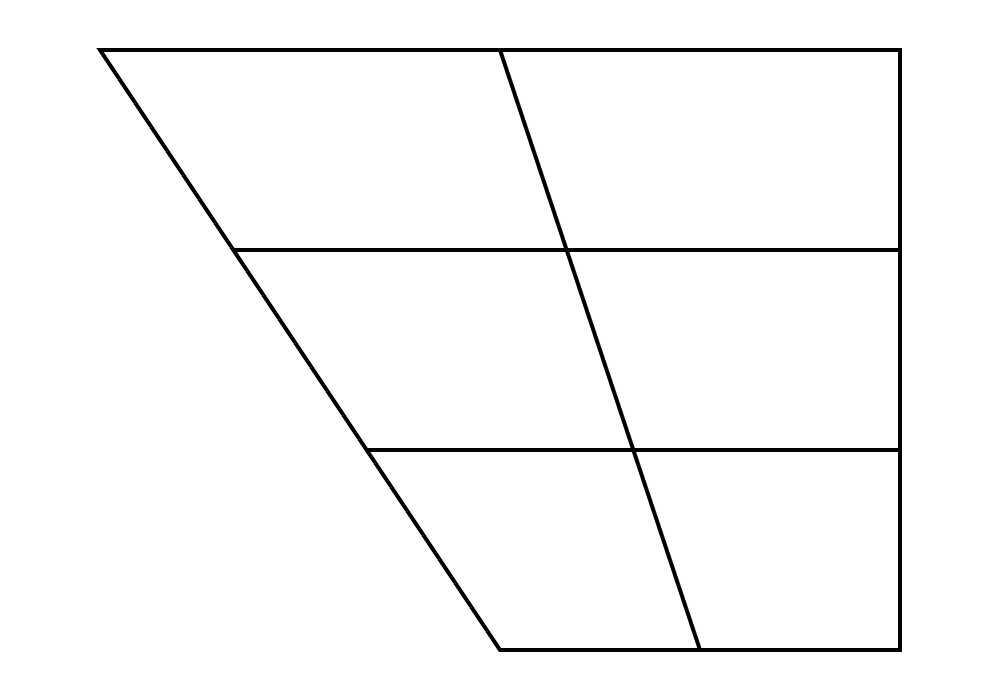
| |||||
| Close-mid | ||||||
| Open-mid | ||||||
| Open | ||||||
Prosody
Length and Stress
Vowel length is distinctive in Nidâri and is indicated by macrons. The phoneme /ɒ:/ is inherently long and indicated by a circumflex <â> in the Vannâri orthography. Stress usually falls on the last syllable, but with certain affixes, whether inflectional or derivational, the stress shifts to the penultimate, e.g. jandarme /jæn'darmɛ/ "healer, doctor" (the affix -mɛ derives occupational nouns).
Intonation
Phonotactics
Morphophonology
Morphology
Nidâri is a fusional language with some agglugination.
Nouns
Nouns inflect for gender, number and case. The original Proto-Duaric gender system consisted of at least eight noun classes, perhaps even up to eleven[1], descended from an earlier system that distinguished animacy through noun classifiers. Of this complex noun class system, Nidâri preserved four of them.
Animacy has some correlation amongst the surviving noun classes, with animacy tending to decrease from left to right across the noun classes. However, the animacy distinctions have blurred, with some of the nouns in the protolanguage being reassigned to another class due to syncretism, as can be seen in the Class III and IV nouns, where both the singular and plural nominative and genitive forms are wildly irregular. Across all noun classes, including the irregular paradigms, there is always an infixed -h- in the plural, reflecting an earlier -θ- in the Proto-language that is still preserved in Ín Duári.
| Case | Noun Classes | |||||||
|---|---|---|---|---|---|---|---|---|
| Class I | Class II | Class III | Class IV | |||||
| Singular | Plural | Singular | Plural | Singular | Plural | Singular | Plural | |
| Nominative | hora | hohra | talâr | tahlâri | ||||
| Genitive | horāne | hohrāne | talâre | tahlâr | ||||
| Instrumental | horē | hohrē | tahlarâni | |||||
| Ablative | talârē | tahlâriye | ||||||
| Allative | horā | hohrā | talârā | tahlârȇn | ||||
| Locative | horāna | hohrēna | talâri | tahlâri | ||||
| Comitative | horē | hohrē | talâre | tahlâr | ||||
Pronouns
| Case | Noun Classes | |||||||||||
|---|---|---|---|---|---|---|---|---|---|---|---|---|
| 1st | 2nd | Class I | Class II | Class III | Class IV | |||||||
| Singular | Plural | Singular | Plural | Singular | Plural | Singular | Plural | Singular | Plural | Singular | Plural | |
| Nominative | šuda | šuha | gardaš | gardân | nia | nihâ | ni | niah | nešq | nâhe | niškâr | našin |
| Genitive | šudâni | šuhân | gardaq | garâdi | niani | nihâni | niar | nihâr | nešqân | na’i | nin | našvâz |
| Instrumental | ||||||||||||
| Ablative | ||||||||||||
| Allative | ||||||||||||
| Locative | ||||||||||||
Verbs
The Copula
The Nidâri copula inflects for TAM and polarity:
| TAM | Positive | Negative |
|---|---|---|
| Present | bâz | bâš, bâšq |
| Future/Irrealis | bidâz | bidâšq |
| Past | baštân | baštâq |
| Imperative | baš | bašqân, bašgân |
The copula originates from two roots, ba- and biy-. The root bi- is used to form the Future/Irrealis stem, whilst ba- forms the rest of the TAM stems. Both ba- and biy- are cognate with Ín Duári bean, “to sit, be in a sitting position”
The Participial
The copula combines with a verbal noun, descended from the Proto-Duaric gerund, to form a compound verb. In Duaric linguistics, this verbal noun is referred to as the participial, as it also functions as nominalizers, adjectives, temporal nouns, among other functions. The participial replaced the original verbal noun that survives in its sister language Ín Duári.
The participial agrees with its subject in gender, number, and case. Adjectives may also appear and modify the participial. Just as in NPs, the participial follows its head.
In intransitive clauses, the participial/participial phrase precedes the copula and any accompanying auxiliaries:
- Birân bagdaman baštân.
/bi'rɒ:n bagda'man baʃ'tɒn/
bir-ân bagda-man baštân
to.house-CL4.NOM running-CL1.NOM was
He ran home.
- Han gabagdaman baštâq gureh birân.
/han gabagda'man baʃ'taɣ gu'rɛh bi'rɒ:n /
han ga=bagdam-an baštaq gureh bir-ân
NEG NEG=running-CL1.NOM was.NEG try to.house-CL4.NOM
He did not try to run home.
In transitive clauses, the gerund precedes the object, which is inflected in the genitive case, followed by the copula:
- Han gatâqivan birânen baštâqešan gureh.
/han gatɒɣi'van birɒ'nɛn baʃtaɣe'ʃan gu'rɛh/
han ga=tâqiv-an bir-ânen baštâq-ešan gureh
NEG NEG=burning-CL1.NOM house-CL4.GEN was.NEG-CAUS try
He did not try to burn down the house.
Adjectives
Syntax
Constituent order
Canonical word order is SV1OV2, but V1OSV2 and V1OV2S also occur, the last of which occurs rarely. The subject can never appear after V1, the participial component of the verb phrase. This is due to diachronic factors: the participial and object developed from a possessive phrase structure, attested to the survival of the genitive marking on the noun head. As this segment of the VP was originally a possessive phrase, non-constituents such as subjects were blocked from insertion into between the original possessum and possessor.
Noun phrase
Possessive Constructions
Comparison
Verb phrase
As mentioned in the Participial Section, the participial and its head, the object, are in form identical with that of a nominal possessive phrase. The possessor of the NP serves as head and the possessum its dependent, just as the direct object serves as the head of its dependent, the participial. Both the possessor and the direct object receive genitive marking. The participial must also agree with the subject in gender and number, as illustrated in the following example:
- Tâqivan birâneqan baštânešan.
tɒ:ɣiv'an birɒ:nɛ'qan baʃtɒ:nɛ'ʃan
tâqiv-an birân-eqan baštân-ešan
burning-CL1.NOM house-CL.IV.GEN was=CAUS
He burned down the house. (lit: "He was the house's burner.").
Adjectives and any modifier, be it for the subject or the object, must agree with their respective heads. The constituent order does not deviate from that of the NP: adjectives follow their heads and agree in case, number and gender. The following example shows the grammatical concordance of the subject and object and their respective modifiers:
- Tâqivan behoran birâneqan bišvi baštânešan.
tɒ:ɣiv'an bɛho'ran birɒ:nɛ'qan biʃ'vi baʃtɒ:nɛ'ʃan
tâqiv-an behor-an birân-eqan biš-vi baštân-ešan
burning-CL1.NOM fat.one-CL1.NOM house-CL.IV-GEN red-CL.IV.GEN-was=CAUS
The fat one burned down the red house. (lit: "The fat one was the red house's burner.").
Sentence phrase
Dependent clauses
Example texts
Footnotes
- ^ The putative eleven cases are based on the Nidâri suffixes -šni, -jan, and -qan, which have no cognate forms in Ín Duári.