Peshpeg: Difference between revisions
| (One intermediate revision by the same user not shown) | |||
| Line 592: | Line 592: | ||
|+ '''Verb Template of ''-mb-'' ''' | |+ '''Verb Template of ''-mb-'' ''' | ||
|- | |- | ||
! Object !! Subject !! | ! Object !! Subject !! Root !! Tense !! Mood | ||
|- | |- | ||
| | | | ||
| Line 612: | Line 612: | ||
*gu-, -g- | *gu-, -g- | ||
*gi-, -g- | *gi-, -g- | ||
| - | | -mb- | ||
| | | | ||
*-ji- | *-ji- | ||
| Line 1,088: | Line 1,086: | ||
===Noun phrase=== | ===Noun phrase=== | ||
===Adjectival | ===Adjectival phrase=== | ||
Adjectives take minimal inflection, based on its position relative to its noun head. A suffix ''-em'' simply indicates the adjective is dependent on another element, and appears when the adjective follows its head. Interestingly, if a periphrastic verb construction appears immediately after the adjective, the adjective is displaced and must appear before its noun head. A connective ''mon'' surfaces between the pre-nominal adjective and its noun. This rule does not apply with synthetic verbs, however, following the default noun-adjective order, wherein the ''-em'' suffix obligatorily surfaces. | Adjectives take minimal inflection, based on its position relative to its noun head. A suffix ''-em'' simply indicates the adjective is dependent on another element, and appears when the adjective follows its head. Interestingly, if a periphrastic verb construction appears immediately after the adjective, the adjective is displaced and must appear before its noun head. A connective ''mon'' surfaces between the pre-nominal adjective and its noun. This rule does not apply with synthetic verbs, however, following the default noun-adjective order, wherein the ''-em'' suffix obligatorily surfaces. | ||
Latest revision as of 12:21, 22 March 2025
 | This article is a construction site. This project is currently undergoing significant construction and/or revamp. By all means, take a look around, thank you. |
Introduction
The Peshpeg language, or Peshpeg humbi todak inlak "true humans speak this way", is a highly endangered language in the valleys of the Kilmay Rī Mountains and the prefectures of south-central Minhay. The language is considered moribund: according to the last census, only about ninety fluent speakers remain, all older than sixty years. Younger generations speak only Minhast, from either the Wolf Speaker, Stone Speaker, or City Speaker dialects. Efforts to revitalize the language have been largely unsuccessful; with the exception of the City Speakers, most Minhast are either apathetic or even actively hostile to revitalization efforts. Social and economic discrimination towards the Peshpegs has only accelerated the decline of the language.
Peshpeg is classified as a language isolate. Any similarities to the Minhast language are due to language contact, with most of the influences being unidirectional; only a handful of Peshpeg words, most of them related to the fauna and flora of their original homeland, have been adopted by the Wolf Speaker and Stone Speaker dialects. However, Minhast has had an enormous impact on the Peshpeg language; close to 70% of the Peshpeg lexicon comes from Minhast, and quite notably, the original base-10 numerical system has been supplanted by the vegisimal system of the dominant language. Some linguists have explored the possibility of a relationship with Ín Duári, another endangered, non-Minhast language, but plausible evidence for such a relationship has not been demonstrated.
Peshpeg is classified as an SOV language. The language apparently had an extensive vowel harmony system, which has been preserved to some extent in its present-day form. Aggluginative and fusional features appear in various areas of the grammar.
The language is head initial: modifiers such as adjectives usually follow their head noun; prepositions are used in adpositional phrases, and relative clauses follow the NP they modify, attributes associated with head-initial languages. Once again, however, the influence of Minhast has introduced a certain level of fluidity, such as numerical modifiers precede their noun heads; this was probably facilitated by the replacement of the original decimal system with Minhast's vegisimal system.
Phonology
Orthography
Fragmentary inscriptions, thus far undeciphered, have been found in ruins scattered throughout Nasket Prefecture in Dog Speaker Country. This area is known for pre-Minhast settlements, and was occupied by the Peshpegs according to their oral history before they were displaced by Minhast invaders. However, the Ín Duári also claim the area as part of their original homeland. The heritage of the inscriptions thus remains in doubt.
The Širkattarnaft was eventually adopted by the Peshpegs, to which they added diacritics and additional vowel signs to represent sounds not represented in the original orthography. During the late 1870's, an Evangelist missionary, Aldous Green Huntly, sneaked into Minhay aboard a Chinese merchant vessel returning from the United States. Hounded by hostile Gull Speakers who discovered him in the port city of Kissamut, he fled west, skirting around the major villages in Dog Speaker Country until he stumbled upon a Peshpeg settlement. There, he was welcomed, and he began to preach and he successfully converted many of the villagers to the Evangelical sect. He transcribed their language into a modified Latin script in order to translate the Bible to them. The script came to be known as the Evanjelastarin or Evanjelastarün, and soon this script was adopted by Peshpegs throughout Minhay, although the Širkattarnaft continued to be used in correspondence with the Minhast, road signs, and legal documents. Unfortunately, as the language has become moribund, the Evanjelastarin has been largely replaced by the Širkattarnaft.
| Evanjelastarin Characters |
|---|
| a á, e é, i í, o ó, ö (oe), u ú, ü (y), b, p, f, v, d, t, g, k, c (ch), j, n, m, l, r, z, zh, s, sh, h, y |
Consonants
| Bilabial | Alveolar | Palatal | Velar | Glottal | Laryngeal | |
|---|---|---|---|---|---|---|
| Nasal | m | n | ||||
| Plosive | p b | t d | k g | ʔ | ||
| Affricates | t͡ʃ d͡ʒ | |||||
| Fricative | v | s z | ʃ ʒ | h | ||
| Approximants | j | |||||
| Flap | ɾ | |||||
| Lateral | l |
Vowels
| Front | Near- front | Central | Near- back | Back | ||
| Close | 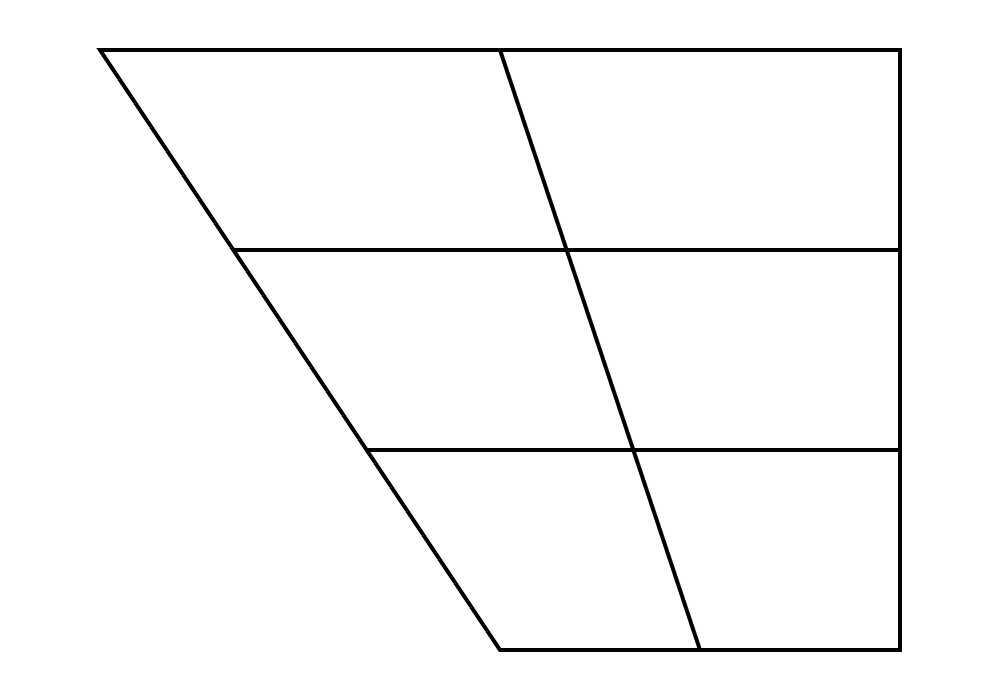
| |||||
| Near-close | ||||||
| Close-mid | ||||||
| Mid | ||||||
| Open-mid | ||||||
| Near-open | ||||||
| Open | ||||||
Prosody
Stress
Nouns are generally stressed on the penult or antipenult syllable, but a number of them receive final-syllable stress. The romanized orthography marks final stress with an acute accent. Antepenultimate stress occurs if the syllable is closed, otherwise the word is pronounced on the penult syllable.
Intonation
Phonotactics
Morphophonology
Morphology
Peshpeg has four formal word classes: nouns, verbs, adjectives, and particles. Of these four parts of speech, nouns and verbs exhibit the most complex parts of the grammar of the language.
The nominal system is divided into a three-way declension system based on natural gender, animacy, and countability and concreteness. The declension system underlies Peshpeg's unusual split-ergative alignment system. Unlike other split systems, which either display tense-aspect based ergative marking (e.g. Hindi and most Indic languages), or pronominal-based splits (e.g. Minhast and Dyirbal), Peshpeg applies nominative-accusative and ergative-absolutive marking based on noun class. This noun class system is based on an animacy hierarchy. Class I nouns, ranked as the most animate in the animacy hierarchy, takes nominative-accusative marking, whilst Class II nouns, which lie lower in the animacy hierarchy, take ergative-absolutive marking. The final group of nouns, falling under Class III, receive no overt marking and therefore show direct alignment as these nouns fall lowest in the animacy hierarchical spectrum.
Verbs fall under two broad classes. One class, which is partially or fully synthetic, derives from an older system. These verbs are usually high-frequency words, such as ru ("to go"). The other verb class involves a periphrastic construction based on an unmarked verbal noun followed by an auxiliary verb which takes person, tense, and aspect marking.
Adjectives take minimal inflection, based on its position relative to its noun head. A suffix -em simply indicates the adjective is dependent on another element, and appears when the adjective follows its head. Interestingly, if a periphrastic verb construction appears immediately after the adjective, the adjective is displaced and must appear before its noun head. A connective mon surfaces between the pre-nominal adjective and its noun. This rule does not apply with synthetic verbs, however, following the default noun-adjective order, wherein the -em suffix obligatorily surfaces.
Particles are uninflected words, a lexically broad collection which include adverbs, negators, discourse markers, and various syntactic operators.
Nouns
Peshpeg nouns are highly inflected, making distinctions in gender, animacy, case, and number. These distinctions are marked by suffixes that show agglutinative and fusional characteristics.
Noun Classes
Peshpeg nouns fall into three declensions, or classes, simply called Class I, Class II, and Class III. The noun classes roughly coincide with natural gender and/or animacy.
- Class I nouns,
- Morphologically follow a nominative-accusative pattern, marking the accusative with the suffixes -jor/-jomu.
- These nouns occupy the topmost level of the animacy hierarchy.
- Typically are male humans, or consist of nouns that are associated with male attributes, particularly weapons. Divinities, supernatural events, wolves, horses, and moving bodies of water also fall within this class.
- Class II nouns
- Morphologically follow an ergative-absolutive pattern: they take the ergative -du/-dumu markers, and null-marking for the absolutive.
- These nouns are lower in the animacy hierarchy than the Class I nouns, but can still express agency and thus occupy the middle level of the animacy hierarchy.
- Follow along biological gender for female humans, and neuter animate count nouns, animals, except reptiles, amphibians, and fish. Some prototypically inanimate nouns are also found in this category, such as trees, household items e.g. tonkul "crockpot", or farming implements, e.g. vulpat "hoe".
- Class III nouns
- These nouns occupy the lowest level in the animacy hierarchy
- Take no marking for case or number.
- Nouns falling in this class include certain body parts, non-mammalian/non-avian animals, most plants, mass nouns, inanimate objects, and abstract nouns.
Case and Number
Peshpeg's three-way split in its morphological alignment underlies its nominal case-number system. Thus, the case-number system reflects the nominal system's animacy hierarchy. A nominative-accusative pattern is observed among Class I nouns, an ergative-absolutive pattern in Class II nouns, and a direct marking pattern in its Class III nouns. The nominative-accusative pattern in Class I nouns marks direct objects with the submorpheme -j-. The ergative-absolutive system is distinguished by the submorpheme -d- for ergative arguments. Class III nouns do not distinguish agent-patient roles, reflecting the direct alignment of these nouns.
| Class I | Class II | Class III | ||||
|---|---|---|---|---|---|---|
| Sg | Pl | Sg | Pl | Sg | Pl | |
| Ergative | -du | -dunu | -ri -rin, -rün *-in, -ün | |||
| Nominative-Absolutive | -∅ | -mu | -∅ | -na | ||
| Accusative | -jor | -jomu | ||||
| Genitive/Dative/Benefactive | -jok | -jomok | -k -ak |
-ndak | -rik -runk, -rünk | |
| Allative | -jori | -jomori | -ri -ori |
-ndori | -ri -rin, -rün | |
| Ablative | -jolak | -jomolak | -lak | -ndolak | †-rlakin, -rlakün | |
| Locative | -jorek | -jomorek | -rek | -ndorek | -renek, -rünik | |
| Instrumental | -majorek | -majomorek | -marek | -mandorek | -marenek, -merünik | |
| Comitative | dorün + NOM.SG | dorün + NOM.PL | dorün + ABS.SG | dorün + ABS.PL | dorün + DIR.CASE | |
*The -in allomorph of the Class III suffix is favoured when the preceding phoneme is a palatalized consonant.
†Not the expected -rinlak/-rünlak
In intransitive clauses, the nominative case of Class I nouns and absolutive case of Class II nouns, are indistinguishable, as both are null-marked:
- Kodzorin iru daltashi.
'kod͡zoɾɪn ɪɾ'u dal'taʃi
kodzorin-∅ i-ru-∅ daltashi
hammer_PN.CL1.S-NOM PST-go-CL1.S alone
Kodzorin went unaccompanied.
- Torzha irumvi daltashi.
torzha-∅ i-ru-mvi daltashi
girl.CL2.S.ABS PST-go-CL2.S alone
The girl went unaccompanied.
Tripartite marking can in the same clause, wherein both the ergative and accusative markers both occur. This situation arises when Class I and Class II arguments co-occur as core arguments in transitive clauses, demonstrated in the next two examples:
1. Marked Agent + Marked Patient (Class II Ergative + Class I Accusative):
- Torzhadu Kodzorinjor sugumbiri jorlu.
torzha-du kodzorin-jor su-gumbiri jorlu.
girl.CL2.S-ERG hammer_PN.CL1.S-ACC CL1.S-AUX.CL2.S.PST hit
The girl struck Kodzorin.
2. Unmarked Agent + Unmarked Patient (Class I Nominative + Class II Absolutive):
- Kodzorin torzha munembiri jorlu.
kodzorin torzha mu-nembiri jorlu.
hammer_PN.CL1.S.NOM girl.CL2.S.ABS CL2.S-AUX.CL1.S.PST hit
Kodzorin struck the girl.
Peshpeg is among the languages that use the conjunction "and" to express comitative relations:
- Kodzorin dorün Jadrom iru.
'kod͡ʒoɾɪn 'doɾyn 'd͡ʒadɾom ɪ'ɾu
kodzorin-∅ dorün jadrom-∅ i-ru-∅
hammer_PN.CL1.S-NOM and sword_PN.CL1.S-NOM PST-go-CL1.S
Kodzorin went with Jadrom.
The verb in the previous example employs Class I singular marking, iru-∅, which disambiguates the meaning and function of dorün, which here can only mean "with". Had the meaning "and" been intended, the verb would require plural marking, i.e. iru-ti, as in the following example:
- Kodzorin dorün Jadrom Joryashri iruti.
'kodzoɾɪn 'doɾyn 'd͡ʒadɾom d͡ʒoɾ'jaʃɾi ɪɾ'uti
kodzorin-∅ dorün jadrom-∅ joryash-ri i-ru-ti
hammer_PN.CL1.S-NOM and sword_PN.CL1.S-NOM place_name.CL3-ALL PST-go-CL1.P
Kodzorin and Jadrom went to Joryash.
Plurality is marked on Class I and II nouns with a suffix beginning with nasal, -m- for Class I nouns, and -n- for Class II nouns, e.g:
- Peshpegmu torzhana humbiri jorlu
pɛʃ'pɛgmu torʒ'ana 'humbiri d͡ʒoɾlu
peshpeg-mu torzha-na humbi-ri jorlu.
human.CL1-NOM.PL woman.CL2-ABS.PL AUX.CL1.P-PST hit
The men struck the women.
Number marking in Class III nouns is neutralized, e.g:
- Tazhin abimon kor vendakrin dezhak gambi.
'taʒin 'abimon kor vɛn'dakrin 'deʒak 'gambi
tazh-rin abi=mon kor vendan-rin dezhak gambi
obedience-CL3 all=CONN virtue-CL3 supercede AUX.CLS3.PRS
Obedience outweighs all (other) virtues.
- Golahátin irunki daltashi.
golahát-in i-ru-nki daltashi
dirt-CL3 PST-go-CL3.S alone
The Ín Duári (man) went unaccompanied.
- Irudak gajak gambi.
i-ru-dak gajak gambi
PST-go-INF foolish AUX.CL3.S.PRS
Going there is foolish (lit. "Having gone there is foolish.")
Pronouns
Independent Pronouns
The independent pronouns, like nouns, reflect the Peshpeg animacy hierarchy-based morphosyntactic alignment. The first and second person pronouns, just like the Class I nouns, are at the top of the animacy hierarchy, following a nominative-accusative pattern. The plural nasal submorpheme -n-/-m- appears in only the first person and Class I pronouns.
| First Person | Second Person | Class I | Class II | Class III | ||||||
|---|---|---|---|---|---|---|---|---|---|---|
| Sg | Pl | Sg | Pl | Sg | Pl | Sg | Pl | Sg | Pl | |
| Ergative | gudu | gordu | yesu | |||||||
| Nominative | su | ne | u | go | e | nu | gu | gor | ||
| Accusative | suri | neri | uri | gori | eri | nori | ||||
Bound Pronominal Affixes
The bound pronominal affixes are agreement prefixes that attach to the beginning of the verb complex. Aside from allomorphs resulting from the earlier vowel harmony system, they do not differ in form regardless of whether they occupy the subject or object positions. Ambiguity arises in number marking in the Class II affixes in their pre-vocalic forms due to phonologic mergers. Class III affixes, like their independent forms, make no distinction in number.
The pronominal agreement markers appear in the following table:
| First Person | Second Person | Class I | Class II | Class III | ||||||
|---|---|---|---|---|---|---|---|---|---|---|
| Sg | Pl | Sg | Pl | Sg | Pl | Sg | Pl | Sg | Pl | |
| Before a consonant: | su- | ve- | mu- | jo- | ne- | hu- | gu- | gi- | ye- e- [1] | |
| Before a vowel: | s- | v- | m- | jor- | n- | h- | g- | y- | ||
Numbers
Adjectives
- Tonkül bodrumem inagorni.
/'toŋkyl 'bodɾumem ɪna'goɾni/
tonkül bodrum-em i-nagor-ni
crockpot.CL2.ABS red-DEP PST-buy-1S
I bought the red crockpots
- Bodrum mon tonkül gisumbiri yilár.
/'bodɾum mon 'toŋkyl gɪ'sumbɪɾi jɪ'la:ɾ/
bodrum mon tonkül gi=su-mon-bi-ri yilár
red CONN crockpot.ABS CL2.PL=1S-CONN-LOC-PST break
I broke the red crockpots (lit. "Red crockpot them-I-of-in-past breakage")
Verbs
Peshpeg verbs are divided into two classes, compound verbs, and synthetic verbs. Compound verbs consist of an inflected auxiliary followed by a verbal noun, although the verbal noun may precede the auxiliary. In contrast, synthetic verbs encode all verbal inflections on the verb root itself. Of these two classes, the compound verbs are the predominant class.
| Person | ||||||
|---|---|---|---|---|---|---|
| Tense | ||||||
| Present | Past | Future | ||||
| Singular | Plural | Singular | Plural | Singular | Plural | |
| 1 | sumbi | vembi | sumbiri | vembiri | sumboji | vemboji |
| 2 | membi | jombi | membiri | jombiri | memboji | jomboji |
| Class I | nembi | humbi | nembiri | humbiri | nemboji | humboji |
| Class II | gumbi gombi |
gundombi godombi |
gumbiri gombiri |
godombori | gomboji | godomboji |
| Class III | yódori yodombi |
yombori yodombori |
ójori yodóroji | |||
| Person | ||||||
|---|---|---|---|---|---|---|
| Tense | ||||||
| Present | Past | Future | ||||
| Singular | Plural | Singular | Plural | Singular | Plural | |
| 1 | yeni | yenti | iyeni | iyenti | tiyeni | tiyenti |
| 2 | yezi | yesti | iyezi | iyesti | tiyezi | tiyesti |
| Class I | ye | yeti | iye | iyeti | tiye | tiyeti |
| Class II | yemvi | yemvit | iyemvi | iyemvit | tiyemvi | tiyemvit |
| Class III | yenki yenkik |
iyenki iyenkik |
tiyenki tiyenkik | |||
Compound Verbs
The auxiliary -mb- of compound verbs developed from the fusion of a bound pronominal marker to the connective particle mon (possibly derived from the Minhast connective min), which is attached to the suffix -bi[2], plus a tense-aspect marker. The verbal noun contains the semantic content of the verb phrase.
Subject and object pronominal prefixes attach to the head of the verb complex. Residual traces of the now-defunct vowel harmony system is preserved to varying degrees depending on the dialect.
| Object | Subject | Root | Tense | Mood |
|---|---|---|---|---|
|
|
-mb- |
|
-ai |
- Orun mon golach on nodórji yomboji uzan.
/'oɾmon 'golatʃon nod'oɾd͡ʒi 'yombod͡ʒi 'uzan/
orun=mon golach=mon nodor-ji ye-mon-bi-ji uzan
many CONN Ín_Duári CONN to.serve-NMLZ.AGT CL3-LOC-FUT riot
Many of the Ín Duári slaves will revolt.
The pronominal affixes do not differ in form regardless of whether they occupy the subject or object positions. The auxiliary thus has full polypersonal marking and serve to disambiguate core arguments. Ambiguity arises in number marking in the Class II affixes in their pre-vocalic forms due to phonologic mergers. Class III affixes, like their independent forms, make no distinction in number.
The pronominal agreement markers appear in the following table:
| First Person | Second Person | Class I | Class II | Class III | ||||||
|---|---|---|---|---|---|---|---|---|---|---|
| Sg | Pl | Sg | Pl | Sg | Pl | Sg | Pl | Sg | Pl | |
| Before a consonant: | su- | ve- | mu- | jo- | ne- | hu- | gu- | gi- | ye- e- (precedes /j/, e.g. e-yódori) | |
| Before a vowel: | s- | v- | m- | jor- | n- | h- | g- | y- | ||
If the verb is transitive, the object agreement clitic attaches to the beginning of the auxiliary, before the initial pronominal affix which occupies the subject position. In the example below, the object clitic gi= is obligatory, even if an overt object (e.g. tonkül "crockpot") is expressed:
- Tonkül gisumbiri yilár.
/'toŋkyl gɪ'sumbɪɾi jɪ'la:ɾ/
tonkül gi=su-mon-bi-ri yilár
crockpot CL2.PL=1S-CONN-LOC-PST break
I broke the crockpots (lit. "Crockpot them-I-of-in-past breakage")
- Norvadu tonkül gugombiri yilár.
/'norvadu 'toŋkyl gu'gombɪɾi jɪ'la:ɾ/
norva-du tonkül gi=gu-mon-bi-ri yilár
PN.CL2-ERG crockpot CL2.PL=CL2.S-CONN-LOC-PST break
Norva broke the crockpots (lit. "Crockpot them-she-of-in-past breakage")
- Tovavat tonkül guyodombori yilár.
/'tovavat 'toŋkyl guyo'domboɾi jɪ'la:ɾ/
tovavat tonkül gi=yod-mon-bi-ri yilár
icicle.CL3 crockpot CL2.PL=CL3-CONN-LOC-PST break
Icicles broke the crockpots (lit. "Crockpot them-she-of-in-past breakage")
Synthetic Verbs
Unlike periphrastic verbs, which require two separate lexemes, an auxiliary verb plus a verb root, synthetic verbs encode all verbal inflections on the verb root itself. Synthetic verbs are conservative, preserving the original Peshpeg verbal paradigms. The majority of the roots of synthetic verbs are monosyllabic and are high-frequency words, the latter of which has led to their preservation.
Non-stative Verbs
Three tenses are distinguished: present (unmarked), past (marked with the prefix i-), and future (prefix ta-). Aspect marking is distinguished by null-marking for the perfect, and the prefix dal- for the imperfect. The prefixes show vowel harmony with the first vowel of the verb root.
The suffix -dak derives infinitives, used mainly to serve as the verb of a purposive clause. They inherit the tense and aspect of the verb of their matrix clause:
- Kogan vordak Kodzorin iru.
/'kogan 'voɾdak 'kodzoɾɪn ɪ'ɾu/
kogan vori-dak kodzorin i-ru
deer.CL2.ABS hunt-INF hammer_CL1.NOM PST.CL1-go
Kodzorin went out to hunt deer (lit. "In order to hunt deer, Kodzorin went out")
Infinitives may also serve as verbal nouns, falling under Class III:
- Irudak gajak gambi.
i-ru-dak gajak gambi
PST-go-CL3.INF foolish AUX.CL3.S.PRS
Going there was foolish (lit. "Having gone there is foolish.")
| Person | ||||||
|---|---|---|---|---|---|---|
| Tense | ||||||
| Present | Past | Future | ||||
| Singular | Plural | Singular | Plural | Singular | Plural | |
| 1 | uzni | uzunti | üzni | üzünti [3] | tuzni | tuzunti |
| 2 | uzi | uzusti | üzi | üzüsti | tuzi | tuzusti |
| Class I | uzu | uzuti | üzü | üzüti | tuzu | tuzuti |
| Class II | uzumvi | uzumvit | üzümvi | üzumvit | tuzumvi | tuzumvit |
| Class III | uzunki uzunkik |
üzünki üzünkik |
tuzunkik tuzunkik | |||
| Person | ||||||
|---|---|---|---|---|---|---|
| Tense | ||||||
| Present | Past | Future | ||||
| Singular | Plural | Singular | Plural | Singular | Plural | |
| 1 | runi | runti | iruni[4] | irunti | turuni | turunti |
| 2 | ruzi | rusti | iruzi | iruzusti | turuzi | turusti |
| Class I | ru | ruti | iru | iruti | turu | turuti |
| Class II | rumvi | rumvit | irumvi | irumvit | turumvi | turumvit |
| Class III | runki runkik |
irunki irunkik |
turunkik tuzunkik | |||
| Person | ||||||
|---|---|---|---|---|---|---|
| Tense | ||||||
| Present | Past | Future | ||||
| Singular | Plural | Singular | Plural | Singular | Plural | |
| 1 | yeni | yenti | iyeni | iyenti | tiyeni | tiyenti |
| 2 | yezi | yesti | iyezi | iyesti | tiyezi | tiyesti |
| Class I | ye | yeti | iye | iyeti | tiye | tiyeti |
| Class II | yemvi | yemvit | iyemvi | iyemvit | tiyemvi | tiyemvit |
| Class III | yenki yenkik |
iyenki iyenkik |
tiyenki tiyenkik | |||
| Person | ||||||
|---|---|---|---|---|---|---|
| Tense | ||||||
| Present | Past | Future | ||||
| Singular | Plural | Singular | Plural | Singular | Plural | |
| 1 | torni | torunti | utorni | itorunti | tutorni | tutorunti |
| 2 | torzi | torusti | utorzi | itorusti | tutorzi | tutorusti |
| Class I | tori[5] | torti | utor | utorti | tutor | tutorti |
| Class II | torumvi | torumvit | utorumvi | utorumvit | tutorumvi | tutorumvit |
| Class III | torunki torunkik |
utorunki utorunkik |
tutorunki tutorunkik | |||
| Person | ||||||
|---|---|---|---|---|---|---|
| Tense | ||||||
| Present | Past | Future | ||||
| Singular | Plural | Singular | Plural | Singular | Plural | |
| 1 | jorni | jorunti | ijorni | ijorunti | tajorni | tajorunti |
| 2 | jorzi | jorusti | ijorzi | ijorusti | tajorzi | tajorusti |
| Class I | jor | jorti | ijor | ijorti | tajor | tajorti |
| Class II | jorumvi | jorumvit | ijorumvi | ijorumvit | tajorumvi | tajorumvit |
| Class III | jorunki jorunkik |
ijorunki ijorunkik |
tajorunki tajorunkik | |||
Stative Verbs
| Person | ||||||
|---|---|---|---|---|---|---|
| Tense | ||||||
| Present | Past | Future | ||||
| Singular | Plural | Singular | Plural | Singular | Plural | |
| 1 | docni | docunti | idocni | idocunti | udocni | udocunti |
| 2 | dozi | dosti | idozi | idosti | udozin | udosti |
| Class I | doc | dosti | udoc | udoci | udoz | udosti |
| Class II | dozi | dozit | dozün | dozüt | udozin | udozüt |
| Class III | docunki docunkik |
idocunki idocunkik |
udocunki udocunkik | |||
| Person | ||||||
|---|---|---|---|---|---|---|
| Tense | ||||||
| Present | Past | Future | ||||
| Singular | Plural | Singular | Plural | Singular | Plural | |
| 1 | tavani | tavanti | itavani | itavanti | etavani | etavanti |
| 2 | tavasi | tavasti | itavagi | itavasti | etavagin | etavasti |
| Class I | tava | tavati | etava | etavai | etavagi | etavasti |
| Class II | tavagi | tavagit | tavagün | tavagüt | etavagin | etavagüt |
| Class III | tavanki tavankik |
itavanki itavankik |
etavanki etavankik | |||
Particles
Peshpeg particles provide myriad functions, among them serving as clause linkers, evidentials, temporals, intensifiers, and other adverbial functions. Some particles exhibit free word order, appearing in any position within a clause or even an entire multi-clausal sentence, whilst others occur in fixed positions within a clause, such as conjunctions, which appear in clause-final position.
| Type | Particle | Meaning | Clause Position |
|---|---|---|---|
| Negator | temon | no | Clause-initial |
| igam, bi | not | igam: Clause initial; bi: Clause-final | |
| beshlor | not | Scope-ordered, clause-final barred | |
| vak | there is/are no | Clause-initial | |
| Conjunction | dorün | and | Clause-final |
| üzin | but | Clause-final | |
| ulár | or | Clause-final | |
| Subordinator | ji | then, and then | Clause-final |
| burin | because | Clause-final | |
| Temporal | gilin | later | Scope-ordered |
| kün | soon | Scope-ordered |
- Gorodüm mon agnizin gilin nembi üzin, beshlor kondan nemboji.
gorodüm mon agnizin gilin ne-mon-bi üzin beshlor kondan ne-mon-bi-ji
PN.CL1 CONN stubborn chase CL1-CONN-LOC but NEG.RSLT win CL1-CONN-LOC-FUT
Stubborn Gorodüm gives chase but will fail (to catch us)
Syntax
Constituent order
Old and Middle Peshpeg exhibited VSO order, but the modern language is now an SOV language due to Minhast influence.
Noun phrase
Adjectival phrase
Adjectives take minimal inflection, based on its position relative to its noun head. A suffix -em simply indicates the adjective is dependent on another element, and appears when the adjective follows its head. Interestingly, if a periphrastic verb construction appears immediately after the adjective, the adjective is displaced and must appear before its noun head. A connective mon surfaces between the pre-nominal adjective and its noun. This rule does not apply with synthetic verbs, however, following the default noun-adjective order, wherein the -em suffix obligatorily surfaces.
Verb phrase
Sentence phrase
Dependent clauses
Example texts
- Dozün sujun guverin.
/'dozyn 'sud͡ʒun 'guvɛɾɪn/
doč=gun su-j-mon guve-rin
be.red.PST 1S-GEN-CONN face-CL3S
My face was red.
Other resources
Footnotes
- ^ Precedes /j/, e.g. e-yódori.
- ^ Possibly from a defunct locative case suffix -bi, ultimately derived from Middle Peshpeg *nimi "chest", c.f. Modern Peshpeg embi "hollow"
- ^ The seemingly irregular ü ablaut is a result of a regular sound change, i + u → ü, which triggers vowel harmonization of the next u, resulting in *iuzunti → üzünti
- ^ The i- prefix does not harmonize to the expected u- form.
- ^ Not the expected tor. The source of the irregular -i ending remains unknown.