Celinese: Difference between revisions
Celinceithir (talk | contribs) Created page with "{{Infobox language |name = Celinese |nativename = celínec |pronunciation = [ˈkɛlinɛk]] |region = Originated in South Tygenoc; now more widely spoken. |states = Elitho, Cir..." |
Jukethatbox (talk | contribs) m spelling mistake fix |
||
| (11 intermediate revisions by 3 users not shown) | |||
| Line 1: | Line 1: | ||
{{featured}} | |||
{{Infobox language | {{Infobox language | ||
|name = Celinese | |name = Celinese | ||
|nativename = celínec | |nativename = celínec | ||
|pronunciation = | |pronunciation = ˈkɛlinɛk | ||
|region = Originated in South Tygenoc; now more widely spoken. | |region = Originated in South Tygenoc; now more widely spoken. | ||
|states = Elitho, Circassio, Ifanco, Gwyðach, Sairstír, Jinyero, Norèscie, Ochrís, Wyšo, Telairo | |states = Elitho, Circassio, Ifanco, Gwyðach, Sairstír, Jinyero, Norèscie, Ochrís, Wyšo, Telairo | ||
|nation = Elitho, Circassio, Ifanco, Gwyðach, Sairstír, Esfoth (Western Jinyero), Norèscie | |nation = Elitho, Circassio, Ifanco, Gwyðach, Sairstír, Esfoth (Western Jinyero), Norèscie | ||
|speakers = 397,531,000 | |speakers = 397,531,000 | ||
|date = 2002- | |date = 2002- | ||
|familycolor = | |familycolor = Tygenoci | ||
| | |ancestor1 = Proto-Tygenoci | ||
| | |ancestor2 = Early Olldrothoan | ||
| | |ancestor3 = Early Elithoan varieties | ||
| | |ancestor4 = Louriemec, Pairseg and other local varieties | ||
|clcr = qce | |||
|scripts = * Tygenoci | |||
| | * [[w:Latin script|Elithoan Romanisation]] | ||
|agency = Ronð Afuirdíreg go Lechlyfrírain go g-Celínec (RALgC) | |agency = Ronð Afuirdíreg go Lechlyfrírain go g-Celínec (RALgC) | ||
|creator = User:Celinceithir | |||
|brcl = celi | |||
}} | }} | ||
Celinese languages (several names in Celinese languages) are divergent dialects that form part of a macrolanguage that is the most spoken offshoot of the Tygenoci language family, and one of the major languages of the Northern hemisphere of Lorech. The spoken and written standard (Celinese languages: '''Celínec''', pronounced {{IPA|[ˈkɛlinɛk]}}), a compromise based on the dialects of Perís and Ioðinbêr, is spoken as a first language by almost 400 million people, and understood by a further 950 million second language learners. | Celinese languages (several names in Celinese languages) are divergent dialects that form part of a macrolanguage that is the most spoken offshoot of the Tygenoci language family, and one of the major languages of the Northern hemisphere of Lorech. The spoken and written standard (Celinese languages: '''Celínec''', pronounced {{IPA|[ˈkɛlinɛk]}}), a compromise based on the dialects of Perís and Ioðinbêr, is spoken as a first language by almost 400 million people, and understood by a further 950 million second language learners. | ||
Originating as independent languages in the Northern swathes of the large island, Tygenoc, the union of | Originating as independent languages in the Northern swathes of the large island, Tygenoc, the union of hitherto sovereign states - first under the Lainoê Elíneg and Northern Elitho, then under a united Elithoan commonwealth - precipitated the need to find a compromise dialect to unite these tongues, creating the standard, trans-Elithoan acrolect that is the basis of this article. To this day, Celinese languages - which will be considered on other pages - remain robust in their divergences from the Períseg-Ioðinbêreg norm, but it is rare to find an individual who cannot speak the standard Celinese language. Celinese is spoken in the North of Beichlë - the nation neighbouring Elitho to the south - where native Celinophones outnumber native Beichlophones 6-1; and in the West of Jinyero, or Esfoth - the nation to the South-East. Because of emigration, expansion and the colonisation of uninhabited islands and landmasses, Celinophones can be found in varying numbers across the entirety of Lorech. A language with a proud literary history, more books are published in Celinese than in any other language of the Northern hemisphere. It is the third most commonly learnt second language abroad, and is one of the official languages of the Lorechian Assembly of Sovereign Nations. | ||
==Name== | ==Name== | ||
| Line 35: | Line 38: | ||
===Consonants=== | ===Consonants=== | ||
{| | {| class="bluetable lightbluebg" | ||
|| || | |+ '''Elithoan Celinese Consonantal Inventory''' | ||
|- | |||
! || Bilabial || Labiodental || Dental || Alveolar || Retroflex || Palatal || Velar || Uvular || Glottal | |||
|- | |- | ||
|| | ! Nasal | ||
| m | |||
| n | |||
| | |||
| | |||
| | |||
| | |||
| (ŋ) | |||
| | |||
| | |||
|- | |- | ||
|| | ! Plosive | ||
| p b | |||
| | |||
| | |||
| t d | |||
| | |||
| | |||
| k g | |||
| | |||
| | |||
|- | |- | ||
|| | ! Fricative | ||
| | |||
| f (v) | |||
| θ ð | |||
| s | |||
| (ʂ) (ʐ) | |||
| (ç) | |||
| (x) | |||
| χ | |||
| h | |||
|- | |- | ||
|| | ! Approximant | ||
| w | |||
| | |||
| | |||
| | |||
| | |||
| j | |||
| | |||
| | |||
| | |||
|- | |- | ||
|| | ! Flap or tap | ||
| | |||
| | |||
| | |||
| ɾ | |||
| | |||
| | |||
| | |||
| | |||
| | |||
|- | |- | ||
! Lateral Approximant | |||
| | |||
| | |||
| | |||
| l | |||
| | |||
| | |||
| | |||
| | |||
| | |||
|} | |} | ||
* <f> is pronounced [f], except intervocally, where it is [v]. In | '''Orthographical notes''' | ||
* <r> is pronounced [ɾ], except in word-final position, where it becomes [ʐ] in | |||
* [k] is written uniformly as <c> and [χ] as <ch>. [j] is typically written as <nowiki><i></nowiki>, but sometimes as <y>. [θ] is written <th>. | |||
* <f> is pronounced [f], except intervocally, where it is [v]. In most dialects, it is also pronounced [v], or vocalised as [u̯] in final position in most words. | |||
* <r> is pronounced [ɾ], except in word-final position, where it becomes [ʐ] in the Perís-Ioðinbêr acrolect. | |||
* <nowiki><s></nowiki> is pronounced [s], except in front of <é> and <í>, where it is instead pronounced [ʂ] | * <nowiki><s></nowiki> is pronounced [s], except in front of <é> and <í>, where it is instead pronounced [ʂ] | ||
* <g> is pronounced [g], except in word-final position, where it is pronounced [ç] | * <g> is pronounced [g], except in word-final position, where it is pronounced [ç] | ||
* <ch> [χ] is in free variation with [x]. [ɾ] is also often pronounced as [r]. | |||
===Vowels=== | ===Vowels=== | ||
{| class="IPA" cellspacing="0px" cellpadding="0" style="text-align:right; background:none;" | |||
|- style="text-align:center; font-size:smaller;" | |||
|style="padding-bottom:3px;"| | |||
| style="width: 60px;" | '''Front''' | |||
| style="width: 60px; word-spacing: -.3em;" | '''Near- front''' | |||
| style="width: 60px;" | '''Central''' | |||
| style="width: 60px;word-spacing: -.3em;" | '''Near- back''' | |||
| style="width: 60px;" | '''Back''' | |||
|- | |||
| style="height: 30px; font-size: smaller; text-align: right;" | '''Close''' | |||
| style="height: 210px;" colspan=5 rowspan=7 | <div style="position: relative;">[[File:Blank vowel trapezoid.svg|300px|link=]]<div style="background:none; position:absolute; top:0; left:0;"> | |||
{| style="position:relative; width:300px; height:210px; text-align:center; background:none;" | |||
|- | |||
| style="width:300px; height:210px; text-align:center; background:none; font-size:120%;"| | |||
<!-- CLOSE VOWELS --> | |||
<div style="position: absolute; left: 5%; width: 2.3em; top: 2%; background: white;">i</div> | |||
<div style="position: absolute; left: 43%; width: 3.1em; top: 2%; background: white;"></div> | |||
<div style="position: absolute; left: 85%; width: 2.3em; top: 2%; background: white;">u</div> | |||
<!-- NEAR-CLOSE VOWELS --> | |||
<div style="position: absolute; left: 28%; width: 2.33em; top: 17%; background: white;">ɪ</div> | |||
<div style="position: absolute; left: 44%; width: 4em; top: 17%; background: white;"></div> | |||
<div style="position: absolute; left: 74%; width: 1.5em; top: 17%; background: white;"></div> | |||
<!-- CLOSE-MID VOWELS --> | |||
<div style="position: absolute; left: 16%; width: 2.7em; top: 30%; background: white;">e ø</div> | |||
<div style="position: absolute; left: 50%; width: 2.7em; top: 30%; background: white;"></div> | |||
<div style="position: absolute; left: 84%; width: 2.7em; top: 30%; background: white;">o</div> | |||
<!-- MID VOWELS --> | |||
<div style="position: absolute; left: 24%; width: 2.7em; top: 44%; background: white;"></div> | |||
<div style="position: absolute; left: 57%; width: 1em; top: 44%; background: white;">ə</div> | |||
<div style="position: absolute; left: 83%; width: 2.7em; top: 44%; background: white;"></div> | |||
<!-- OPEN-MID VOWELS --> | |||
<div style="position: absolute; left: 30%; width: 3em; top: 58%; background: white;">ɛ (œ)</div> | |||
<div style="position: absolute; left: 57%; width: 2.7em; top: 58%; background: white;"></div> | |||
<div style="position: absolute; left: 83%; width: 2.7em; top: 58%; background: white;">ɔ</div> | |||
<!-- NEAR-OPEN VOWELS --> | |||
<div style="position: absolute; left: 37%; width: 1.3em; top: 73%;"></div> | |||
<div style="position: absolute; left: 64%; width: 1em; top: 73%; background: white;"></div> | |||
<!-- OPEN VOWELS --> | |||
|| | | <div style="position: absolute; left: 44%; width: 3em; top: 86%; background: white;"></div> | ||
<div style="position: absolute; left: 68%; width: 1em; top: 86%; background: white;">ä</div> | |||
<div style="position: absolute; left: 85%; width: 2em; top: 86%; background: white;"></div> | |||
|} | |||
</div></div> | |||
|- | |||
| style="height: 30px; font-size: smaller; text-align: right;" | '''Near-close''' | |||
|- | |- | ||
| | | style="height: 30px; font-size: smaller; text-align: right;" | '''Close-mid''' | ||
|- | |- | ||
| | | style="height: 30px; font-size: smaller; text-align: right;" | '''Mid''' | ||
|- | |- | ||
| | | style="height: 30px; font-size: smaller; text-align: right;" | '''Open-mid''' | ||
|- | |- | ||
| | | style="height: 30px; font-size: smaller; text-align: right;" | '''Near-open''' | ||
|- | |- | ||
| | | style="height: 30px; font-size: smaller; text-align: right;" | '''Open''' | ||
|} | |} | ||
<div style="font-size: smaller; line-height: 1.25em; margin-bottom: 0.33em"></div> | |||
<noinclude> | |||
<!-- Categorising template --> | |||
[[Category:Celinese templates]] | |||
</noinclude> | |||
* Acute diacritics appear on e and i to signify a change in vowel quality, namely from [ɛ] and [ø] to [e] and [i]. Syllables with an acute are always stressed: norís [nɔˈɾis], élainig [ˈe.laɪn.øç]. | * Acute diacritics appear on e and i to signify a change in vowel quality, namely from [ɛ] and [ø] to [e] and [i]. Syllables with an acute are always stressed: norís [nɔˈɾis], élainig [ˈe.laɪn.øç]. | ||
| Line 494: | Line 609: | ||
[[Category:Artlangs]] | [[Category:Artlangs]] | ||
[[Category:A priori]] | [[Category:A priori]] | ||
[[Category: | [[Category:Languages]] | ||
[[Category:Celinese]] | |||
Latest revision as of 10:05, 20 November 2023
 | This article is a featured language. It was voted featured thanks to its level of quality, plausibility and usage capabilities.
|
| Celinese | |
|---|---|
| celínec | |
| Pronunciation | [ˈkɛlinɛk] |
| Created by | Celinceithir |
| Native to | Elitho, Circassio, Ifanco, Gwyðach, Sairstír, Jinyero, Norèscie, Ochrís, Wyšo, Telairo |
| Native speakers | 397,531,000 (2002-) |
Tygenoci
| |
Early forms | Proto-Tygenoci
|
| |
| Official status | |
Official language in | Elitho, Circassio, Ifanco, Gwyðach, Sairstír, Esfoth (Western Jinyero), Norèscie |
| Regulated by | Ronð Afuirdíreg go Lechlyfrírain go g-Celínec (RALgC) |
| Language codes | |
| CLCR | qce |
| BRCL | celi |
Celinese languages (several names in Celinese languages) are divergent dialects that form part of a macrolanguage that is the most spoken offshoot of the Tygenoci language family, and one of the major languages of the Northern hemisphere of Lorech. The spoken and written standard (Celinese languages: Celínec, pronounced [ˈkɛlinɛk]), a compromise based on the dialects of Perís and Ioðinbêr, is spoken as a first language by almost 400 million people, and understood by a further 950 million second language learners.
Originating as independent languages in the Northern swathes of the large island, Tygenoc, the union of hitherto sovereign states - first under the Lainoê Elíneg and Northern Elitho, then under a united Elithoan commonwealth - precipitated the need to find a compromise dialect to unite these tongues, creating the standard, trans-Elithoan acrolect that is the basis of this article. To this day, Celinese languages - which will be considered on other pages - remain robust in their divergences from the Períseg-Ioðinbêreg norm, but it is rare to find an individual who cannot speak the standard Celinese language. Celinese is spoken in the North of Beichlë - the nation neighbouring Elitho to the south - where native Celinophones outnumber native Beichlophones 6-1; and in the West of Jinyero, or Esfoth - the nation to the South-East. Because of emigration, expansion and the colonisation of uninhabited islands and landmasses, Celinophones can be found in varying numbers across the entirety of Lorech. A language with a proud literary history, more books are published in Celinese than in any other language of the Northern hemisphere. It is the third most commonly learnt second language abroad, and is one of the official languages of the Lorechian Assembly of Sovereign Nations.
Name
The naming of the standard Celinese language was a matter of some controversy. Today's standard acrolect, largely derived from the urbane speech of Perís and Ioðinbêr, two of the most prominent cities of the time; the speech of the other major conurbations - the twin cities of Chlasc-Lainoch in the South-West, and Iferðí-Danðí in the North-East - was considered too divergent to be the basis of a pan-Elithoan prestige dialect.
Up to that point, speakers of Celinese languages generally referred to their variety by the name of the tystír where it was spoken. Thus, speech in Perís was invariably referred to as perísec, and despite attempts to declare the language of the Southern Lainoê Elíneg as 'elínec', it was usually called 'ioðinbêric'.
Having commissioned a dictionary and linguistic survey, the first Senate of the Commonwealth of Elitho was determined to refer to the compromise acrolect as Elithoan (Celinese: elithoëc), but were persuaded not to by representatives from Circasio, who were insulted at the idea of their shared language being named after Elitho. Alternatives based on the two languages from which Standard Celinese was principally drawn, such as perðinec and pèrberec, were rejected for being too divisive. The name celínec - derived from celín (language tongue) and -ec (a suffix often used to denote language, similar to English -ish or -ese) - was eventually agreed upon. However, most Celinese speakers describe themselves as speakers of their local language first and foremost, and only refer to the prestige dialect as "Celinese".
Phonology and Orthography
Consonants
| Bilabial | Labiodental | Dental | Alveolar | Retroflex | Palatal | Velar | Uvular | Glottal | |
|---|---|---|---|---|---|---|---|---|---|
| Nasal | m | n | (ŋ) | ||||||
| Plosive | p b | t d | k g | ||||||
| Fricative | f (v) | θ ð | s | (ʂ) (ʐ) | (ç) | (x) | χ | h | |
| Approximant | w | j | |||||||
| Flap or tap | ɾ | ||||||||
| Lateral Approximant | l |
Orthographical notes
- [k] is written uniformly as <c> and [χ] as <ch>. [j] is typically written as <i>, but sometimes as <y>. [θ] is written .
- <f> is pronounced [f], except intervocally, where it is [v]. In most dialects, it is also pronounced [v], or vocalised as [u̯] in final position in most words.
- <r> is pronounced [ɾ], except in word-final position, where it becomes [ʐ] in the Perís-Ioðinbêr acrolect.
- <s> is pronounced [s], except in front of <é> and <í>, where it is instead pronounced [ʂ]
- <g> is pronounced [g], except in word-final position, where it is pronounced [ç]
- <ch> [χ] is in free variation with [x]. [ɾ] is also often pronounced as [r].
Vowels
| Front | Near- front | Central | Near- back | Back | ||
| Close | 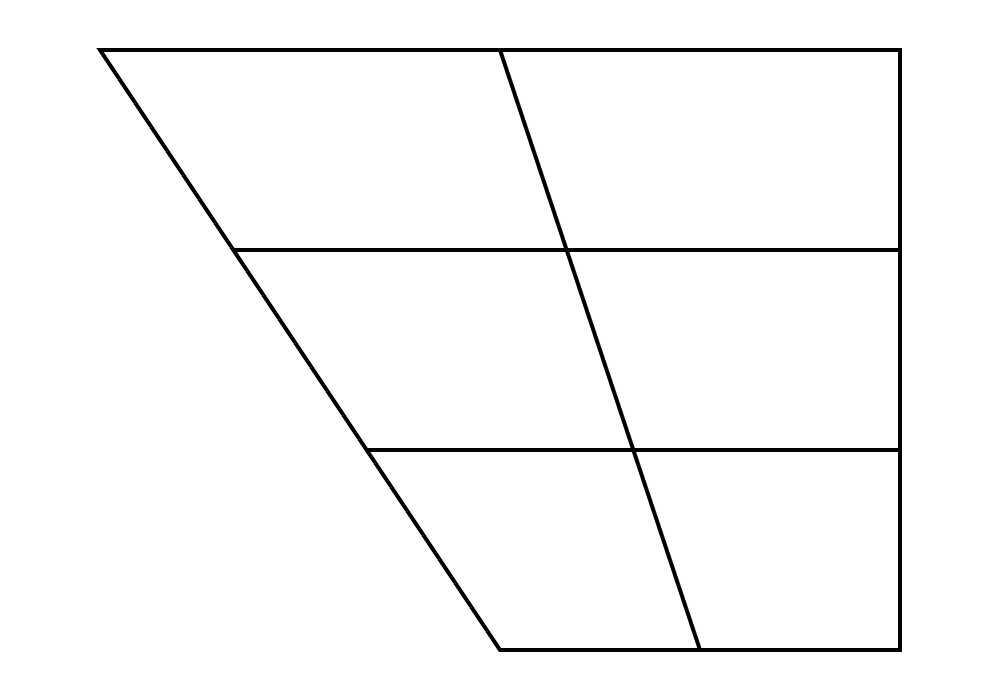
| |||||
| Near-close | ||||||
| Close-mid | ||||||
| Mid | ||||||
| Open-mid | ||||||
| Near-open | ||||||
| Open | ||||||
- Acute diacritics appear on e and i to signify a change in vowel quality, namely from [ɛ] and [ø] to [e] and [i]. Syllables with an acute are always stressed: norís [nɔˈɾis], élainig [ˈe.laɪn.øç].
- Circumflex accents – ê and ô - denote a change in vowel quality without a change in stress. Êdithír (parent) is pronounced [e.døθ.ˈiʐ]; ôthím is [oθ.ˈim].
- Unaccented vowels are only stressed if they are in the penultimate syllable of a word with neither an acute nor a grave-accented vowel: thus, alsë would be stressed on the penult [ˈalʂə], but soisé would be stressed on the accented final syllable: [sɔˈʂe].
- Vowels with a grave accent have the same quality as unaccented vowels (e.g. è, ò and ù are pronounced [ɛ], [ɔ] and [u] like e, o and u are), but are stressed: sefodèsg (Swedish) is pronounced [sɛfɔˈdɛsç].
- In other Celinese languages, one can see other diacritics being used. They are nearly always used in a similar way to standard Celinese - e/è comparing with ê and é. Common even in Standard Celinese is the transcription of irregularly stressed [u] as <ú> rather than <ù>. This is an accepted variant for the subjunctive mood, but the Representative Council of the Celinese language dissuades it from being used elsewhere.
Stress
On most words, primary stress falls on the penultimate syllable, unless a subsequent syllable is marked with an acute or grave accent. Thus tynðeg is pronounced [ˈtɪnðɛç], but welèc and mairís are both stressed on the last syllable: [wɛˈlɛk] [maɪˈɾis].
When a word is made by attaching a suffix or suffixes to a root, the penult of the root is stressed. Take the word ecosoireg, meaning scholastic, which derives from ecosí ("to study") + -oir (suffix denoted "place of") + -eg (one of the regular adjectival endings.) Learners of the language may initially pronounce the word with the stress on the penult, but it would instead be pronounced [ɛˈkɔsɔɪɾɛç], with the stress falling on the penult of the root.
When it comes to compound words that combine two roots, some speakers stress the penult of the first root, some the penult of the last. Consequently, drethcybethír (taxpayer), which comes from dreth (tax) + cybethí (to pay) + -ír (suffix to denote "person who does action") can be heard to be pronounced as [ˈdɾɛθkɪˌbɛθiʐ] or [ˌdɾɛθkɪˈbɛθiʐ], with the former being more common.
In words of three or more syllables, secondary stress is applied to the syllables two syllables before and/or two syllables after the stressed syllable; thus celnoê (discussion) is pronounced [ˈkɛlnɔˌjɛ] and momeirlairel (candlelight) is pronounced [ˈmɔmɛɪʐˌlaɪɾɛl] (or [ˌmɔmɛɪʐˈlaɪɾɛl].
Epenthesis
In most Celinese languages, epenthesis has arisen to separate two consecutive vowel sounds at the end of one word and at the very beginning of the subsequent word. Take the words mo (my) and athlë (town). When mo directly precedes athlë, either an r- (in Ioðinbêr and much of the South) or a th- (in Perís and most of the North.) The epenthetic r can be pronounced [ɾ] ([mɔ ˈɾaθlə]) or [ʐ] ([mɔ ˈʐaθlə]).
Morphology
Celinese is a moderately inflected language. Nouns have not been declined for case since the "Middle Elithoan Celinese" era, but they still decline for number, and for grammatical gender in the plural. Pronouns still retain vestiges of the case system. Adjectives (which double as adverbs) are uninflected, whilst verbs inflect for person, mood and tense.
Nouns
The biggest challenge for the learner, with respect to nouns, is pluralising them. There are three standard plural endings, -ím (for 'masculine' nouns), -ot (for 'feminine' nouns), and -ain (for 'neuter' nouns). The gender system is entirely formal and not semantic in the least; without exceptions, the gender of a noun is determined by the last sound in that noun. As a result, taðír and maiðír, dad and mom, are not masculine and feminine respectively, but neuter, because the vast majority of words ending in -r are neuter. Similarly, garys (boy) and gathal (girl) are feminine and masculine respectively, because -s is a feminine word ending and -l is generally a masculine word ending.
Regular pluralisation pattern
Singular Plural Masculine lech (word) lechím (words) Feminine laið (song) laiðot (songs) Neuter syrthoir (home) syrthoirain (homes)
Other pluralisation patterns
- Words ending in the unstressed ë - which are invariably feminine - delete the ë and add -ot in the plural. Thus, athlë [ˈaθ.lə] becomes athlot [ˈaθ.lɔt]
- The same goes for words ending in e or a - the borrowed atèlie (workshop) becomes atèliot in the plural.
- Very frequent are words ending in ê, particularly oê. In these words - which are also invariably feminine - the ê changes to a semi-vocalic i in the plural: celnoê (discussions) [ˈkɛlnɔˌ(j)e] becomes celnoiot (discussions) [ˈkɛlnɔˌ(j)ɔt].
- Words ending in <o> or <u>, whether masculine or neuter, take the ending <-m> rather than -ím or -ain. Wylo (wave) becomes wylom rather than *wyloain.
Irregular plurals
Middle and Late Middle Celinese varieties had hundreds of irregular plurals, and some dialects (particularly those of the rural parts of West Elitho) retain nearly all the irregular plurals. However, when the Perís-Ioðinbêr influenced acrolect was standardised, most of the irregular plurals were replaced with ones following a more regular pattern. E.g. mildë (friend) was once pluralised as milðot - [d] to [ð] and [t] to [θ] being a common sound change before plurals. Now, in the standard language, it is the regular 'mildot', but the irregular still remains in many dialects.
Some irregular plurals remained (usually because they were irregular in both Perís and Ioðinbêr acrolects). They can generally be divided into three categories:
- Nouns whose plural is a different gender to what one would predict from its ending. Two good examples of this would be the word for apple and aspect, eflím [ɛfˈlim] and elym [ˈɛlɪm] respectively. Despite -m being a consistently masculine noun ending, the former takes a feminine plural, eflímot, and the latter takes a neuter plural, elymain.
- Nouns that are the same in the singular and plural forms - calím (climate), originally the pluralised form of cal, is now used for the singular and plural. The same can be said about dychlain (clothes), which lost its singular form dychël. Two other key words like this are bairím (fruit/s) and chenosain (evil/s).
- Nouns with an irregular plural inflection, such as calbys (hook) turning to ca(u)lsain in the plural, hidim (insect) to hiðmain, aðel (Elithoan currency) to aðail, selmoth (second) to selmaith and talom (space) to taloim.
Gendered endings
Though there are sometimes exceptions, the table below gives a general idea of which endings correspond to which genders.
Always Sometimes Masculine -ch, -f, -g, -c, -u -l, -m Feminine -th, -ð, -s, -ë, -e* -a -l, -n Neuter -r, -o -os -l, -n, -m
e* refers to <e> and <e> with any diacritic, i.e. <é>, <ê>.
Pronouns
There are four sets of independent pronouns in Celinese - ergative, absolutive, dative and possessive. The ergative pronoun is nearly always avoided, except when emphasising or comparing - e.g. "Tefy mildeg ðo sà sío ana" (you are friendlier than him) or "Foí sé ais!" (I did it.) Many prepositions combine with pronouns to make inflected prepositions.
The subject uses the ergative, unless it is the subjective of an intransitive verb:
- I lay him down - Lygoí sé (ais).
- I lay down - Lygín mé (literally "they" laid me down.
Ergative Absolutive Dative 1 Possessive 2 Possessive 1SG ais mé moir mo mínn 2SG ana/tú ané/té toir to/ano tínn 3SG sà sé soir so sínn 1PL aisot fair fyrir fyr fínn 2PL anot anaith anair anor anínn 3PL saiot seith syrir syr syrínn 4 ainh én ainor ànair ainhínn
The difference between 1 Possessive, shorthand for pre-modifying possessive, and 2 possessive, shorthand for non-pre-modifying possessive, can be compared to the difference between my and mine or their and theirs:
- Sío mo nothín - It is my idea.
- Nêsío mínn - It's not mine.
- Mínn sío aitwys - Mine is that one.
There is also a set of clipped absolutive pronouns that attach onto the end of a verb. In the two instances in the first person singular where a clipped pronoun can be mistaken for a verbal ending, a hyphen is placed between the verb and the pronoun:
ending example translation 1SG -(o)m, --m daisí-m, daisíom, daisínom I saw myself; s/he saw me; they saw me 2SG -(o)th mairíth, mairímoth I love you; we love you 3SG -(o)s, --s cofí-s, cofíos, cofíotos I hate him/her; s/he hates him/her; ye hate him/her 1PL -(o)f tamíof, tamínof s/he bit us, they bit us 2PL -aith cênoríaith I know ye 3PL -eith nerothímeith We avoid them
Verbs
The verbal system of Celinese is mixed - some cases (the present and past) and moods (the subjunctive) are inflectional; others (such as the future, conditional and habitual past) are formed using periphrastic constructions. Both inflected tenses and the auxiliary verb in periphrastic tenses are conjugated for person.
Non-periphrastic tenses and moods
The following table is an example of norí, a regular verb, being inflected for person, number and tense:
Present Simple Past Subjunctive mood 1SG norí noroí norù 2SG norís noroís norús 3SG norío noroío norúo 1PL norím noroím norúm 2PL noríot noroíot norúot 3PL norín noroín norún
The current pattern of inflection above applies to nearly every verb, and is a considerable simplification from middle Celinese variants. One first adds -í for the present, -oí for the past and ú for the subjunctive mood to the root, and then add one of five endings (or -ø for the first person singular) to inflect for person and number.
The subjunctive is used as an imperative, as a result of the fact that Old Elithoan Celinese had no way of making demands, only requests (one of the things covered by the subjunctive) such as Old Perisian's chlení þa barùs (I ask that you stop - Modern flyní ðo parús) and Old Iferðisc's no t-Der ðo (in God that).
Participle
A participle can be made by adding -and to the root verb. Thus tarochí becomes tarochand. Multi-clause sentences often begin with a gerund:
This structure is similar to one commonly seen in English:
- Pathoiot ethoío - s/he knew the consequences.
- soir rôfoío - s/he called him/her
- Dysand pathoiot ethand, soir rôfoío - despite knowing the consequences, s/he called him/her.
The choice of phrase in this example is relatively uncommon in English:
- Ðrairig foín - they were violent.
- Hyrgyroðot tachoín - they were given red cards.
- Na ðrairig sand, hyrgyroðot tachoín - due to being violent (lit. in being violent), they received red cards.
Periphrastic constructions
Tense Construction Example Translation Future Present tense of fyðí + INF Lo r-Aisatho anðí fyðím We will go to America Conditional Present tense of weðí + INF Sé ethí weðís You would know it Future perfect Past tense of fyðí + INF Naint athlí fyðoín They will have lived there Past conditional Past tense of weðí + INF Weðoíot aithrí You (pl) would have come Present continuous Present tense of sí + ag + INF Sío ag ceoní S/he is speaking Past continuous Past tense of sí + ag + INF Foio ag ceoní S/he was speaking Present habitual Present tense of tynðí + INF Sêlmím tarochí tynðí I usually/tend to play sixes Past habitual Past tense of tynðí + INF Sêlmím tarochí tynðoí I used to play sixes
Note that the infinitive and the auxiliary verb can precede and follow one another, depending on the stylistic choice of the writer; thus the last sentence could also be phrased as tynðoí sêlmím tarochí. Many of the periphrastic constructions are avoided unless the writer wishes to disambiguate - so, for example, often information that one would expect to be conveyed using such past continuous and past habitual will instead be written using the simple past. However, the future and conditional periphrastic constructions are very commonly used.
Abbreviated forms of the future and conditional, fyð and weð, can be used instead of the full verb, in which case the other verb in the periphrastic phrase conjugates. Thus we will go can be expressed as anðí fyðím or fyð anðím/anðím fyð. "Will be" and "would be" each have a special compound verb, fysí (will be) and wesí (would be).
Adjectives and Adverbs
Adjectives are nearly always placed after the noun that they modify, except for in poetry or affected speech. There are a few adjectives, however, that are always placed before the noun, such as mereð, and some which were originally before-only which now can be placed before or after, such as ifanc and gimel (young/new and old). Adjectives are not inflected for the gender or number of the noun that they relate to. They are usually formed by taking the root of a verb and adding -eg or -ig: teroðí (to calm, allay) becomes teroðeg (calm).
There are very few words that are purely adverbs - things like naloith (also) and ionic (enough). In most cases, the adjective is used, unmodified, as an adverb:
- Lyra - beautiful
- Lyra noleiðís - You played (i.e. an instrument) beautifully.
Comparatives and superlatives are not inflectional, but are instead translated by putting a comparative adjective before or after the noun or verb being related to:
- Athlë lyra na r-Elitho - a beautiful town in Elitho
- Athlë tefy lyra - A more beautiful town
- Athlë tont lyra - The most beautiful town
- Athlë thut lyra - A less beautiful town
- Athlë teðo lyra - The least beautiful town
Prepositions
Prepositions can sometimes be an area of difficulty for learners, because a great number of them can be inflected. Whilst in English, one would say "with her", in Celinese, the word for with is inflected in circumstances where it is followed by a pronoun in English. Contrast:
- I was with her - cêis foí (cêis from cé (with) + sé (3rd person singular absolutive).
- I was with Syríe - cé Syríe foí.
Some examples of inflected prepositions. Note that the language standardisation process did not manage to resolve the great amount of irregularity in how each preposition is inflected.
preposition mé (me) ané/té (you) sé (him/her/it) ainh (one) fyr (us) anaith (you plural) seith (them) cé (with) cêim cêith cêis cainh cêifyr cêinot cêisot doth (for [recipient]) dothym dothyth dothys dothainh dothyr dothot dossot fent (without) fentom fentoth fentos fenainh fenyr fennot fensot go (from/of) gôm gôth gôs gainh gôr goiot goseith na (in) nêm nêth nê nainh nêr nêiot nein
Mutations
Consonant mutation plays a big part in Celinese, and is very commonly triggered. There are two instances of Celinese mutation - initial consonant mutation, triggered by preceding words, and internal consonant mutation, triggered by attaching phonemes such as né (not, an-) to existing words. Mutation affects nouns, adjectives, pronouns and can even occasionally effect verbs. Whilst languages such as Middle Perisian had a five-way mutation system, the compromise acrolect features just one mutation, a soft mutation whereby unvoiced consonants become voiced, with the exception of <f>, which once was voiced to [v] but is now mutated to [w].
Mutation table
Consonant Mutated consonant Ecliptic form [t] [d] t-d [p] [b] b-p [k] [g] g-c [θ] [ð] ð-th [f] [w] w-f
Initial consonant mutation
Initial mutation is denoted by attaching the mutated consonant to the original consonant: caroig (heart) becomes mo g-caroig (my heart). The original consonant in the ecliptic form is not pronounced, so the example is pronounced [mɔ 'gaɾɔɪç] and not *[mɔg ˈkaɾɔɪç]!
The things that always trigger initial consonant mutation are:
- The vast majority of prepositional adpositions:
- Na b-Pynðoro - In Brazil
- Lo g-Cinfro anðoí - I went to Wales
- Cé w-fyr mildot - With our friends
- „Och g-Compton“ - Out of Compton
- All possessive pronouns:
- Ano d-taðír sío - Your father is (here)
- So b-pitulchast moir corío - His/her stupidity annoys me
- Sío dairast fyr d-tír - Our country is wonderous
Things that optionally trigger initial mutation (and nearly always do in the written language) include:
- Adjectives preceding nouns:
- Cé gimel g-cailúsot - With the old custom
- Na b-poreg ð-thúl - In the small house
- When a number greater than two precedes a noun or adjective. In the most literary speech, two triggers this mutation too:
- Sêlm w-fabolím - Six fables
- Ðwy ð-thonsamím - Two banquets
Internal consonant mutation
Internal consonant mutation is often caused when creating compound words or adding morphemes to the beginning of words. As a rule of thumb, it is words and modifiers that end in vowels that bring about these changes, such as cê- (with, co-), na (to), and né (not, an-). When internal mutation occurs, there is no ecliptic form - instead, the consonant is written like its mutated sound.
Original word Meaning Modified word Meaning Tinyor Sound Cêdinyor Connotation Ceðorí Sort Cêgeðorí Coordinate Theilast Lucky Néðeilast Unlucky Trechíreg Dependant Nêdrechíreg Independent Pomí Breathe Nabomí Inhale Tolí Add Nadolí Insert Thut + peth Few + thing(s) Thubeth Few things Taig + plairí Self-/auto- + please Taiblairig Self-content
Derivational morphology
The Celinese language relies heavily on affixes to build vocabulary. Since the convergence of Ioðinbêr and Perís forms, the word formation system has become very regular - if certainly not perfectly regular. More times than not, the root of a verb can be used to create an adjective and several noun forms. Compound nouns (and verbs), built from two roots or more, are also frequent.
Prefixes
- Né-/an- : These are two of the most useful prefixes for building your vocabulary. They both are used to negate adjectives and even some verbs and nouns. Some examples with né: theilast (lucky) turns to néðeilast (unlucky, unfortunate); pontheg (certain) changes to nébontheg (uncertain, unsure); édithig (caring) to nédithig (uncaring, callous). There are a few examples where expected internal mutation does not take place, e.g. cluthand (hearing) > nécluthand (deaf), rather than négluthand. But these are in the minority. When the stress falls on another syllable, né turns to nê - e.g. nêthí [neˈθiː] (to not know, to be ignorant of).
- Examples with an, which typically does not provoke mutation - bereðand (respectful, humble) becomes anbereðand (rude, uncouth); alsiast (moneyed, rich) to analsiast (poor, impoverished), and an example with mutation, celínír (speaker) becomes angelínír (mute, silent person). There are no set rules that determine which of the two negational prefixes to use; an- is more common in Perís, né- in Chlasc and Ioðinbêr, but some dialects use one form to the complete exclusion of the other. "Nêgelínír" and "anbontheg", whilst not the traditional dictionary forms, are perfectly understood and admittable words.
- Chen(o)-: From the adjective chenog (bad), the prefix chen can be used in a similar manner as mis- is used in English, used to refer to anything done incorrectly or badly, but is rather more common. Chen does not cause internal mutation. Some examples: chengrefír (pulp fiction author), chenleiðír (poetaster - bad poet), chenlaiðoê (misgovernance, bad leadership), chen(o)ceðorí (mismanage).
- ðwy-: from the word for two and sometimes written as dwy, ðwy- is used to translate English words prefixed with bi- or di- (meaning double or half); examples being ðwydraigyn (bicycle = two wheel), ðwygelínast (bilingual = two language having), and ðwyceilí (disect = two cut). It is also used for concepts that are not expressed with a prefix in English; an example being ðwyburí, fold, literally meaning two bend. Try-, hyð- etc can be used for three, four and so on.
- lo- : Lo- (from the word for to) is often used to express causation, though how lo- forms differ from the original infinitive can be complex. Gloðí (I compromise, as in I compromise to benefit the other person) becomes logloðí (I make the other person compromised; compromising them for my benefit.) Loloiðí, from loiðig (loud), makes "to make loud"; lorí (get on the floor) contrasts with lolorí (to make someone get on the floor.)
- cé: Cé- (from the word for with, written cê when the stress is marked on another syllable) is one of the most commonly used Celinese prefixes and usually denotes mutuality. Taking an example from lo, whilst gloðí means that one party compromises for the other's benefit, cêgloðí means that both parties compromise. Cégynolchír is a person from the same generation as you (with + descendant = those you descended with); cêcaithír is someone with whom you work (a colleague), cêloithí is to place something together (to link), and cêsyrí is to enjoy (literally with + like).
- na: (from the word for in, sometimes written as no), usually creates compound words containing in: naðon (na + thon, in-food, i.e. things in food), songwriter is naleiðír (in-song person, i.e. someone who puts things in song), naloiðeg means unavoidable (literally translating to "in the stars adjective") and nadolí is to insert (from na + tolí, add). Na always provokes internal mutation.
- doir: This prefix comes from the preposition for "from one side to another" and often has parallels with trans- or cross- in English. Examples of its use include doirgrefí (translate = cross-write); doirarileg (trans-Atlantic), doirbyrí (to cross), and transport (doirwyðar, across door.)
Suffixes
Suffixes are built (unless an exception is noted) by taking a verb, removing its verbal ending (i.e. moirí would be reduced to moir, laiðí to laið), then adding the appropriate suffix.
- -ír: -ír is used to denote someone or something that carries out the specific verb. Thus, moirí (fight) becomes moirír (fighter, soldier) and laiðí (to sing) becomes laiðír (one who sings.) This ending can be attached to any verb in Celinese; so teisí (to prosper or to fare well) becomes teisír (one who prospers.)
- -oê: 'oê' is perhaps the common suffix in Celinese. Its use is best illustrated with examples. To bite is tamí. If you want to describe a single action of having bitten someone, one would use tamos, but a bite on your skin or off an animal - semantically speaking 'the after-effect of being bitten' - is tamoê. Likewise, a burn is brechoê (the after effect of brechí, to burn) and union or solidarity is lainoê (the after effect of lainí, to unite.) Most, but not all words ending in -oê correspond precisely to this explanation, because some words that to-day ending in -oê once ended in -aê, a suffix with somewhat of a different meaning.
- -air: in many ways, air is a counterpart to oê. Whilst the latter describes the time or state after an action took place, the former describes a time or state during which an action is taken - norair is night (time of continued darkness), mereð-séilair is happiness (time of continued "good sun" - i.e. positive feeling) and winter is feifrair (time of continued frost).
- -ast: This ending is somewhat similar to -ful, but unlike in English, it is usually attached for verbs, rather than nous. It suggests a full possession of the quality expressed in the verb. Thus, if to pay attention is gachtí, someone or something that is attentive or careful (i.e. characterised by fully paying attention) could be described as gachtast. To care is êdithí - someone who is caring or considerate (characterised by fully caring) is êdithast.
- -eg/ig: The standard way to create adjectives, it can be attached to nouns or adjectives. E.g. peroðí is to lose, peroðeg is lost; brochí is to need - brocheg is needy.
- -am: Am is used to make intensive adjectives, which often carry a sense of an action or state being 'excessive.' These can be formed by chopping off the -eg/-ig ending and replacing it with am, or sticking am onto the ending of an adjective if it ends in another manner. Thus thyreg is the Celinese adjective for sweet; thryam is sickly sweet, saccharine. Foireg is cold, foiram is freezing or bitter. Am appears as an infix to make 'excessive verbs' too, and to make something even more excessive, one adds -an as well as -am: twymaman suggests (exaggeratedly) that it is physically impossible to get any hotter than it is now.
- Whilst -am is often used negatively, it also has a positive connotation: whilst the English "big man" is often used disparagingly and sarcastically in English, its counterpart ðywysam is very positive, suggesting a generous, amiable person. Mildam ("big friend") is used to refer to close friends.
- -och: Och is used for the opposite of -am, as a diminutive that indicates that something is small - e.g. thúl (house) > thúloch (small cottage); dosnë (dog) vs dosnoch (lap dog); twym (hot) vs twymoch (tepid). It can often be used negatively - see the difference between poreg athlë (small town) and athloch (little burg). To indicate that something is small but good, one can add -ic on the end (athlochic: quaint little village). To indicate that something is bad, but not small, one adds -am (athlocham, hellhole).
Syntax
Whilst such things as word order are relatively free in Celinese - and very free when using poetic license - Celinese speakers have commonly shared preferences; when one breaks from these preferences, it often shades their speech with a different nuance than that which might be intended.
- Basic clauses are almost always OVS: nê crestío Enys - Enys believes in it. When the subject is dropped, or an object not used, the same order is preserved: sé syrí - (I) like it; desochío to mildë - your friend is waiting.
- Many speakers - but far from all; this is not as hard and fast a rule as the above - shift to SOV in the first clause of a multi-clause sentence. On its own, 'Everyone wants freedom' would be translated as sairsoê norío caith. 'Everyone wants freedom and we want it now' would usually change into caith sairsoê norío, ar anois sé norím. Notice how the second clause follows the expected OVS order.
- Questions without interrogative words are nearly always phrased as OVS - "is your husband/wife coming to the cinema?" would be translated as 'lo g-cynô aithrío to lobroiðír?' Most questions with interrogative words are OVS too - though phrases with an interrogative, a verb and an inflected object pronoun are very often phrased IVO(S) - 'what do you want with me?' becomes cioth norís cêim? To put the object in front of the verb in such phrases, one emphasises the object - cioth cêim norís? would be interpreted by a native speaker as 'what do you want with me (as opposed to someone else?)
- Simple positive commands and requests, using the subjunctive, are usually phrased VO(S): 'tell me' becomes lyhús moir - though note the OSV order in norí ðo moir hynðo sé lyhúo to d-taðír, I want your dad to tell me about it. Negative commands and prohibitions are usually OSV - né moir lyhús! (don't tell me).
- Most of the time, in Celinese, the clause that is most important in the mind of the speaker will go second. It is perhaps unhelpful to talk about subordinate clauses in the context of Celinese, because of this flexibility. Few clauses are inherently subordinate:
unemphasised clause emphasised clause meaning 1. Lauth, ðo seyinaireg ceonoío na r-athlë tryfoí In town I met a person who spoke Jinyera 2. Na r-athlë tryfoí lauth, ðo seyinaireg ceonoío In town I met a person who spoke Jinyera 3. Célois cergos lorechig ðysat ilðoío, na Wyen athloí. When WW2 broke out, I was living in Vienna. 4. Na Wyen athloí, célois cergos lorechig ðysat ilðoío. When WW2 broke out, I was living in Vienna.
- It is more helpful to talk about the emphasised clause. When translating from another language into Celinese, clauses can appear in any order, but the second clause is the one which is emphasised. In phrase 1, where the Jinyer person speaking is the most important piece of information that the speaker wants to communicate; in phrase 2, one emphasises who one met over where. Phrase 3 emphasises the individual story, phrase 4 the global.
- All of the above phrases deal with two concurrent actions - meeting someone who spoke Jinyera at the same time as being in town; living in Vienna at the same time that WW2 broke out. If the clauses are not concurrent, then the clauses are ordered chronologically:
First action Second action Meaning 1. Célois chyntoín, caiðeg foí. When they left, I was happy (happy that they'd left) 2. Caiðeg foí, célois chyntín. I was happy when they left (at the time they left, I was happy)
- In the first sentence, the speaker is glad to see the back of the people who left - his/her happiness results from their leavetaking. In the second sentence, all the speaker is saying is that s/he was happy at the time they left - s/he was already happy at the time of their leaving, but may have then been saddened to see them go. This nuance can have a significant impact on how a sentence is understood - the first sentence is a clear insult to those who left; the second is perfectly neutral.
- When using the participle to link sentences, there is a similar nuance. The first clause is always considered to be chronologically prior to the second clause. The first clause is considered the cause, the second the effect:
First action Second action Meaning 1. Na r-ochaithrand na safais, caroig lauthig otrefoí. By prevailing in the elections, I gained the people's affection. 2. Na r-otrefand caroig lauthig, na safais ochaithroí By gaining the people's affection, I prevailed in the election.
In the first sentence, the people did not have an affection for the speaker until after winning the elections, the cause which brought about the effect of their affection. In the second sentence, the speaker gained the people's affection before winning the election; gaining their admiration was the cause, winning the election the consequence. Compare this to the implications of using the participle with the second clause - na safais ochaithroí, otrefand caroig lauthi and caroig lauthig otrefoí, ochaithrand na safais" both suggest a concurrence, winning the elections and gaining the public heart happening at the same time.