Nankôre: Difference between revisions
Eliminated section |
|||
| Line 1,342: | Line 1,342: | ||
# Rompóy kurasno rayro ita-tā'itá'. "The girls played with the dogs." | # Rompóy kurasno rayro ita-tā'itá'. "The girls played with the dogs." | ||
# Rompóy kurasno tarayro ita-tā'itá'. "The dogs played with the girls." | # Rompóy kurasno tarayro ita-tā'itá'. "The dogs played with the girls." | ||
===== Finals ===== | ===== Finals ===== | ||
Revision as of 04:24, 26 January 2018
 | This article is a construction site. This project is currently undergoing significant construction and/or revamp. By all means, take a look around, thank you. |
| Nankôre | |
|---|---|
| Nankôre | |
| Pronunciation | [/nan.'ko:re/] |
| Created by | – |
| Native to | Nanhoshka Kôya |
| Native speakers | 3,232,430 (2014) |
Nahenic
| |
| Official status | |
Official language in | Koya Island |
| Language codes | |
| ISO 639-1 | nk |
| ISO 639-2 | nnk |
Background
Nankôre, from the words nan ("man, human") and kôre ("speech"), is spoken by the Nanhoshka people of Kôya Island. There are two main dialects, the Konishmak, located in the Northeastern Coastal Mountains, and the Sapshira, encompassing the western and southern parts of the country. The dialects differ chiefly in pronunciation and differences in certain lexical items, but are otherwise mutually intelligible.
For a little over a century the origins of the language and its people remain clouded in mystery. Physically, the Nanhoshka people look distinct from the Northwest Pacific Native Americans just 862 kilometers from the eastern shore, but their physical features bear a strikingly close resemblance to the Minhast people of the Republic of Minhay, who live much further away on the other side of the Pacific Ocean close to Japan and Ainushir. Because of these physical resemblances, both anthropologists and linguists started exploring a possible relationship between the two peoples. Recent genetic research uncovered that both the Nanhoshka and Minhast belong to the haplogroup C-M212, indicating a common ancestry. Linguists had a more difficult task in establishing a relationship. Finally Benson et. al. compiled an extensive Swadesh list and internally consistent sound correspondences between the two languages. Most importantly, a set of affixes that were quite conservative were revealed, notably the Causative affix, and a set of fossilized affixes which are prefixed to body parts to derive verbs. In addition, a third language, Nahónda, also previously classified as a language isolate, was discovered to contain common vocabulary and affixes which it shared with both Nankôre and Minhast. Therefore, both Nankôre and Minhast, along with Nahónda, are now recognized as belonging to the same language family, which has been named the Nahenic language family.
Phonology
Orthography
The Nankôre orthography is based on the Allen-Mills system, derived from the Latin alphabet. However, a second system, the American Media system, has started displacing the Allen-Mills system. Although based on the Allen-Mills system, the American Media system uses the grapheme <y>, and the digraphs <ch> and <sh>, to make transcription of the language more accessible to American readers.
| Allen-Mills | American Media | IPA |
|---|---|---|
| ' | (n/a) | ʔ |
| a,ā, â, á | a,ā,â, á | a, a: |
| e | e | e |
| i | i | ɪ, i |
| o, ô | o, ô | o, o: |
| u | u | u |
| c | ch | tʃ |
| s | sh | s, s̺, ʃ |
| š | sh | ʃ |
| h | h | ɦ |
| k | k | k |
| r | r | r |
| m | m | m |
| n | n | n |
| p | p | p |
| t | t | t |
| y | y | j |
Note that the grapeme <s> in the Allen-Mills system is pronounced /ʃ/ or /s̺/ when followed by [i] (e.g. sinkokah /ʃin'kokah/ "orca"), or in coda position (Nanhoska /nan'hoʃka/ "the True People"). A few decades after the Allen-Mills transcription system was developed, a sound shift in the northwestern Hoyampe dialect, whereby /s/ shifted to the voiceless apico-alveolar fricative /s̺/ when followed by /i/ or in coda position. A similar sound shift occurred at around the same time in the northeastern Konishmak dialect (possibly the result of the Hoyampe sound shift), but it was the voiceless palato-alveolar fricative /ʃ/ that appeared. It was this sound shift that spread out through most of the country, although there are some remote regions of the country that have not been affected by either sound shift. As a result in foreign transcriptions <sh> is often used in words where the /s/ >> /ʃ/ has already occurred, e.g. akôsh vs. the original akôs transcription
The grapheme <ô> is used to indicate vowel length for /o/, and <ā> for /ɑ/.
Because the American Media orthography system is the most widely used system, it will be used throughout the rest of this article, unless otherwise noted.
Consonants
Nankôre has a small inventory of consonants, only thirteen in number. Noteworthy is the paucity of voiced consonants which contributes to the limited number of consonants in the Nankôre language. The following table contains the entire consonantal inventory:
| Bilabial | Dental | Alveolar | Apical | Post-alveolar | Palatal | Velar | Glottal | |
|---|---|---|---|---|---|---|---|---|
| Nasal | m | n | ||||||
| Stop | p | t | k | ʔ | ||||
| Affricate | ͡tʃ | |||||||
| Fricative | s | s̻ | ʃ | ɦ | ||||
| Approximant | j | |||||||
| Flap | r |
Vowels
| Front | Near- front | Central | Near- back | Back | ||
| Close | 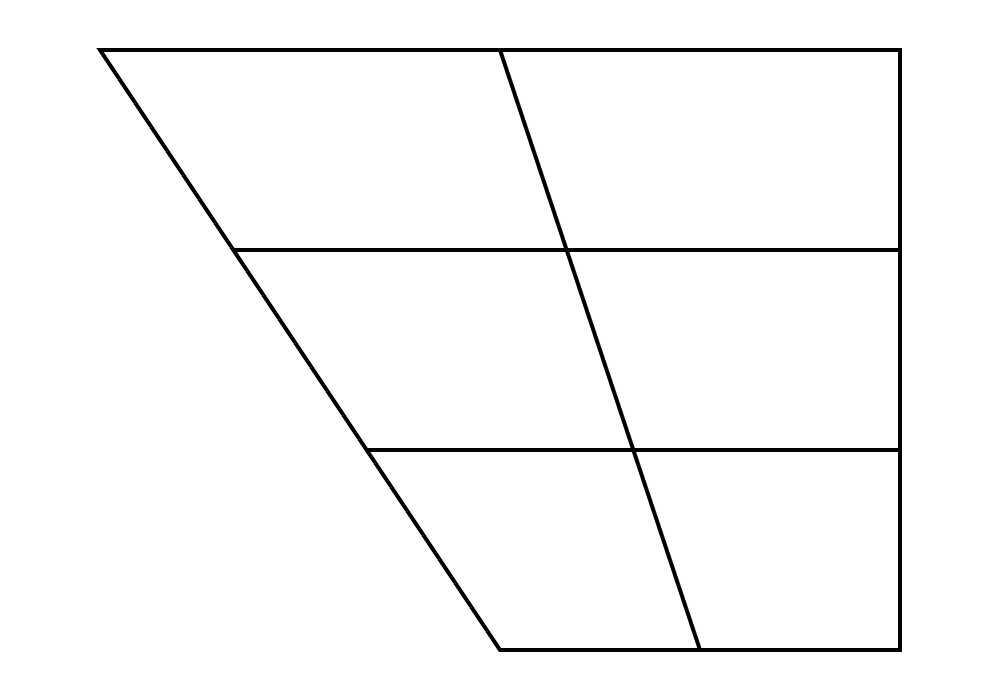
| |||||
| Near-close | ||||||
| Close-mid | ||||||
| Mid | ||||||
| Open-mid | ||||||
| Near-open | ||||||
| Open | ||||||
Prosody
Stress
Intonation
Phonotactics
Morphophonology
Morphology
Nouns
The Nominal Hierarchy
Nankôre nouns, at first glance, appears very simple. They are not inflected for case, gender, nor do adpositions indicate their directional or positional relationships. Number is distinguished only in pronouns. Nevertheless, the nominal system has a complex hierarchy of animacy, which although unmarked, is a semantic feature of the noun and pronoun. This hierarchy of animacy is used to determine the syntactic roles of the core arguments of a clause, namely that of Agent and Patient. Arguments that are higher in the Animacy Hierarchy are by default considered Agents, whereas lower animacy arguments are considered Patients. If the syntactic roles of two core arguments are reversed, namely a lower animacy argument acts as an Agent on a higher animacy Patient argument, a special construction known as the Inverse Voice, involving the prefix tā(h)-, is added to both the first verb in the verb phrase and the auxiliary verb itá'. Thus, the Inverse Voice is doubly-marked.
Where a given NP falls within the animacy hierarchy must be memorized in order to use the verbal inverse prefix tā(h)- correctly (see section on Verbs for additional details regarding inverse marking).
The Nankôre nominal hierarchy has been traditionally classified along two axes, the first marking the noun class, and the second marking levels of hierarchy within a given class. Animacy along classes decrease as one traverses from Supernatural/Phenomonological onwards towards the Ephemeral. Animacy decreases as one goes down the Level axis. The hierarchy is arranged according to the following table:
| Noun Class | ||||||||||
|---|---|---|---|---|---|---|---|---|---|---|
| Level | Supernatural & Phenomonological |
Human | Animals | Weather | Lower Animals | Plants | Geophysical | Material | Ephemeral | |
| Mammals | Birds | |||||||||
| 1 | Gods, the Earth, the Sun, the Sky/Heavens | Adults >> Children | predator >> prey | Clouds | Reptiles (excluding snakes) | Forests | Rushing rivers | Water | Magic | |
| 2 | Demons | Older >> Younger | wild >> domesticated | Rain | Snakes | Large Trees | Slow-moving rivers | Food | Actions | |
| 3 | Human & Animal Spirits | Male >> Female | Pet (usually carnivorous) >> Non-Pet (usually raised for food) | Snow | Amphibians | Small Trees | Streams, brooks, springs | Fabrics, fibers, skins, clothing | Emotions | |
| 4 | Destructive Forces of Nature | Large >> Small | Wind | Fish | Fruit/Nut Trees | Lakes | Wood | Thoughts | ||
| 5 | Lightning | Strong >> Weak | Breeze | Crustaceans | Bushes/Shrubs | Glaciers | Buildings | Disease | ||
| 6 | Ocean | Quick >> Slow | Water | Insects | Prairie grass | Mountains | Metals | States | ||
| 7 | Thunderstorms | Intelligent >> Unintelligent | Carnivore >> Herbivore >> Carrion Eater | Air | Worms | Leafy plants | Cliffs, jagged outcroppings, tumuli, boulders | Jewels and gemstones | Abstractions | |
| 8 | Fire | Fertile >> Infertile | Stud >> Gelded | Flight >> Flightless | Muggy weather | Mollusks | Mushrooms/Fungi/Mosses/Gelatinous sea invertebrates | Flat land or gently rolling landscape | Stones, rocks, pebbles | Death |
If two nouns with equal animacy but different number appear as core arguments, the plural noun is assigned a higher animacy status than the singular noun. However, if animacy and number are equal, the most recently introduced noun, providing it was introduced as a core argument, is assigned the higher animacy status.
In situations were two nouns have equal animacy and equal number, the rules for assigning the position each core argument in the hierarchy is as follows:
- If one of the nouns is newly introduced information, it is considered less animate because the older noun has been presumably been the center of discourse and at least during part of the previous discourse it was agent. SOV order is usually used, particularly if pragmatics and other contextual cues cannot disambiguate the syntactic roles
- HOWEVER, if the new noun is topicalized with the clitic ="=hat", it is considered the agent.
- Another pattern, where a new noun is introduced as a Patient argument, it is regarded as the less animate argument once the older noun is reintroduced back into the discourse in a transitive construction.
- If the animacy level of each argument cannot be resolved, then the unmarked SOV word order is used when context can't disambiguate syntactic roles.
The Noun Template
root - derivation - adjective - demonstrative/decessives
Derivational Affixes
-no: Diminutive suffix, e.g. kuras (woman), kurasno (girl)
Adjectival Suffixes
Nankôre lacks a separate word class for adjectives. They may be expressed as attributive verbs, e.g. Aryak neshkak itá, "Aryak is smart", Kanko shoykar itá, "Kanko (an indigenous vegetable) is good" (for your health), or a suffix may be attached to the noun it modifies. These suffixes are called adjectival suffixes. Some of these suffixes are etymologically derived from an attributive verb, e.g. -kerek > karyak itá "to be red". Others appear to be derived from separate roots, c.f. "Aryak-arku", ("clever Aryak") vs "Aryak neshkak itá" ("Aryak is clever"). Theoretically an unlimited number of suffixes may be appended to the noun, but in practice the number of adjectival suffixes seldom exceeds three. The suffixes may appear in any order, so long as the meaning is comprehensible. Nevertheless it appears that scope determines the ordering of the suffixes: suffixes with wider scope tend to appear towards the end e.g. "Kenenkor-pita-shune-une itá" (bed plush-red-soft-very 3S.COP ) "It is a very soft, red and plush bed."
There are seven observed categories of adjectival affixes:
- Quality
- Quantity
- Strength
- Size
- Color
- Tactile
- Other Attributes
Demonstrative Clitics
| Type | Spatial | English Translation | Example |
|---|---|---|---|
| Proximal | =skoro | this one near me; now | nan=iskoro "this man here"; oriyat=hepi "today" |
| Medio-Proximal | =hori, =ori | that one by you; just awhile ago | nan=hori "that man next to you"; |
| Distal | =nko, =kekori | yonder, that one near him/her/them; yesterday, a few days ago | nan=inko "yonder man"" |
| Invisible | =nanak | that one beyond the horizon, or occluded by a distant object | nan=nanak "that man (e.g. on the other side of the mountain)" |
Number
Number is usually determined by context, but plurality can be indicated by either joining a cardinal number, a quantifier, or the plural marker no before the noun. The noun is always linked to these modifiers by the si- connective, as in no si-kurashno "the girls".
Quantifiers
| Quantifier | Substantive | Attributive |
|---|---|---|
| All | kamun | kamun si= |
| Most | toman | toman si= |
| Some | cene | cisi= |
| Many | etco | etcisi= |
| Both | hani | hanisi= |
| Each | nune | nisi= |
| Few | cato | catci= |
| Another/Other | hane | hanesi= |
Interrogatives
| Header text | Header text | Notes |
|---|---|---|
| Who | ra' | Possibly cognate with Minhast redad |
| What | pôh | c.f. Minhast bak |
| When | tu'a | |
| Where | nahí' | c.f. Minhast nakki. Also, note dialectal variant enket (Sapshira dialect) |
| Why | penóh | |
| Which | yôri- |
The Interrogatives manifest WH-movement, appearing immediately before the auxiliary itá' with rising intonation and a slight pause after the main VP.
- Okep nari ayrarke, penóh hô'itá'?
'okɛp 'na:ri aɪ'rarke pe'noɦ ɦo:ʔi'taʔ
Okep nari ayrarke, penóh hô-'itá'
PN child spank why HOD-DIR-HASxLAS.COP
Why did Okep spank (her) child earlier this morning?
- Ka tahone, ra taspitá'?
ka ta'ɦo:ne ra taʃpi'taʔ
Ka ta-honé, ra ta-sp-itá
2S INV-cry who INV-CAUS-HASxLAS.COP
Who is making you cry?
All Interrogatives can also serve as conjunctions, eg Hôri ak kosno tā'itá' penóh Okep nari ayrarke ho (I did not hear/receive the news why Okep spanked (her) nephew early this morning").
Interrogatives can also serves as Conditionals by a =si Topicalization structure:
- Ra'si karampo taneknek tā'itá, siakos tamakó itá'
'raʔʃi ka'rampo ta'nɛknek 'ta:ʔɪtaʔ 'ʃakoʃ tama'ko ɪ'taʔ
Ra'=si karampo ta=neknek tā='itá, si=akos tamakó itá'
Who=CONN bear INV=kill INV=COP.SG CONN=1P danger.liability COP.SG
Whoever slaughtered the bear (in this manner) is a danger to us all.
The Topic marker =si should not be confused with the Connective si= that is linking the embedded clause to the matrix clause. The former is an enclitic, whereas the latter is a proclitic.
Among the Interrogative pronouns, ra' ranks the highest in animacy, although it still is lower than personal pronouns.
Yôri- is always prefixed to the noun it modifies and can never appear as an independent word. It can be prefixed to pôh and ra' , i.e. yôripoh and yôra' , where it takes the meaning "which one", yôripoh for Noun Classes II and III, the sentient members of Class I, and yôra' for the rest.
Pronouns
The first group of pronouns are the simple independent pronouns. The animacy of each pronoun is arranged in the following hierarchy:
| Pronominal hierarchy |
|---|
| 1st >> 2nd >> 3rd |
Plurality generally does not affect the animacy level across persons. However, if two 3rd person arguments have the same animacy and one of the arguments is plural, then the plural argument is assigned a higher animacy level.
The following table lists the forms of the simple independent pronouns:
| Singular | Plural | |
|---|---|---|
| 1S | ak | akôs, akôsh |
| 2S | kā, ka | kakôs, kakôsh |
| 3S | tā, ta | takôs, takôsh |
If used as a core argument, they appear in intransitive clauses only, and just before the clause-final copula itá,e.g. Nitori kā itá! (You are a fool); sometimes the pronoun is cliticized to the main verb, e.g. Nitoriká' itá!, in which case a final long vowel is shortened and is appended with the glottal stop. They may also be used to emphasize a noun, in which case the pronoun precedes the noun linked with the connective si=, as in tā shi=naho (She/Her, the mother).
| Singular | Plural | ||||||
|---|---|---|---|---|---|---|---|
| 1S | 2S | 3S | 1P | 2P | 3P | ||
| 1S |
-- |
akak | akat |
-- |
akakos, akakosh | akatos, akatosh | |
| 2S | akak |
-- |
kat | akoska, akoshka |
-- |
katakos, katakosh | |
| 3S | akat | kat | tat | akosta, akoshta | kakosta, kakoshta | takosta, takoshta | |
| Plural x Plural | |||||||
| 1P |
-- |
akoskos, akoshkosh | akostos, akoshtosh | ||||
| 2P | akoskos, akoshkosh |
-- |
kakostos, kakoshtosh | ||||
| 3P | akostos, akoshtosh | kakostos, kakoshtosh | takostos, takoshtosh | ||||
As earlier stated, nouns in Nankôre are not inflected, nor are case clitics attached to them to indicate case relations. Transitive verbs take two NPs as core arguments. The case relations of the two arguments are determined by the position of the noun in the animacy hierarchy; the core argument that is higher in the animacy hierarchy is assigned the Agent role, and the other argument is assigned the Patient role. However, an inverse affix tā=/tāh=/ta=/t= is prefixed to the primary verb, as well as a redundant ta- affix that is added to the auxiliary to alter the argument structure and promote the lower-animacy argument to Agent role.
Unlike the Intransitive forms, the portmanteau Transitive forms come before the main verb, not the auxiliary verb, e.g. Akostos karok tā'itá' , "I ate it". Sometimes the portmanteau is cliticized to the main verb, as in Akostos=karok tā'itá' . If the Inverse marker appears simultaneously with the Transitive portmanteau pronoun, the preverbal Inverse marker tā=/tāh=/ta=/t= cliticizes to the portmanteau pronoun. Since the Inverse voice is double-marked, the Inverse form of the auxiliary itấ' also is used, as in the improbable sentence, Takostos karok tahortā'itá'/Takostoskarok tahortā'itá' , from Tā-akostos-karok tahortā'itá' , "He/she/it ate me".
Oblique arguments on the other hand are treated as adjuncts, and are thus bound to their clause with the connective clitic si=. Context alone determines the semantic role of the oblique. Because obliques are considered adjuncts, they may not come between the core arguments and the verb, and therefore must appear either before or after the clause nucleus. To illustrate, the sentence Maska si=ohipna koykare ekán itá (anthill=CONN twig boy twist COP.PST), i.e. "The boy inserted the twig into the anthill", the noun maska (anthill) is the oblique argument and is marked with the clitic si= to join it to the rest of the sentence, e.g. Ohipna koykare ekán itá si=maska.
Verbs
Verbs mark for [blah blah blah blah]
Copula Forms
| Present | Low Animate Patient | ||||||||
|---|---|---|---|---|---|---|---|---|---|
| Indicative | Causative | ||||||||
| SG | PL | SG | PL | ||||||
| High Animate Agent | SG | itá' | itán | sip'itá' (pis'itá') | sip'itán (pis'itán) | ||||
| PL | nitá' | nitán | sipnitá' (pisnitá') | sipnitán (pisnitán) | |||||
| High Animate Patient | |||||||||
| Indicative | Causative | ||||||||
| SG | PL | SG | PL | ||||||
| Low Animate Agent | SG | tā’itá | tā’itán | taspitá | taspitán | ||||
| PL | tānitá | tānitán | tāsipnitá | tāsipnitán | |||||
| Hodiernal Past | |||||||||
| Low Animate Patient | |||||||||
| Indicative | Causative | ||||||||
| SG | PL | SG | PL | ||||||
| High Animate Agent | SG | hô'itá | hô'itán | hô'ipnitá | hô'ipnitán | ||||
| PL | hô'intá | hô'intán | hô'ipnintá | hô'ipnintán | |||||
| Low Animate Patient | |||||||||
| Indicative | Causative | ||||||||
| SG | PL | SG | PL | ||||||
| Low Animate Agent | SG | ta’hô'itá | ta’hô'itán | tāhópsintá | tāhópsintán | ||||
| PL | tāhô'intá | tāhô'intán | tāhópsintá | tāhópsintán | |||||
| Recent Past | |||||||||
| Low Animate Patient | |||||||||
| Indicative | Causative | ||||||||
| SG | PL | SG | PL | ||||||
| High Animate Agent | SG | nitá | nitán | sipnitá | sipnitán | ||||
| PL | nintá | nintán | sipnintá | sipnintán | |||||
| Low Animate Patient | |||||||||
| Indicative | Causative | ||||||||
| SG | PL | SG | PL | ||||||
| Low Animate Agent | SG | ta’nitá | ta’nitán | tāsipnitá | tāsipnitán | ||||
| PL | tānintá | tānintan | tāsipnintá | tāsipnintán | |||||
| Medio-Distal Past | |||||||||
| Low Animate Patient | |||||||||
| Indicative | Causative | ||||||||
| SG | PL | SG | PL | ||||||
| High Animate Agent | SG | hitá | hitán | hispitá | hisiptán | ||||
| PL | hintá | hintán | hisipnitá | hisipnitán | |||||
| High Animate Patient | |||||||||
| Indicative | Causative | ||||||||
| SG | PL | SG | PL | ||||||
| Low Animate Agent | SG | tāhitá | tāhitan | tāsiphitá | tāsiphitán | ||||
| PL | tāhintá | tāhintan | tāsiphintá | tāsiphintán | |||||
| Distal Past | |||||||||
| Low Animate Patient | |||||||||
| SG | PL | SG | PL | ||||||
| High Animate Agent | SG | pitá | pitán | pisiptá | pisiptan | ||||
| PL | pintá | pintán | pisipnitá | pisipnitán | |||||
| High Animate Patient | |||||||||
| Indicative | Causative | ||||||||
| SG | PL | SG | PL | ||||||
| Low Animate Agent | SG | ta’pitá | ta’pitán | tapsipta | tapsiptan | ||||
| PL | tapintá | tápintan | tapsipnitá | tapsipnitán | |||||
| Medio-Proximal Future | |||||||||
| Low Animate Patient | |||||||||
| Indicative | Causative | ||||||||
| SG | PL | SG | PL | ||||||
| High Animate Agent | SG | nitáh | nitáhan | nisiptáh | nisiptahan | ||||
| PL | nintáh | nintáhan | nisipnitáh | nisipnitáhan | |||||
| High Animate Patient | |||||||||
| Indicative | Causative | ||||||||
| SG | PL | SG | PL | ||||||
| Low Animate Agent | SG | ta’nitáh | tantáhan | tāsipnitáh | tāsipnitáhan | ||||
| PL | tanintáh | tanintáhan | tāsipnitáh | tāsipnintáhan | |||||
| Immediate Future | |||||||||
| Low Animate Patient | |||||||||
| Indicative | Causative | ||||||||
| SG | PL | SG | PL | ||||||
| High Animate Agent | SG | hitáh | hitáhan | hisipitáh | hisiptáhan | ||||
| PL | hintáh | hintáhan | hispintáh | hisipnitáhan | |||||
| High Animate Patient | |||||||||
| Indicative | Causative | ||||||||
| SG | PL | SG | PL | ||||||
| Low Animate Agent | SG | tāhitáh | tāhitáhan | tāhisipitáh | tāhisiptáhan | ||||
| PL | tāhintáh | tāhintáhan | tāhispintáh | tāhisipnitáhan | |||||
| Distal Future | |||||||||
| Low Animate Patient | |||||||||
| Indicative | Causative | ||||||||
| SG | PL | SG | PL | ||||||
| High Animate Agent | SG | pitáh | pitáhan | pisiptáh | pisiptáhan | ||||
| PL | pintáh | pintáhan | pisipnitáh | pisipnitáhan | |||||
| High Animate Patient | |||||||||
| Indicative | Causative | ||||||||
| SG | PL | SG | PL | ||||||
| Low Animate Agent | SG | ta’pitáh | taptahán | tapsiptáh | tapsiptáhan | ||||
| PL | tāpintáh | tāpintáhan | tapsipnitáh | tapsipnitáhan | |||||
The Verb Phrase
The following example demonstrates a complex verb predicate, with the Inverse marker ta= cliticizing to the coverb yam (accompany) in the Imperfect aspect, followed by the main verb yayak (go up a mountain) with the Hearsay Evidential suffix -kor, and finally the copular verb marked with the secondary Inverse clitic tā=.
- Rompóy kurasno tayampo yayak hosmakor tā'itá'.
/rom'poɪ ku'raʃno ta'yampo 'yayak hoʃma'kor ta:ʔɪt'aʔ/
Rompóy kurasno ta=yam=po yayak hosma-kor tā'-itá'.
dog girl INV=accompany=IMPF go.up.mountain-EVID.HEAR INV-PST.COP
The dog was going up the mountain with the girl, I heard.

The verbal elements follow a relatively strict order. The required elements for a VP to be well-formed are the Main Verb and the Copula. Adjuncts are unbound morphemes, and exhibit rather free order; however, they are barred from appearing between the Inverse Marker and any following verb, be it the Coverb or the Main Verb. If a Coverb appears between the Inverse Marker and Main Verb, an adjunct may appear between the Coverb and Main Verb. However, if the Inverse Marker is not followed by a Coverb, then an adjunct may not appear between the Inverse Marker and the Main Verb. Moreover, if Quasi-Noun Incorporation (QNI) takes place, an adjunct may not intervene between the Main Verb and the quasi-incorporated noun (QIN), although bound adverbial affixes may.
Main Verb
The main verb is believed to be descended from a verbal noun. The main verb hosts the Inverse Marker tā-/ta-, applicative, aspect, and evidential/modal markers. If a pronoun is used, it may cliticize to the first element of the verb. However, one or more adjuncts may be inserted between the portmanteau pronoun and the verb, in which case the portmanteau cliticizes to the adjunct following it.
Applicatives
The Applicative affixes betray their origins as motion and positional verbs. However, Applicatives, unlike their locomotive verbal counterparts, also alter the argument structure of a clause by promoting an oblique NP to a derived Patient argument; this promotion of an oblique argument triggers the demotion of the original Patient argument to oblique status. Applicatives are mutually incompatible with the Passive and Antipassive markers that are carried on the auxiliary verb (see section on Auxiliary Verbs below). However, since the Applicatives increase the transitivity of a clause, thereby creating a derived Patient, the Inverse Prefix can be prefixed to the Applicative in the usual manner, namely, to mark lower animacy core arguments as Agents and higher animacy arguments as Patients in transitive clauses. When the Inverse marker cliticizes to an Applicative, morphophonemic may alternations occur.
Because of their origin from motion and positional verbs, these affixes are prefixed to the main verb.
| Applicative Marker | Inverse Marker + Applicative Marker | Meaning | |
|---|---|---|---|
| Dative/Allative | san- | tasan- | to, towards |
| Benefactive | nas- | tanas- | for |
| Commitative | yam- | tayam-, teym-, tem- | with, along |
| Instrumental | mak- | tamak- | by means of, using |
| Ablative | ris- | tarsh- | from |
| Locative | ne- | tan- | in, within |
| Vialis | nak- | tanak-, tank- | through |
| Prolative | rosh- | torsh- | across |
| Elative | nakri- | takri- | out of |
| Illative | nak- | tanak- | into |
| Superessive | or- | tor- | above |
| Subessive | yor- | chor- (Shapshira dialect: "toyor-") | below |
| Ablative-Superessive | suk- | tushk-, toshk- | from above |
| Ablative-Subessive | roy- | toroy- | from below |
| Perlative | tek- | tatek- | across |
| Riverine | tem-, ten- | tatem, taten- | along a river |
| Montaigne | yayk- | teyk- | upwards on a mountain |
Aspect
Nankôre has a wealth of aspect markers. These are clitics that attach to the first verb of the verb phrase. The Perfective Aspect is null-marked, but several non-Perfect Aspects are recognized:
| Aspect Marker | Meaning | |
|---|---|---|
| Perfect | -Ø | |
| Semelfective | =no | completed in one single motion/act, e.g. hit |
| Simple Imperfect | =po | |
| Durative/Repetitive | =nahoyra, =noyra | several times |
| Habitative | =(h)osma, =sma | often |
| Factive | =yosir | (general truth statement, e.g. "The sun rises in the east") |
| Continuative | =namporo | to continue |
| Inceptive | =otah | to begin |
| Cessative | =ciri | to stop |
| Terminative | =ruykáno | to finish |
| Incipient | =kara | about to |
| Approximative | =tontoro | almost, nearly |
| Frequentative | =nokori, -(o)nkori | often |
Modals and Evidentials
The Modal and Evidential suffixes occupy the final position of the main verb's template.
| Mode | |
|---|---|
| Factual | -mash |
| Hearsay | -kor |
| Visual | -nui |
| Intentive | -neat |
Auxiliary Verbs
Auxiliary verbs encode number, voice and tense. Intransitive pronominal core arguments, if used as independent pronouns, precede the auxiliary.
((More stuff to follow))
Animacy-Number Agreement Marking
Transitive verbs mark number on core arguments by ablaut, or by adding a prefix, to the auxiliary. These markers indicate the number of both the higher animate and the lower animate arguments.
| Higher Animate Singular | Higher Animate Plural | |
|---|---|---|
| Lower Animate Singular | -- | t(i)- |
| Lower Animate Plural | first /a/ lengthened to /a:/ | ita- |
Unmarked:
- Rompóy kurasno rayro ta'itá'. "The girl played with the dog."
- Rompóy kurasno tarayro ta'itá'. "The dog played with the girls."
Higher Animate Plural x Lower Animate Singular
- Rompóy kurasno rayro ti-ta'itá'. "The girls played with the dog."
- Rompóy kurasno tarayro ti-ta'itá'. "The dog played with the girl."
Higher Animate Singular x Lower Animate Plural
- Rompóy kurasno rayro kor tā'itá'. "The girl played with the dogs."
- Rompóy kurasno tarayro kor tā'itá'. "The dogs played with the girl."
Higher Animate Plural x Lower Animate Plural
- Rompóy kurasno rayro ita-tā'itá'. "The girls played with the dogs."
- Rompóy kurasno tarayro ita-tā'itá'. "The dogs played with the girls."
Finals
The Irrealis -hi is suffixed to the copula. It is obligatory for all Future tenses. It also surfaces in imperatives, yes-no questions which are marked with the -yo marker cliticizing to the first or second word of a sentence, as in Chire-yo tā'itá'-hi? "Did he die?", and in WH-questions when the event actually happening has not yet been established as having occurred; for example, Enket chire tā'itá'?, "Where did he die?" implies that the person's death is a fact, and it is only the location that is being inquired, versus Enket chire tā'itá'-hi? implies that not only is the location unknown, but the person's actual death happening still remains to be established. An interesting structure, called the "double interrogative", is a combination of a WH-word followed by a word bearing the -yo clitic, which also turns the question into yes-no question: Enket chire-yo tā'itá'-hi?, "Did he die, and if so, where?" The -hi suffix is believed to be cognate with the Minhast Irrealis clitic =š.
Positional and Motion Verbs
The Positional/Motion verbs usually appear at the beginning of the VP.
| Positional/Motion Verb | Sample Sentence | Translation | Comment | |
|---|---|---|---|---|
| Directional | sanha | Anut America sanha-kor kamuk itá. | Anut supposedly flew to America. | -kor = HEARSAY.EVID, attaches to the first verb of a VP. |
| Benefactive | nasko | Nanhoska karen tā-nasko-ro-kor eyna itá. | It is said the (sacred) tree gave (life) for the people. | Note also the inverse marker tā- -ro- = IMPF. |
| Commitative | yampe | Anut yampe-kor temen itá | Anut walked beside the river with him. | temen = to perform an activity by a river |
| Instrumental | makôr | Ehok yurasna makôr-nahoyra-kor neat itá. | The adolescent struck (it) repeatedly with a club. | -nahoyra- = Repetitive neat, ne'at = INTENTIVE |
| Ablative | risa | Shôni Nan Kamun Koryash risa-kor man itá | First Man emerged from (out of) the snow. | Shôni Nan "First Man" Kamun Koryash "All Snow" (the birthplace of First Man) |
| Locative | neyhi | Yonka asrok tāh-neyhi-kor akun ho itá. | The fly buzzed inside Yonka('s mouth) this morning. | Note inverse marker -tāh asrok = fly, insect ho = earlier this morning. |
| Vialis | nahke | Pohak tā-nahke-nui shokor-ken ka itá | I saw the river take you through the cave. | pohak = cave shokor = to flow -ken- = CAUS -nui- = VIS.EVID |
| Prolative | roshkar | Ak piri roshkar hô'itá'. | I crossed the street earlier this morning | piri = street, road, path |
| Superessive | oros | Ayôhe arupenrô oros-kor yaunke hô'itá. | The airplane flew over Ayôhe township earlier this morning. | arupenrô = airplane yaunke = to fly |
| Subessive | yorha | Ekurki saska yorha-ro-kor kahoro itá. | The turtle swam underneath the ice. | ekurki = turtle saska = ice kahoro = to swim |
| Ablative-Superessive | isuk | (Example) | (Example) | |
| Ablative-Subessive | royna | (Example) | (Example) | |
| Riverine | temen | No si-kurasno temen-kor rohnas itá. | The girls supposedly were playing by the river. | |
| Montaigne | yayak | Kahno chôri yayak chire itá | The boy went up the mountain. |
These auxiliaries are often confused for adpositions, or relational nouns, but unlike adpositions and locative nouns, these auxiliaries are full-fledged verbs. If inverse marking is required, the prefix tā/tāh is still prefixed to the auxiliary verb. Likewise, aspect and modality markers are attached to the auxiliary, a process that occurs only with verbs in the language, never with nouns. Moreover, these auxiliaries can stand alone as independent verbs, such as Kosmakis Anut yampe itá "Anut walked with Koshmak" (yampe = to be arm-in-arm; c.f. yanup "elbow").
Derivation
Nankôre has a set of verbalizing prefixes that when attached to nominal roots, often body parts, create verbs. These prefixes are most likely the remnants of Proto-Nahenic noun incorporation, based on comparisons with Nankôre's distant relatives, Minhast and Nahónda; similar or even identical fossilized affixes have been found in these languages that likewise attach to nominal roots for body parts to derive verbs, e.g. Minhast kirim (from k-erum, literally "make sound with the mouth) and Nahónda teloma (from t-loma, note that Minhast /k/ maps to Nahónda /t/); kirim is the Minhast cognate of Nankôre kôre.
| Prefix | Sample Noun | Example | Meaning | Nahenic Cognates | |
|---|---|---|---|---|---|
| Sound | k- | ore "mouth" | k-ore | to speak | Common Minhast k-irim "to speak" (NB: Nankôre ôre = "mouth" is cognate with Minhast erum = "mouth") |
| Striking | ya- | shipa "hand" | ya-shpa | to punch | Minhast, Horse Speaker dialect: wi-šnu "to strike, hit" (Minhast išna "fist", "knuckles") |
| Movement | ha- | nake "foot" | ha-nake | to scoot along the floor with one's foot; to kick around | Nahónda: ho-shishpa "to give" shishp = hand; c.f. Minhast sespir = hand, Nankôre shipa = hand |
| Stability | pa- | are "eye" | p-are | to stare | Common Minhast p-uħta "to stand up" (from yuħta = "sole of the foot", cognate with Nankôre yohíhita = "flat surface") |
| Removal | ro- | ampe "body" | ro-yampe | to remove one's clothes | Common Minhast ruyyamb "to take off clothing" (but note that Minhast lost the original *yambet (body), replacing it with tarti (body) |
Numbers
The Nankôre number system is dozenal, i.e. base-12. The numbers thirteen through twenty-three are modified compounds consisting of the unit numbers shori (1) through shiktash (11) compounded to shin (12). The number twenty-four hanoshin can be analyzed as han-o-shin, where the affix -o- signifies "multiplied by", so hanoshin literally means "two times twelve". The multiplicative pattern continues until the number 144, which is called nakpa. The number 100 (nenanoshin >> nena ān-o-shin) is literally "four (and) eight times twelve". The ordinals for the numbers 1-7 are the cardinal numbers suffixed by -ak or -ok. Numbers 8-11 are the cardinal numbers suffixed with the ending -u. The ordinal for the number 12 is again suffixed with -ok, and the higher numbers with -nok. If the -nok affix is preceded by a consonant followed by -i-, the -i- may be dropped, provided that this does not form the impermissible consonant cluster -CCC- sequence.
| Number | Cardinal | Ordinal |
|---|---|---|
| one | šôri | šoriak |
| two | hani, ôhi | hanyak |
| three | tusta, tak | tustak |
| four | nena, kayoka | nenak |
| five | sišak | catak |
| six | sirišo | siiršok |
| seven | kerišo | kiršok |
| eight | ān | anku |
| nine | karu | karku |
| ten | kaše | kasku |
| eleven | siktas | sistu |
| twelve | sin | sinok |
| thirteen | šorsin | šorsinok |
| fourteen | hansin | hanisnok, hanisnok |
| fifteen | tusin | tusnok |
| sixteen | ninsin | ninsinok, nisnok |
| seventeen | casin | casinok,casnok |
| eighteen | sirsin | sirsinok, sirisnok |
| nineteen | kirsin | kirisnok |
| twenty | ansin | asnok |
| twenty-one | karusin | karushnok |
| twenty-two | kasmin | kasminok |
| twenty-three | siksin | siksinok |
| twenty-four | hanosin | hanosnok |
| thirty-six | tustosin | tustosnok |
| one hundred | nenanosin | nenanosnok |
| one hundred forty-four | nakpa | nakpanok |
Clitics and Particles
Temporal Deictic Clitics
The Temporal Deitic clitics are usually attached to the first word of a sentence, e.g. Anut=antak America san-kamuk tā'itá' , "A year ago, Anut flew to America". In multiclausal sentences, the clause in which they appear have scope over the elements preceding it. At least one, =yorai, cannot appear after the initial clause. These clitics may also be attached to the main verb, and in the process replace the auxiliary tense affixes of the Direct Voice, as in Anut America san-kamuk=inkát itá' "Several years ago Anut flew to America" (note that the Temporal Deictic clitic =inkát has replaced the past tense affix tā- in tā'itá' ). Compare this with the Direct Voice Distal Past form suphitá' , in Anut America san-kamuk suphitá' , "Anut went to America a while back". Also note that the other verb voices do not lose their tense markers, as in Otok erashi ta-karok=inkat ta'itá' (boy crab INV-eat=several.years.ago INV.PST-COP) "The crab ate the boy."
| Clitic | Meaning | Header text |
|---|---|---|
| =yorai | Once upon a time | Example |
| =(i)nkát | Several years ago | Example |
| =sheyhori | A few years ago | Example |
| =(a)ntak | A year ago | Example |
| =(e)kak | Several days ago, last week | Example |
| =nate | The day before yesterday | Example |
| =kira | Yesterday | Example |
| =ho | Earlier this morning | Example |
| =tora | Just awhile ago | Example |
| =(e)yót | Now | Example |
| =(e)nash | Soon | Example |
| =k(e)sor | Tomorrow | Example |
| =n(i)kos | In the next few days | Example |
| =n(a)koy | In the indeterminate future | Example |
Syntax
Word Order
Nankôre is classified as a SOV language. The auxiliary verbs, such as the copula itá, obligatorily appear in clause-final position. Although the core argument NPs do not take any overt case marking, the animacy hierarchy and inverse system usually provide enough information to identify the Agent from the Patient, so OSV orders are also found in speech and text. Although auxiliary verbs are obligatorily clause-final, the main verb may appear at the beginning of the clause for emphasis, as in Kakno, rihat makshe no itá >> seize.3, falcon.AGT mouse.PT SEM COP, lit. "It seizes it, the falcon the mouse in.one.act it.does", i.e. "The falcon seizes the mouse in one fell swoop." Note that the fronted verb is followed by an audible pause.
As in many SOV languages, modifiers precede their heads, e.g. Shirkosh shi=rohpa, "This fine foreign cloth" (lit. "Foreigner fine.cloth").
The Noun Phrase
The Verb Phrase
The verb phrase may contain up to three independent verb stems or roots. All verb phrases must end with the appropriate form of the auxiliary itá. Itá was originally a copula but later on accreted voice, tense, and the secondary ta- Inverse marker. The main verb precedes the auxiliary and may be separated from it by a de-focused noun or by one or more adjuncts. De-focused nouns appear immediately after the main verb and adjuncts cannot be inserted between the two (see "Quasi-Incorporation" below). Positional or motion verbs appear before the main verb. The primary ta- Inverse marker cliticizes to the first verb of the verb phrase.
Quasi-Incorporation
Nankôre canonical word order is SOV1V2, but under certain circumstances, the O-argument may occur between V1 and V2, i.e. SV1OV2. The O-argument becomes backgrounded, thereby assuming a peripheral role; as a result, the clause is effectively detransitivized. The Inverse marker ta- does not occur in intransitive clauses; it must be omitted for the clause to remain grammatical. This operation is called quasi-incorporation, and occurs cross-linguistically in unrelated languages, e.g. Dutch and Hungarian. A feature of Nankôre quasi-incorporation is that adjuncts, which typically can occur in most positions of a clause, including clause-finally, cannot occur between V1 and the relocated O-argument.
Quasi-incorporation may eventually evolve into full noun incorporation, as in the case of Nankôre's distant relatives, Minhast and Nahónda. Both exhibit full noun incorporation. Like Nankôre, both languages add the incorporated noun after the verb root, e.g. Minhast Ušnirupmakekaru << ušn-ruppumak-ek-ar-u (hit-face-3S.ABS+1S.ERG-PST.PFCT-TRANS) "I hit him in the face, I face-hit him", Nahónda klomenatsoyetolayo<< kloma-natsoye-Ø-t-ola-yo (speak-wisdom-3S.PT-1S.AGT-PST-AGT) "I gave him counsel, I wisdom-speak to him. Most languages that exhibit noun incorporation attach the incorporated noun before the verb root; placement of the incorporated noun after the root is rare among incorporating languages. The process by which Nankôre performs quasi-incorporation, namely by placing the O-argument between the primary verb and auxiliary verbs, may explain why Minhast and Nahónda place their incorporated nouns after the verb. Proto-Nahenic may have also placed a quasi-incorporated noun after the primary verb but before the auxiliary verb, an order which the descendant languages preserved.
Possession
Possession is indicated by joining the possessor to the possessum with the connective si=/shi=, followed either by the verb ras/rash to indicate inalienable possession e.g. Koykare shi=naho rash, "The boy's mother", or ocité for alienable possession, e.g. Koykare shi=mashka ocité. If the possessor is lower in the animacy heirarcy, the inverse marker ta'/tah is prefixed to the verb, as in the improbable Mashka shi=koykare tah-ocité, "The anthill's boy".
Comparatives and Superlatives
Degrees of comparison are formed by placing the auxiliary verb soyka (to be big, i.e. to be more) or hatka (to be small, i.e. to be less) before a stative verb. Since two arguments are involved, namely the comparer NP and the compared NP, the phrase is structurally equivalent to a transitive clause, requiring an Agent and a Patient, and follows the rules governing the nominal animacy hierarchy. In the sentence Joe Sara soyka inupe tā itá (Joe is stronger than Sarah; lit. "Joe bigs strongs Sara"), soyka precedes the stative verb inupe (to be strong). Joe, being male, is higher in the animacy scale and so is assigned Agent status. If Sara were stronger, the Inverse affix tā-/tāh- surfaces, as in Joe Sara tā-soyka inupe tā itá (Sara is stronger than Joe). Other examples:
1) Joe Sara soyka soyka tā itá (Joe is taller than Sara; lit. "Joe bigs bigs Sara").
2) Joe Sara tā-hatka nahamosh tā itá (Sara is less tan than Joe).
3) Joe Sara hatka hatka tā itá (Joe is smaller than Sara; lit. "Joe small smalls Sara").
4) Natos Suhe soyka makit itá (Natosh [masc.] runs faster than Suhe [fem.]; lit. "Natosh big runs Suhe").
5) Orôyo Paul tā-soyka soyka itá (The volcano is bigger than Paul; note that orôyo is less animate because it is a sessile object, hence the use of the inverse marker tā-).
To express the superlative, the clause must be antipassivized with the auxiliary verb norhe/norhâ e.g. Orôyo norhe soyka soyka itá (This is the largest mountain), or Sikôya orôyo norhe soyka soyka itá (This is the largest mountain in Kôya Island).
Constituent order
Dependent clauses
Example texts
Other resources
(Phrases and terms from FB - To be incorporated later)
1) "tak orâshim kot": 3 Orashim trees hands" (i.e. the number 300). The length of the trunk of an orâshim tree is the length of approximately 100 hand-lenghths, from heel of the hand to tip of the middle finger.
2) "koytan karásh", meaning "lava lizard", a scarlet colored giant salamander with venomous glands scattered across its skin. It lives in certain mountain rivers in Kôya Island
koytan = lava karásh = lizard
3) "Ekáh akôsh atoroh itá, penoh Konkekma Yamâtaroh karhok tā'itá" (We do not know why the Minhast expelled the Japanese refugees)
4) Example of the Perlative Applicative:
"Shirikoy akat teki-temen tā'itá." (I walked across the river/I forded the river).
river 1S+3S PERL.APPL-walk DIR.PST.COP
5) "bear": raiyarke
6) "spider": erte
7) "Minhashtôri nahke-nui pohro ninúrta takôsh itá. Shinráko nató ak nampita." Meaning: "The Minhast came with weapons. Thus did I take out my knife."
Minhasht-tôri nahke-nui pohro ninúrta takôsh itá. Shinráko nató ak namp-itá.
Minhast-to.be.wrong come.through while carry.weapons 3P PAST knife take.out 1S as.a.result-PAST.
8) Nankôre has two words for flesh, one for human, the other for food: "nashpi" = (carnal) flesh "aroyka" = (meat) flesh
9)