Nidâri: Difference between revisions
Added new section on forming compound verbs with gerund, and verb phrase with DO in genitive case of possessive phrase |
|||
| Line 621: | Line 621: | ||
The copula originates from two roots, ''ba-'' and ''biy-''. The root ''bi-'' is used to form the Future/Irrealis stem, whilst ''ba-'' forms the rest of the TAM stems. Both ''ba-'' and ''biy-'' are cognate with Ín Duári ''bean'', “to sit, be in a sitting position” | The copula originates from two roots, ''ba-'' and ''biy-''. The root ''bi-'' is used to form the Future/Irrealis stem, whilst ''ba-'' forms the rest of the TAM stems. Both ''ba-'' and ''biy-'' are cognate with Ín Duári ''bean'', “to sit, be in a sitting position” | ||
==== The Verb Phrase ==== | |||
The copula combines with a verbal noun, descended from the Proto-Duaric gerund, to form a compound noun. In Duaric linguistics, this verbal noun is still referred to as a gerund, as it also functions as nominalizers, adjectives, temporal nouns, among other functions. | |||
In intransitive clauses, the gerund precedes the copula and any accompanying auxiliaries: | |||
{{Gloss | |||
|phrase = Birân bagdamin baštâq. | |||
| IPA = /bi'rɒ:n bagda'min baʃ'taɣ/ | |||
| morphemes = birân bagda'mi baʃ'taɣ | |||
| gloss = to.house running was | |||
| translation = He ran home. | |||
}} | |||
{{Gloss | |||
|phrase = Gabagdamin baštâq gureh birân. | |||
| IPA = /gabagda'min baʃ'taɣ gu'rɛh bi'rɒ:n / | |||
| morphemes = ga=bagdamin baštaq birân | |||
| gloss = NEG=running was.not try to.house | |||
| translation = He did not try to run home. | |||
}} | |||
In transitive clauses, the gerund precedes the object, which is inflected in the genitive case, followed by the copula: | |||
{{Gloss | |||
|phrase = Gatâqiv birânen baštâqešan gureh. | |||
| IPA = /gatɒ'ɣiv birɒ'nɛn bagda'min baʃtaɣe'ʃan gu'rɛh/ | |||
| morphemes = ga=tâqiv birân-en baštâq-ešan gureh | |||
| gloss = NEG=burning house-GEN was.not=CAUS try | |||
| translation = He did not try to burn down the house. | |||
}} | |||
==Syntax== | ==Syntax== | ||
Revision as of 19:20, 21 August 2021
Introduction
Ín Duári is an indigenous minority language spoken in small pockets in Minhay. The language is not related to the Minhast language, nor the Peshpeg language, another minority language in the Minhast Nation. A relationship with the extinct Corradi language, another language indigenous to Minhay, has not been successfully demonstrated. Some linguists have also tried to establish a relationship with nearby languages in Northeast Asia, including Japanese, Korean, Ainu, and various Altaic, Tungusic, and Paleosiberian languages. Others have tried to link it to the Indo-European language family, due to typological similarities between the two. Nevertheless, a relationship with other languages continues to elude scholars, and thus Ín Duári remains classified as a language isolate.
The Ín Duári have often been referred to in older literature by the name Golahát. The term is an exonym, originating from the Peshpeg word gola, meaning inferior, and -hát, a Peshpeg suffix used to derived denonyms; the suffix -hát is itself a borrowing from the Minhast suffix -ast/-hast. The endonym ín Duari, used by native speakers to refer to themselves, means "the people", and they refer to their language as rinázi, meaning "those who speak (intelligibly)".
Like Peshpeg, Ín Duári is an endangered language; according to the 2010 census, less than one thousand people still speak the language, the youngest in their late 30's or early 40's. ín Duari has fared better than Peshpeg, which has only a few hundred speakers at most. Nevertheless, ín Duari continues to lose speakers due to several factors, such as the influx of Minhast speakers into traditionally Ín Duári-speaking areas, emigration by the younger generation to urban areas in search for employment, and the influence of the Minhast-dominated media. Particularly devastating to the language in recent years was when the Ín Duári fled to Horse Speaker territory after suffering numerous punitive attacks by the Wolf Speakers during the Three Speakers War. The Ín Duári suffered heavy casualties and as a result lost many native speakers.
Ín Duári is divided into several dialects, with various degrees of mutually intelligibility. The Anzi dialect has historically been the dominant dialect, however an unofficial lingua franca based on the Enoţin dialect has recently spread as its speaker base has been least affected by the diaspora resulting from Wolf Speaker expansion. The GæÞwin dialect, although considered a minor dialect, is found in most linguistic literature as it is the most conservative of all the surviving dialects and is found in most native literary works and prevails in oral tradition; it is considered as the prestige dialect for these reasons and is the dialect described in this article.
Phonology
Orthography
Ín Duári was originally written in the native Minhast abugida called the Širkattarnaft, but as it reflected Minhast's four-vowel system, it was deficient in representing Ín Duári's, whose present-day vowel inventory distinguishes seven phonemically distinct vowels. Stress, rather than length, is phonemic and is reflected in the practical Uannar orthography, adopted with modifications from the Latin alphabet. Uannar means "Eastern Sea", a historical reminder that it was early American missionaries that developed the system before the Minhast prefectures imposed restrictions limiting Western access to Aškuan.
| Uannar Characters |
|---|
| a, á, æ, e, é, i, í, o, ó u, ú, b, p, f, v, d, ð, t, ţ, g, k, n, m, l, r, z, s, h, ua, ue, w, y |
The Uannar, originally representing the pronunciation of the Gæţwin dialect faithfully, has now diverged from the language as it is now spoken, so silent letters have arisen. One such example is the definite article ðæl, which is now pronounced /dɛ/ in most dialects.
The grapheme <æ> is freqently pronounced /ɛ/ and written as <e> if it falls within a stressed syllable. <y> is pronounced /ʌ/, reflected in the Uannar when it was first developed, but in contemporary speech may be pronounced /ɪ/ or /ɛ/; this change resulted as a compromise between separate sound changes that occurred in two separate dialects. /ð/ generally changes to /d/ when preceded by a voiced nasal or liquid, or by a vowel followed by an obstruent or voiced nasal or liquid.
An example of the current orthographical representation and original pronunciation, and the current pronunciation in the Gæţwin dialect, is represented in the following example:
| Year | Spelling | Pronunciation | Meaning | |
|---|---|---|---|---|
| Differences | c. 1897 | Đæl mireli torma ueðen | /ðæl 'mirɛli torma wɛðyn/ | "The chair was (sitting) over there." |
| 2003 | Đæl mireli torma ueðen | /dɛ 'mirli 'dɔmʌ wedɪn/ | ||
Consonants
| Bilabial | Alveolar | Palatal | Velar | Glottal | Laryngeal | ||
|---|---|---|---|---|---|---|---|
| Nasal | m | n | |||||
| Plosive | p b | t d | k g | ʔ | |||
| Fricative | Non-Sibilant | f v | θ ð | ç | x | h | |
| Sibiliant | s z | ||||||
| Affricates | |||||||
| Approximants | w | j | |||||
| Trill | r | ||||||
| Lateral | l | ||||||
Vowels
| Front | Near- front | Central | Near- back | Back | ||
| Close | 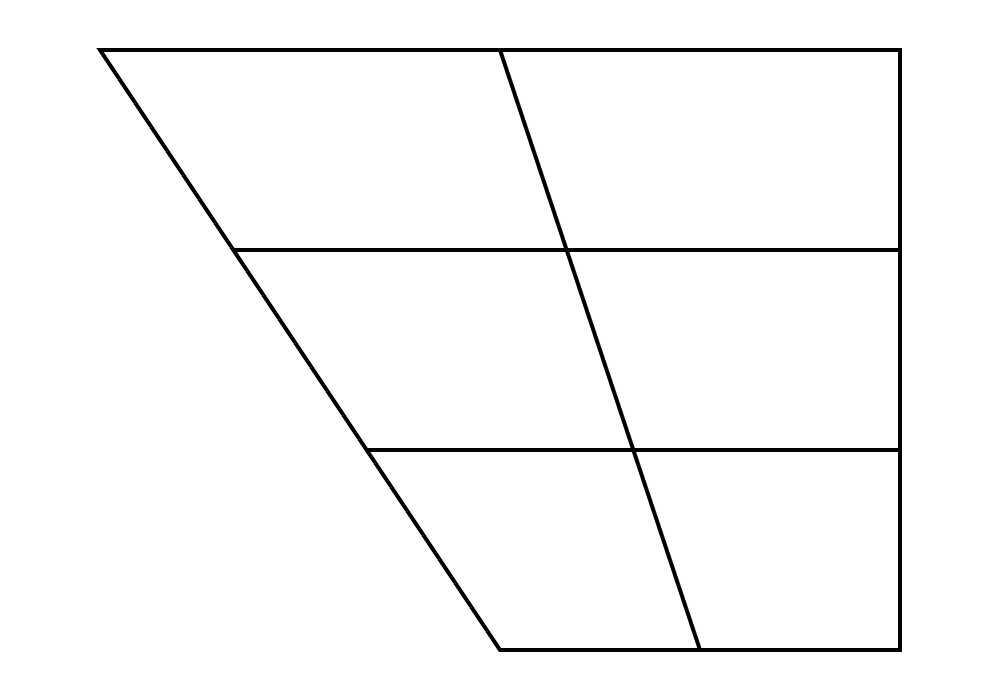
| |||||
| Near-close | ||||||
| Close-mid | ||||||
| Mid | ||||||
| Open-mid | ||||||
| Near-open | ||||||
| Open | ||||||
Prosody
Length and Stress
Vowel length is distinctive in Ín Duári, and is indicated in the orthography by acute accents over the lengthened vowels. Additionally, the acute accent in ú and í also signify vowel quality. Since vowel length affects the stress; the acute accent also indicates the location of the primary stress of the word.
Vowel length is almost always associated with syllable stress. As a general rule, long vowels do not occur in CVCC clusters, although some exceptions arise, as in mínþir (exhaustion). If two or more long vowels occur in a word, the final long vowel is stressed.
Intonation
Phonotactics
Morphophonology
Morphology
Ín Duári is a fusional language with some agglugination.
Nouns
Nouns inflect for gender, number and case. The gender system contains eight classes, descended from an earlier system that distinguished animacy through noun classifiers. In time these classifiers became bound morphemes, accounting for the disparate patterns found across the present noun class system. Animacy is still correlated with noun classes, with animacy tending to decrease from left to right across the noun classes. However, the animacy distinctions have blurred, with some of the nouns in the protolanguage being reassigned to another class due to syncretism.
The Class I and Class II nouns are unmarked in the nominative, but take accusative suffixes. Nouns from Class III to Class VI all exhibit suffix marking on the nominative, with null marking on the accusative. These nouns are referred to as the unmarked accusative nouns, or marked nominative nouns. Based on this type of case marking, linguists have classified Ín Duári's morphosyntactic alighnment as nominative-absolutive , a subtype of the more familiar nominative-accusative morphosyntactic alighment. Nominative-absolutive languages occur rarely throughout the world. However, Ín Duári exhibits nominative-absolutive alignment only in Class III-Class VIII. Class I and Class II exhibit the prototypical nominative-accusative pattern though, so Ín Duári is highly unusual as it appears to exhibit a split alignment system between the nominative-accusative and the nominative-absolutive morphosyntactic alignment classifications.
Class VII and Class VIII nouns have merged the nominative and accusative cases into a single, direct case. The plural forms originally reduplicated the initial syllable with the CV- pattern followed by and infixed -θ-, but through phonological erosion initial consonants were lost, leaving behind the vowel of the original reduplicated syllable. Through time the vowels were leveled to an e- prefix in all noun classes, save for the plural in the form VIII direct case, which changed to initial i- prefix.
| Case | Noun Classes | |||||||||||||||
|---|---|---|---|---|---|---|---|---|---|---|---|---|---|---|---|---|
| Class I | Class II | Class III | Class IV | Class V | Class VI | Class VII | Class VIII | |||||||||
| Singular | Plural | Singular | Plural | Singular | Plural | Singular | Plural | Singular | Plural | Singular | Plural | Singular | Plural | Singular | Plural | |
| Nominative | hora | hohrāni | ||||||||||||||
| Genitive | horan | hohrā | ||||||||||||||
| Comitative | horȇ | |||||||||||||||
| Ablative | ||||||||||||||||
| Allative | horȇn | |||||||||||||||
| Locative | ||||||||||||||||
| Instrumental | hordâni hordâne |
|||||||||||||||
Pronouns
| Case | Noun Classes | |||||||||||||||||||
|---|---|---|---|---|---|---|---|---|---|---|---|---|---|---|---|---|---|---|---|---|
| 1st | 2nd | Class I | Class II | Class III | Class IV | Class V | Class VI | Class VII | Class VIII | |||||||||||
| Singular | Plural | Singular | Plural | Singular | Plural | Singular | Plural | Singular | Plural | Singular | Plural | Singular | Plural | Singular | Plural | Singular | Plural | Singular | Plural | |
| Nominative | vaš | veš | jan | zay | nay | zay | āni | zan | zane | zan | hašvin | haš | roše | roš | lašne | lašen | raše | raš | hazen | haz |
| Genitive | vašân | |||||||||||||||||||
| Instrumental | ||||||||||||||||||||
| Ablative | ||||||||||||||||||||
| Allative | ||||||||||||||||||||
| Locative | ||||||||||||||||||||
Verbs
The Copula
The Nidâri copula inflects for TAM and polarity:
| TAM | Positive | Negative |
|---|---|---|
| Present | bâz << bey-ân-z, biy-ân-z | bâš, bâšq << bey-ân-z-g, biy-ân-z-g |
| Future/Irrealis | bidâz << biy-ad-ân-z | bidâšq << biy-ad-ân-z-g |
| Past | baštân << ba-š-t-ân | baštâq << ba-št-ân-g |
| Imperative | baš << ba-š | bašqân, bašgân << ba-š-g-ân |
The copula originates from two roots, ba- and biy-. The root bi- is used to form the Future/Irrealis stem, whilst ba- forms the rest of the TAM stems. Both ba- and biy- are cognate with Ín Duári bean, “to sit, be in a sitting position”
The Verb Phrase
The copula combines with a verbal noun, descended from the Proto-Duaric gerund, to form a compound noun. In Duaric linguistics, this verbal noun is still referred to as a gerund, as it also functions as nominalizers, adjectives, temporal nouns, among other functions.
In intransitive clauses, the gerund precedes the copula and any accompanying auxiliaries:
- Birân bagdamin baštâq.
/bi'rɒ:n bagda'min baʃ'taɣ/
birân bagda'mi baʃ'taɣ
to.house running was
He ran home.
- Gabagdamin baštâq gureh birân.
/gabagda'min baʃ'taɣ gu'rɛh bi'rɒ:n /
ga=bagdamin baštaq birân
NEG=running was.not try to.house
He did not try to run home.
In transitive clauses, the gerund precedes the object, which is inflected in the genitive case, followed by the copula:
- Gatâqiv birânen baštâqešan gureh.
/gatɒ'ɣiv birɒ'nɛn bagda'min baʃtaɣe'ʃan gu'rɛh/
ga=tâqiv birân-en baštâq-ešan gureh
NEG=burning house-GEN was.not=CAUS try
He did not try to burn down the house.
Syntax
Constituent order
Canonical word order is VSO. Nevertheless, SVO, SOV, VOS, OSV, and OVS may appear as the case system allows such flexibility since it explicitly marks syntactic roles. Modifiers for the most part follow their heads, although determiners and deictics precede their heads.