Minhast: Difference between revisions
mNo edit summary |
|||
| Line 267: | Line 267: | ||
Although the Tašširkantaft is based on the Baybayin, several differences can be found between the two. Several Minhast innovations arose, partly from the influence of the materials used for writing, and the addition of characters from the older Minhast ideographic-logographic script. Comparisons and contrasts are enumerated as follows: | Although the Tašširkantaft is based on the Baybayin, several differences can be found between the two. Several Minhast innovations arose, partly from the influence of the materials used for writing, and the addition of characters from the older Minhast ideographic-logographic script. Comparisons and contrasts are enumerated as follows: | ||
The relationship between the glottal stop in the Baybayin and that of the Tašširkantaft is recognizable. The Tašširkantaft glyph for <d> is actually an inverted form of the Baybayin glyph for <t>. Similarly, the Tašširkantaft glyph for <z> is descended from the Baybayin glyph <s>. Other discernable similarities can be found with the glyphs <l> and <m>. Some phonemes not found in the Tagalog or Ilocano languages were innovated, but these innovations came from | The relationship between the glottal stop in the Baybayin and that of the Tašširkantaft is recognizable. The Tašširkantaft glyph for <d> is actually an inverted form of the Baybayin glyph for <t>. Similarly, the Tašširkantaft glyph for <z> is descended from the Baybayin glyph <s>. Other discernable similarities can be found with the glyphs <l> and <m>. Some phonemes not found in the Tagalog or Ilocano languages were innovated, but these innovations came from a method of deriving additional glyphs from a base glyph from which certain classes of phonemes could be derived. | ||
The Tašširkantaft was modified from the original Baybayin to map a base glyph and its variants to certain related phonemes (e.g. the base glyph <b> and its variants to the labial consonants). For example, the glyphs for the labials <b>, <p>, and <f> are based on the glyph <b>. Additions of dashes to the base glyph distinguish voiced, unvoiced, and fricatives. This explains why there is less variability in the Tašširkantaft script. The <d> and <t> glyphs in the Baybayin are noticeably different from each other; in contrast the glyphs in the Tašširkantaft for these same glyphs differ from each other only by the addition of a dash to the glyph <t> from the base glyph, <d>. As can be seen from the chart, the voiced consonant is assigned the base glyph, and dashes are added to this base glyph for unvoiced and fricatives for a given phonemic class (labials, dentals, aleveolars, etc). The Tašširkantaft is thus more economical. | The Tašširkantaft was modified from the original Baybayin to map a base glyph and its variants to certain related phonemes (e.g. the base glyph <b> and its variants to the labial consonants). For example, the glyphs for the labials <b>, <p>, and <f> are based on the glyph <b>. Additions of dashes to the base glyph distinguish voiced, unvoiced, and fricatives. This explains why there is less variability in the Tašširkantaft script. The <d> and <t> glyphs in the Baybayin are noticeably different from each other; in contrast the glyphs in the Tašširkantaft for these same glyphs differ from each other only by the addition of a dash to the glyph <t> from the base glyph, <d>. As can be seen from the chart, the voiced consonant is assigned the base glyph, and dashes are added to this base glyph for unvoiced and fricatives for a given phonemic class (labials, dentals, aleveolars, etc). The Tašširkantaft is thus more economical. | ||
Revision as of 22:23, 30 August 2014
 | This article is private. The author requests that you do not make changes to this project without approval. By all means, please help fix spelling, grammar and organisation problems, thank you. |
 | This article is a construction site. This project is currently undergoing significant construction and/or revamp. By all means, take a look around, thank you. |
| Minhast | |
|---|---|
| Minhast | |
| Pronunciation | [/'min.hɑst/] |
| Created by | – |
| Native to | Minhay |
| Native speakers | 26,232,430 (2005) |
Language Isolate
| |
| Official status | |
Official language in | Republic of Minhay |
| Language codes | |
| ISO 639-1 | min |
Introduction
Minhast (Minhast min kirim, lit. "Minhast-speak") is the spoken language of the Republic of Minhay, with a robust speech community of nearly 26 million people, approximately one million of them living in expatriate communities, with the largest concentrations residing in the U.S., Xayda, Mexico, the Middle East, Kailukuanpūr, and Canada. Significant numbers also exist in Southeast Asia and Norhern Europe. It is divided into two major dialects, Upper Minhast and Lower Minhast, each of which is divided into several smaller subdialects, such as the Salmon Speaker variant of the Upper Minhast dialect, and the Osprey Speaker variant of the Lower Minhast dialect.
Located just 1,232 km from northeast Japan, this Northeast Asian language has no known relatives and bears few if any similarities with Japanese and its two other nearest neighbors, the Kingdom of Kogureo (Korea) and the Ainu Democratic Federation (Ainushir). Two other languages in the island nation, Peshpeg and Golahat, both of which are moribund, are also unrelated; any similarities existing between the two languages and Minhast are due to areal features, with Minhast as the dominant influence. Linguists have investigated possible relationships with the Altaic, Paleosiberian, and Native North American languages, but so far have failed to find any conclusive evidence. Therefore, Minhast remains classified as a language isolate.
Typologically, Minhast is an ergative, polysynthetic language. Verbal morphology is highly aggluginative and performs noun incorporation and other complex valence operations. Unmarked word order is SOV. Ergativity surfaces both at the morphologic and syntactic levels. Both its ergative and polysynthetic characteristics have generated much academic research in comparative and theoretical linguistics.
Dialectology
Minhast is divided into two major dialects. Upper Minhast, which is centered in the highlands of Kilmay Rī, Ešked (Ekšed), and Attum Attar; the northeastern coastal prefectures of Iskamharat and Perim-Sin; and the National Capital Region, consisting of Āš-min-Gāl, Ankussūr, Huruk, Nammadīn, and Kered. Lower Minhast is spoken mainly in the southeastern coastal prefectures of Neskud, Yaxparim, Senzil, and Rēgum. The two dialects differ chiefly in phonetics and the lexicon, with Lower Minhast containing loanwords from neighboring languages (e.g. Golahat). Otherwise, the two dialects are mutually intelligible.
Additionally, the two dialects are divided into several smaller dialects. The major subdialects of Upper Minhast include the Salmon Speakers of the "Gaššarat" (Northeastern Coast), the Dog Speakers of the "Hisašarum" (The Northeastern Plains), the Horse Speakers of the "Gannasia" (The Central Plateau), and the Knife Speakers (Lesser Plateau Prefecture). Lower Minhast consists of the Gull Speakers (Senzil and Rēgum Prefectures), the Osprey Speakers (Kings' Bay), and the Stone Speakers of the southernmost prefectures (Neskud and Yaxparim).
Two new dialects have arisen in the National Capital Region (NCR). One is Modern Standard Minhast, a variant of Upper Minhast that serves as the standard dialect used for government, commerce, and media. The second dialect, known as Modern Colloquial Minhast, is admixture of several subdialects from both Upper and Lower Minhast. Spoken mostly by people in their 30's and earlier, it contains more loanwords from foreign languages than the standard language, especially in areas of technology and the Internet, and from foreign films and media. This new dialect is replete with slang and nonstandard jargon that is often looked down upon by older generations.
This grammatical sketch is a description primarily of Modern Standard Minhast. Examples from other Minhast dialects, or from Old or Classical Minhast will be noted as appropriate.
Phonology and Orthography
Phonemic Inventory
The following chart contains the consonants in the Minhast phonology. The Minhast Latinized alphabet is derived from the Americanist system and is used throughout this article. Where Americanist and IPA symbols diverge, the IPA version is indicated by the IPA syllable surrounded by two forward slashes.
| Bilabial | Alveolar | Palatal | Velar | Uvular | Glottal | Laryngeal | Pharyngeal | |
|---|---|---|---|---|---|---|---|---|
| Nasal | m | n | ŋ | |||||
| Plosive | p b | t d | k g | |||||
| Fricative | f | s z | ʃ ƹ | χ | ʔ | h | ħ | |
| Affricates | t͡ʃ d͡ʒ | |||||||
| Approximants | w | j | ||||||
| Trill | r | |||||||
| Lateral Approximant | l |
Minhast Vowel Inventory
| Front | Near- front | Central | Near- back | Back | ||
| Close | File:Blank vowel trapezoid.svg
| |||||
| Near-close | ||||||
| Close-mid | ||||||
| Mid | ||||||
| Open-mid | ||||||
| Near-open | ||||||
| Open | ||||||
| Short | Long | Devoiced |
|---|---|---|
| a | ā | (ạ) |
| e | ē | (ẹ) |
| i | ī | (ị) |
| u | ū | (ụ) |
Syllabic Structure and Phonemic Interactions
Minhast words are subject to complex morphophonemic changes resulting from interactions with other morphemes occurring in the word. The verb is particularly complex in the various sound changes that may occur as a result of noun incorporation as well as the aggluginative processes involved in conjugation or other inflectional processes. These phonemic changes can be broken down according to the following classifications:
- Assimilation
- Metathesis
- Syncope
- Epenthesis
- Voicing/Devoicing
These complex morphophonemic interactions operate according to the general phonological principals outlined below:
- No syllable can have a consonant cluster of more than two consonants. Syncope can be applied only if a biconsonantal cluster is formed, and the vowel is not a part of a heavy syllable (i.e. the vowel is long, or it occurs in a VCC sequence).
- No Minhast word can have an initial consonant cluster. After any initial consonant cluster results from one or more of the possible morphophonemic alternations described below, an epenthetic is automatically appended to the head of the word to form the permissible iCC- pattern.
- An epenthetic vowel is always inserted between two syllables if combining the syllables results in a triconsonantal cluster. The default epenthetic vowel is -i-, but the other 3 vowels may also be used, depending on multiple factors (e.g. vowel harmony, an underlying quiescent initial vowel as part of the attached morpheme, etc.)
- Minhast has a strong tendency to form intermedial clusters, either or , providing that Rules #1-#3 are observed. If necessary, an epenthetic vowel may be added before or after the syllable to create these syllabic patterns, e.g. e.g. kanut-maris-kar- >> -kant-(u)-maris-kar
- The tendency to form intermedial consonant clusters creates complex assimilation interactions that nevertheless are predictable and almost always regular. These interactions are illustrated in Table X below:
Minhast Phonotactics Table
Initial
ConsonantFinal Consonant f p b k x g t d s š z l r m n h w y f ff pp pp fk fx fk ft ft fs ff fs fl fr fm fn ff fw fy p pp pp pp pk xp pk pt pt ps ħp ps pl pr pm pn ħp pw py b pp pp bb pk xp mg pt mb ps ħp ps bl br mb mb ħp bw by k kf kp kp kk kk kk kt kt ks kš ks kl kr km kn ħk kw ky x xf xp xp kk xx gg xt xt ss šš ss xl xr xm xn xx xw xy g kf kp gb kk kk gg kt gd ks ħk zg lg gr gm gn ħk gw gy t ft pt pt kt xt kt tt tt st št st tt rt mt nt ħt wt šš d ft pt bb kt xt gd tt dd st ħt zd ld rd mb nd ħt dw dy s sp sp sp sk šš sk st st ss šš ss sl
ssss sm sn ħs sw šš š šf šp šp šk šš šk št št ss šš ss šl
šššš šm šn ħš šw šš z sp sp zb sk ss zg st zd ss šš zz zl
zzzz zm zn ħs zw zy l lf pp lb kk xl lg tt ld sl
ssšl
ššzl
zzll rr lm
mmnn ħl lw yy r rf rp rb rk rx rg rt rd
ddrs
ssrš
ššzz ll rr rm
mmnn rħ
ħrrw ry m mf mp mb nk xn mg mt md ns šm nz lm
mlmr mm nn mh ww my n mf mp mb nk xn mg
ngnt nd sn
ss
(ns)šn
šš
(nš)nz ll rr mm nn nh nw ny
yyh ff ħp ħp ħk xx ħk ħt ħt ħs ħš ħs ħl ħr ħm ħn ħħ ħw ħħ
- Vowels are classified according to a "weak-strong" gradient, where the "strong" vowels are more resistant to syncope than neighboring "weak(er)" vowels. All long vowels are by definition "strong", so the weak-strong gradient really applies to short vowels: Table X: Vowel Gradients In Order of Increasing Strength
- The shape of a -CVCVC- syllable may contract either to a -CCVC- or -CVCC- pattern, depending on the strength gradients of the vowels with respect to one another. The -CaCaC- syllable pattern is the only one that does not contract. Syllables consisting of the same vowels may appear in either -CCVC- or -CVCC- patterns; the pattern they resolve to is influenced by interactions from surrounding syllables. These contractions are summarized in the following table:
Initial Pattern Final Contraction -CaCaC- (no change) -CaCuC- -CaCeC-
-CaCiC-
-CaCC- -CuCaC- -CeCaC-
-CiCaC-
-CCaC- -CuCuC- -CuCeC-
-CuCiC-
-CuCC- -CuCuC- CeCuC-
-CiCuC-
-CCuC- -CeCeC- -CeCiC-
-CeCC- -CeCeC- -CiCeC-
-CCeC- -CiCiC- -CCiC- -CiCC-
- A verb root or an incorporated noun tends to lose one or more vowels to form at least one biconsonant cluster. The vowel that is lost depends on its strength gradient in relation to the noun of the neighboring syllable.
- With the exception of pattern -CaCa-, when two adjoining syllables have vowels within the same gradient, vocalic syncope resolves to CVCC.
- The pattern (C)VVCC always resolves to (C)VCC
- Compared to nominal and verbal roots, inflectional morphemes (e.g. theme, aspect, tense, person, etc) are resistant to syncope because this may lead to the inflectional morpheme to be changed beyond recognition. For example,-šp-irak- he informed (him) (lit. "he caused him to know") does not resolve to -šip-rak-, even though this would prevent the impermissible CCV pattern from occurring. Instead, an epenthetic vowel is added before the causative affix to prevent this impermissible consonant cluster from occurring.
- Although inflectional morphemes do not experience syncope, they still may experience phonological changes in the form of metathesis and devoicing.
- Vowel devoicing occurs in CVħC, CVxC, CVsC, or CVC syllables, where C is any of the unvoiced consonants listed in Table X.
- Two consecutive syllables with the pattern CVħCVħ resolves to CVCCVħ, due to the difficulty of pronouncing the allophone in two consecutive closed syllables. Additionally, the vowel in the previous syllable may be devoiced if its adjacent consonants are voiceless, as in Example A, where the verb root vowel -a- which occurs the voiceless consonants -k- and -h- devoices to -ạ-. Note also the epenthetic vowel -i- appearing between the verb root and the 1st person incl. pl. affix ,-ħk- e.g.: nattiħkemkaraban >> *naħtiħkemaraban >> *naħt-hkem-ar-ab-an "We were (being) annoying" (lit.: annoying-we.and.you-[past]-[ imperf.]-[intrans]) nekạħtikemaraban >> *nekạħtịħkemaraban >> *nekạħt-ħkem-ar-ab-an "I was avoiding..."
- Dissimilation occurs in CVC-patterns involving š-Vš, resolving to s-Vš. A prime example is the number "twenty", e.g.*šan-šentāz >> *san-šentāz > > saššentāz
- Dissimilation occurs in CVC-patterns involving mVm, resolving to nVm.
Orthography
Minhast uses two writing systems. One of them is a variant of the Latin script, called "Ammerkast". This variant is an adaptation of the Americanist phonetic notation, with the exception of the grapheme <ħ>, which was adopted from IPA.
Another system is an indigenous script adapted from the Tagalog and Ilocano versions of the Baybayin script, a native Philippine abugida. The Minhast script is called Tašširkantaft, which literally means "that which is scratched across a surface".
-
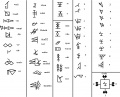 The Tašširkantaft


Although the Tašširkantaft is based on the Baybayin, several differences can be found between the two. Several Minhast innovations arose, partly from the influence of the materials used for writing, and the addition of characters from the older Minhast ideographic-logographic script. Comparisons and contrasts are enumerated as follows:
The relationship between the glottal stop in the Baybayin and that of the Tašširkantaft is recognizable. The Tašširkantaft glyph for <d> is actually an inverted form of the Baybayin glyph for <t>. Similarly, the Tašširkantaft glyph for <z> is descended from the Baybayin glyph <s>. Other discernable similarities can be found with the glyphs <l> and <m>. Some phonemes not found in the Tagalog or Ilocano languages were innovated, but these innovations came from a method of deriving additional glyphs from a base glyph from which certain classes of phonemes could be derived.
The Tašširkantaft was modified from the original Baybayin to map a base glyph and its variants to certain related phonemes (e.g. the base glyph <b> and its variants to the labial consonants). For example, the glyphs for the labials <b>, <p>, and <f> are based on the glyph <b>. Additions of dashes to the base glyph distinguish voiced, unvoiced, and fricatives. This explains why there is less variability in the Tašširkantaft script. The <d> and <t> glyphs in the Baybayin are noticeably different from each other; in contrast the glyphs in the Tašširkantaft for these same glyphs differ from each other only by the addition of a dash to the glyph <t> from the base glyph, <d>. As can be seen from the chart, the voiced consonant is assigned the base glyph, and dashes are added to this base glyph for unvoiced and fricatives for a given phonemic class (labials, dentals, aleveolars, etc). The Tašširkantaft is thus more economical.
Each glyph of the Tašširkantaft has a default underlying vowel /a/; all other vowels must be marked explicitly attached to the vowel signs (indicated in the lower right-hand corner; the box is simply a representation of where the base glyph would be located). I still have to formulate how the long vowels would be represented, as they are phonemically significant, but most likely it's going to be a vertical dash through the diamonds representing the short vowels <u> and <e>, and a horizontal one between the diamonds of the vowel <i>.
One striking difference between the two writing systems is the angularity of the Tašširkantaft vs. the Baybayin. The Tašširkantaft consists of straight lines and is very angular, whereas the Baybayin is wavy. This is because the Tašširkantaft was originally carved into wooden planks, as is still done today among the Salmon Speakers; writing on a hard writing surface is easier with straight lines than curvy shapes.
Another difference, as mentioned earlier, is the addition of glyphs from the older native script. This script was largely ideographic, but a few glyphs were determinatives used to indicate case or even verbal tense. Glyphs for common words, such as conjunctions, connectives, existential particles, and negators were added to the Tašširkantaft. Some of these glyphs are combinations of two glyphs, as in the glyph for hambin (there is no X), which is a combination of the negator hatāʔ and matti (there is an X). The characters for the case clitics =(a)ran (Dative), =ni (Benefactive), =yar (Ablative), =par (Instrumental), etc. can actually appear before a verb written in the Tašširkantaft, in which case these characters represent the Applicative affixes -dut-, -rak-, -raħk-, -ngar-, respectively.
Nouns
Gender, Number, and Case Marking
1) Gender: All nouns have an intrinsic gender; interestingly, some nouns may have multiple genders, each gender conveying different meanings; these should be considered separate lexical entities. However, nouns are not inflected or marked by gender affixes or clitics. Instead, cross-reference affixes in the verb identify the gender of the nouns that serve as core arguments of a clause; in contrast, oblique argument, however, do not receive any marking. Thus, gender of each noun must be memorized in order to choose the correct verbal affix, or to identify the gender of a noun serving as an oblique argument.
2) Number: Nouns do not inflect for number. Verbal cross-reference affixes (see section below on verbal Pronominal Affixes) can mark number on Ergative and Absolutive noun phrases, but do not provide any information about number for non-core NPs. Speakers must rely on context or use numbers in a min construction using the formula [number + min + NP], e.g. “šānī min redad” (i.e. “two man”) to mark plurality; otherwise the default number is singular.
3) Case: Although nouns are not overtly marked for gender or number by inflection or clitics, they do take case marking clitics that attach to the end of the noun or noun phrase. There are two core nominal arguments: the Absolutive which receives zero marking, and the Ergative clitic =de. The Genitive derives from the same =de clitic as the Ergative, and in most declension tables are thus listed as the Ergative-Genitive case. However, there are several allomorphs which are explained where the Ergative and the Genitive diverge in shape, as illustrated in the following table:
| Resulting Form | ||||
|---|---|---|---|---|
| Preceding Phoneme(s) | Ergative | Genitive | Genitive + Ergative | |
| (V)V, g, z | =de | =de | =de | |
| l,r, n | =de | =t | =te | |
| f, p,k, x, s, š,h | =te | =t | =te | |
| m | =be | =t | =te | |
| b | =mbe | =pt | =pte | |
| d | =e | =te,=tide | =te,=tide | |
| t | =te, =tide | =te | =te,=tide | |
| C1C2 | =e,=ide | =e | =e | |
| nk, ng | =ide | =ide | =ide | |
| CC | =e,=ide | =ide | =e,=ide | |
Additionally, there are seven basic Oblique case clitics to non-core NP arguments, plus a few others that are rare or have fallen out of use, such as the Inessive =kīr/=kir. Most of the Oblique clitics have two forms, one form with a short medial vowel, and the other with a long medial vowel. Use of both forms are acceptable, but native speakers tend to use the clitics with short vowels when the clitic is preceded by a long vowel, while the converse is true for the clitics forms with long vowels.
| Case | Postposition |
|---|---|
| Dative | =(a)ran |
| Benefactive | =nī, =ni |
| Ablative | =yār, =yar |
| Locative | =kī, =ki |
| Instrumental | =pār, =par |
| Commitative | =kān,=kan |
| Malefactive | =daħ, =dāš |
4) Tense-Aspect Marking
Interestingly, nouns can receive the same TA marking of verbs. Minhast lacks a copula; instead, two separate NPs are simply juxtaposed, e.g. Ruggāyam kaslubekte ("Ruggāyam is my dog"). However, if the statement refers to a past or future event, simple juxtaposition cannot convey tense information. Therefore, the NP may be marked with any TA marker, in lieu of a copular verb, as in Ruggāyam kaslubekt-ar ("Ruggāyam was my dog"). The TA marker could just have easily been added to the first NP as opposed to the second, Ruggāyam-ar kaslubekt; or even both NPs could be marked, Ruggāyam-ar kaslubekt-ar.
Noun Classes
Nouns are divided into three classes based on the syllabic pattern of the final syllable of the noun. The Class I nouns (also known as “Strong Stem” nouns) are those whose Absolutive forms end in a single consonant, or a short vowel. Additions of a short-vowel clitic do not change the noun stem's final vowel. The rules of vowel apocopation, however, still apply.
Class II nouns are divided into three subtypes, with Absolutive forms ending with the glides -ea, -ia, or -ua. Class II nouns undergo a morphophonemic process whereby the final -a of the noun stem is dropped and the preceding vowel is automatically lengthened when either a short or a long-vowel case clitic is attached to the noun stem. Additionally, during noun incorporation the entire glide is elided. Examples are as follows for marua, yarea, and simmia, meaning “the 'star' Venus”, “young girl”, and “moonless night”, respectively.
Class III nouns all terminate with either a consonant cluster or gemminate consonnants. If the following clitic that attaches to it has a quiescent vowel, such as the Dative clitic =(a)ran, the quiescent vowel resurfaces to prevent an impermissible CCC pattern, or the epenthetic vowels -i- or -e- is inserted. An additional feature is that these nouns will select the long-vowel forms of case clitics if they do exist.
These nouns are contrasted against the Class I noun gal (“horse”).
| Absolutive | Pre-clitic Form | Incorporated Form | Examples | Meaning | |
|---|---|---|---|---|---|
| Class I | gal | gal= |
-gal- |
galde, galyār | horse |
| Class II | marua | marū= |
-mar- |
marūde, marūpar | the "star" Venus |
| yarea | yarē= |
-yar- |
yarēde, yarēran | young girl | |
| simmia | simmī= |
-simm- |
simmīde, simmīkan | moonless night | |
| Class III | asr | asr-, asre- |
-asr- |
asride, asrenī | nose |
| niss | niss-,nisse- |
-niss- |
nisside, nissekī |
Interrogative Pronouns
| English | Minhast |
|---|---|
| Who | šikk, darad |
| What | bak |
| Which | ādan min; * ādam |
| When | sippan, sippamey |
| Why | širekka, bakran |
| Where at | nakkī |
| Where to, whither | nakran |
| Where from, whence | nakyar |
| At which location | nakkīdān |
| From which location | nakkīdanyār |
| To which location | nakkīdarran |
| How many/how much | bitakku |
| Quantifier | Substantive | Attributive |
|---|---|---|
| All | rea | rem
suppī min |
| Most | šie | šim |
| Some | rem | azarim
ikyem |
| Many | san | sam |
| Both | šani | šanim |
| Each | uššumī | uššumīm |
| Few | kattua | kattum |
| Another/Other | xani
nexāni |
xanim
nexāni min |
Pronominal Forms
Minhast Independent and Cliticized Pronominal Forms
| Person - Number - Gender | Independant Forms | Bound Forms | ||
|---|---|---|---|---|
| Ergative | Absolutive | Oblique | Stative | |
| 1st Sg. | yakte | yak | yak- | -ek |
| 2nd Sg. | tahte | taħ | tah-,taħ- | -taħ |
| 3rd Masculine - Common Sg. | kūde | kua | kū- | -na |
| 3rd Feminine Sg. | lēde- | lea | lē-, ley- | -lea |
| 3rd Neuter Animate Sg. | šemet | šea | šē-, šey- | -šea |
| 3rd Neuter Inanimate Sg. | mēde | mea | mē-,mey- | -mea |
| Plural | ||||
| 1st Plural Inclusive | hakemt(e) | hak | hak- | -hakkem |
| 1st Pl Exclusive | nemt(e) | nem | nem- | -nem |
| 2nd Pl. | taħtemt(e) | taħtem | -taħtem | -taħtem- |
| 3rd Masc./Common Pl | kemt(e) | kem | kem- | -kem |
| 3rd Fem. Pl. | wext(e) | wexī, weššī | wex- | (n/a) |
| 3rd Neut. Anim. Pl. | sešt(e) | seš | sešš(i)- | -sseš |
| 3rd Neut. Inanim Pl. | maħt(e) | maħ | mah-, maħ- | -maħ |
Demonstratives
| Independent | Attributive | Clitic | Comments | |||
|---|---|---|---|---|---|---|
| Absolutive | Ergative | Absolutive | Ergative | |||
| Proximal | sap | sapte | sapim, sap min | =sap | =sapte | this one, near the speaker |
| Medio-proximal | nax | naxt(e) | naxtim | =nax | =naxt(e) | this/that one near the listener |
| Distal | waššī | wašt(e) | waššim | =waš | =wašt(e) | far from both speaker and listener |
| Invisible | kiryit | kirte | kiryit min | =kirit | =kiryit | |
Numbers
Cardinal and ordinal numbers are one of the [two/XX] groups of true adjectives in the Minhast language. Minhast employs a vigesimal, i.e. base-20, counting system. Numeric expressions involve binding the number and modified noun in a specific construct involving the ligature: Both cardinal and ordinal numbers can take possessive pronominal suffixes (see Part III "Syntax - Possession" for discussion of possessive constructs), which then convey "X number of..." in the case of cardinal numbers, and "the Xth one of/among..." for ordinals, e.g.:
Meneħnemš nasxēreħ iŋkunnuħnemaran "Four of us went out there into the forest."
Menhakkem nasxēreħ iŋkunnuħkēmaran "The fourth one among them went into the forest."
The numbers 1-10 even have intransitive verbal forms, meaning "There were X number of us/you/them." The cardinal, ordinal, and verbal forms are summarized below:
| Number | Cardinal | Ordinal | Verbal |
|---|---|---|---|
| one | šūmi | sanannūx, manx | -šūmi-an |
| two | šānī | šānāx | -šān-an- |
| three | duxt | duxtāx | -duxut-an, -duxt-an |
| four | meneħ | menhāx | -mene-an, -menh-an |
| five | kaħtam | kaħtamāx | -katam-an |
| six | silix | silxāx | -silix-an, -silx-an |
| seven | gelix | gilxāx | -gelix-an, -gelx-an |
| eight | mun | munāx | -mun-an |
| nine | karun | karnāx | -karun-an, -karn-an |
| ten | tazem | tazmāx | -tazem-an, -tazm-an |
| eleven | šiktāz | šiktezāx | ---- |
| twelve | sen | senāx | ---- |
| thirteen | halk | halkāx | ---- |
| fourteen | duggalk | duggalxāx | ---- |
| fifteen | āš | āšāx | ---- |
| sixteen | neš | nešāx | ---- |
| seventeen | manšat | manšatāx | ---- |
| eighteen | zenat | zenatāx | ---- |
| nineteen | zelkark | zelkarkāx | ---- |
| twenty | šentāz | šentezāx | ---- |
| twenty-one | šentāz-u-šum | šentāz-u-manāx | ---- |
| twenty-two | šentāz-u-šan | šentāz-u-šanāx | ---- |
| twenty-three | šentāz-u-duxt | šentāz-u-duxtāx | ---- |
| thirty | šentāz-u-tazem | šentāz-u-tazmāx | ---- |
| forty | saššentāz | saššentezāx | ---- |
| fifty | saššentāz-u-tazem | saššentāz-u-tazmāx | ---- |
| sixty | duššentāz | duššentezāx | ---- |
| seventy | duššentāz-u-tazem | duššentezāx-u-tazmāx | ---- |
| eighty | meneštazem | meneštazmāx | ---- |
| ninety | meneštazem-u-tazem | meneštazmāx-u-tazmāx | ---- |
| one hundred | gādi | gādyāx | ---- |
| one thousand | gaggādi | gaggadyāx | ---- |
Verbs
Minhast possesses a complex grammar, demonstrated in particular by the elaborate polysynthetic morphology of its verbal system. The Minhast verb inflects not only for tense and aspect, but can inflect to indicate mood, modality, causation, potentiality, intensity, and other functions. The verb also possesses a well-developed set of pronominal affixes used to cross-reference the core arguments of a clause. These affixes indicate both gender and number of the nouns they cross-reference, an essential function as Minhast nouns themselves do not have any markings to indicate these two classifications.
Additionally, the verb can carry out three other operations, that of noun incorporation, antipassivation, and applicative formation, used by speakers for discourse purposes such as backgrounding previously established information and for changing the argument structure of the phrase for the purposes of focusing on a particular argument, ensuring that priviledged noun phrases retain their core status, or to employ rhetorical devices. This polysynthetic characteristic can lead to very long verbs that can express an entire sentence. To demonstrate, the English phrase, "You did not even try to get them to reconsider the matter with this evidence" requires only three words in Minhast: "Keman yattah, tašnišpipsaryentinasummatittaharu", meaning literally "To them the evidence, not-try-cause-return-look.at-yet-matter-with-it.you-did." The verb "tašnišpipsaryentinasummatittaharu", which is an individual sentence in its own right, can be parsed to its individual morphemes, yielding "ta-šn-šp-b-sar-yenti-nasum-mat-tittah-ar-u" (neg.-conative-causative-resumptive-look.at-yet- matter-instr.applicative-3rd.inanim.sg.patient/2nd.sg.agent-past-transitive).
Transitivity is determined by the number of core arguments, that is Agent or Patient/Goal. Minhast verbs do not necessarily map to traditional (i.e. Indo-European) notions of transitivity. As an example, the English sentence, "He jumped on the table" is grammatically intransitive. Available to the Minhast verb are both intransitive and transitive mappings: "Zekyaškī nirriekaran" , which is grammatically intransitive, with zekyaš=kī an oblique argument. The same meaning can be expressed transitively when the verb's valence is altered when the locative applicative affix (i)-n(i)- is applied: Zekyaš in-nirrieku.
Verb Types
Minhast verbs can perform functions that are usually associated with other grammatical categories in other languages. For example, Minhast does not have a separate grammatical category for adjectives. Instead, verbs are used in place of adjectives. Verbs are divided into five broad categories:
- Impersonal
- Interrogative
- Attributive
- Stative
- Event
Interrogative verbs are an unusual feature of the Minhast verbal system, and are rare cross-linguistically. In many languages, certain interrogative words co-occur with certain verbs with high frequency. Using English as an example, the verbs in the questions "What happened?", "Where are you going?", "Why did you do it?" illustrate that certain verbs, when they take a WH-word as an argument, have a statistically higher probability of picking one or two WH-words above others. In Minhast, the Interrogative Verbs serve as a shortcut, precluding the need for constructing a whole interrogative sentence with at least two constituents, the WH-word and the verb it is serving as an argument to.
Interrogative verbs can either be zero-valent (i.e. an Impersonal Verb), as in "Innearaš?" >> *inea-ar-an=š [what.happened-PAST-INTRANS=IRREAL] ("What happened?"), univalent, e.g. "Nassuriattaharaš?" >> *nassuriat-tah-ar-an=š [what.did.do-2S.ABS-PAST=IRREAL] ("What did you do?"), or even divalent, i.e. transitive, e.g. "Išpinassuriattaharuš?" >> *šp-nassuriat-tah-u=š [CAUS-what.did.do-2S.ERG+3MS.ABS-TRANS=IRREAL] ("What did you make him do?). Interrogative Verbs can be inflected for tense, aspect, person-number (for univalent verbs), and in some cases, theme, as illustrated in the last example.
Where person-number marking is allowed, both second and third person singular/plural marking predominate; first person marking is infrequent. Many of these verbs appear to have a default tense, usually in the past but sometimes in the future, even though the verb has no explicit tense marking, e.g. maymaštahaš seems to have a default past tense even though the past tense affix -ar- does not appear; however if the past tense affix appears, the verb remains well-formed. Present tense meaning, if intended, is usually recoverable from context or discourse.
The following table contains the most frequently used Interrogative Verbs:
| Verb | Meaning | Valency | Gloss | Restrictions |
|---|---|---|---|---|
| tippakaš | “How did it happen?” | zero | tippak-an=š [happen.how-INTRANS-IRREAL] |
|
| kurraktahaš | "How many do you want?" | univalent | kurrak-tah-an=š [how.many.want-2S.ABS-INTRANS-IRREAL] |
|
| nassuriattahaš | "What did you do?" | univalent | nansuriat-tah-an=š [what.do-2S.ABS-INTRANS-IRREAL] |
|
| inneaš | "What happened?" | zero | innea-ar-an=š [what.happen-INTRANS-IRREAL] |
|
| paxtamaš | "When did it happen?" | zero | paxtam-ar-an=š [when.do-INTRANS-IRREAL] |
|
| iskumattahaš | "When will you come?" | univalent | iskumat-tah-an=š [when.come-2S.ABS-INTRANS-IRREAL] |
|
| naktatintahaš | "Where are you going?" | univalent | naktatin-tah-an=š [where.are-2S.ABS-INTRANS-IRREAL] |
|
| annatimaraš | "Where did this happen?/Where was this done? Where did he do this?" |
univalent | annatim-ar-an=š [where.happen-PAST-INTRANS-IRREAL] |
|
| maymaštahaš | "Who did this?" | zero | maymaštah-an=š [who.do-INTRANS-IRREAL] |
Verb Template
1) Negators, Precatives 2) Theme 1 Affixes 3) Applicatives 4) Theme 2 Affixes 5) Verb Stem: Verb-like Derivational Affixes, Root, Noun-like Derivational Affixes, Incorporated Noun 6) Social-Distributional Affixes 7) Pronominal Cross-Reference Affixes 8) Tense-Aspect Markers 9) Post-TA Markers (includes transitivizer, detransitivizer, and nominalizer affixes) 10) Terminals (clause operator affixes, irrealis markers)
Theme 1 Affixes
| Theme | Affix | Meaning | Additional Notes |
|---|---|---|---|
| Expective | -naš- | supposed to, expected to | |
| Desiderative | -šak- | to desire, wish | Other affixes that may occur in this slot are "-xp-" (to enjoy), "-nisp-" (to hate), -"ruxt-" (to like), etc. |
| Conative | -šn- | try | |
| Abilitative | -mar- | can, to be able to | |
| Approximative | -ntar- | almost | Denotes an action that was or is nearly to be carried out. |
| Potentive | -nitt(a)- | might, possibly | |
| Causative | -šp- | to cause, bring about | When used with the Privative, become the Negative Causative |
| Resumptive | -b- | again | |
| Intensive | -nt(a)- | very, extremely | |
| Privative | -mašn- | to undo | Reverses a state or action. When used with the Causative, it means "to cause to not be/do something" |
| Necessitive | -(y)yat- | to be necessary | |
| Continuative | -xt- | to continue | |
| Cessative | -kš- | to cease | Indicates the cessation of an action or state |
| Iterative | -xr- | to do several times | |
| Reactive | -knak- | to do the same action back to another (e.g. she hit him back) | This affix occurs only with semantically transitive verb roots |
| Excessive | -(ha)pm(a)- | very, extremely, too much |
Applicative Affixes
The Applicative Affixes are used to change the argument structure of a clause by increasing its valency, or by changing an oblique NP to core status as an Absolutive argument. The process of using an Applicative affix is often called "Applicative Formation", although other linguists prefer to use the term "Applicative Voice". This article will use the term "Applicative Formation" to emphasize that the argument structure of the clause is being changed by use of the Applicative affix.
| Case Role | Affix |
|---|---|
| Dative | -dut-
-utt- |
| Benefactive | -rak- |
| Instrumental | -mat- |
| Locative | -n-
-naħk- |
| Commitative | -ngar- |
| Ablative | -raħk- |
| Malefactive | -nusk- |
Theme 2 Affixes
| Theme | Affix |
|---|---|
| Habitual | -asm- |
| Inchoative | -saxt- |
| Inceptive | -nd- |
| Inverse Volitional | -kah- |
| Partial Control | -šk(e)- |
The Verb Stem
Verb Root
Adverbial Affixes
Incorporated Noun
Restrictions on incorporated nouns: they can only be noun stems; case and other markers are not allowed. Morphophenemic operations may occur as a result of the incorporation process. These operations may be seen in the Phonology section.
Prepronominal Affixes
| Class | Affix | Additional Notes |
|---|---|---|
| Reflexive | -šar- -saššar- |
-saššar- is restricted to 3MS.PRF.REMOTE.PST (from: -šar-∅-šerr-) |
| Reflexive-Benefactive | -sakšar- | |
| Reciprocal | -šattar- -šatta- -šatt- |
|
| Reciprocal-Benefactive | -sakšatt- | |
| Reciprocal-Adversarial | -dus(s)art -dust- |
|
| Associative | -mmak- | |
| Associative-Benefactive | -sammak- | |
| Distributive | -tar- | The Distributive refers to an action or state across each Patient, and is usually translated as "each". The Distributive may also in some verbs indicate that the verbal event is spread out spatially across a surface, The Distributive has sometimes been analyzed as indicating pluractionality, but this interpretation presents problematic theoretical issues. |
| Partitive | -nesr- -ness- |
Conveys that only a portion of the argument(s) is involved in the verbal event or state, sometimes translated as "some". The Partitive does not refer to the Ergative argument of transitive clauses; for that, the appropriate Quantifier adjective/noun is used. |
The Reflexives, Reciprocals, and Associatives for the most part require plural agent marking and the Intransitive marker -an, but under certain circumstances, the verb may take a transitive structure with both agent and patient marking. For example, the Reciprocal Adversarial is required if the Reactive affix co-occurs to mean "do something back at someone". Transitivity raising via Applicatives may also trigger agent plus patient marking, with the possibility of either or both arguments being singular, as in the following example:
- Iyyamtarkarišpintasaxtinuskihuslapallustakšarekarundurkilwāš!
/ij:amtarkariʃpintasaxtinuskihuslapal:ustakʃarekarundurkil'wa:ʃ/
iyyat-mar-kar-išp-inta-saxt-nusk-huslap-allut-sakšar-ek-ar-un-dūr-kilwāš
NEC-ABIL-PREP-CAUSE-INTENS-INCHO-MAL.APPL-be.sharp-weapon-REFL.BEN-3S.ABS+1S.ERG-PST-TRANS-RSLT-MIRATIVE
Therefore it is necessary for me to ready myself thoroughly against him and make these weapons sharp, I say!
Pronominal Affixes
The pronominal affixes present one of the greatest challenges to the students of the Minhast language due to their inherent complexity in structure and morphosyntax. These affixes serve important functions to the core arguments they coreference, such as indicating syntactic roles, gender, animacy, and number. These affixes, along with the role affixes, also serve to identify the verb as transitive or intransitive. For the transitive verb, the pronominal affixes present greater complexities than those of the intransitive verb - the transitive affixes, representing both the ergative and absolutive arguments of the clause, are portmanteau affixes; although some patterns can be discerned from this fusion of the segments representing the ergative and absolutive components, the transitive pronominal affixes are mostly irregular and have to be memorized individually. As expected, the affixes may change shape due to the sound changes created by adjacent morphemes. However, many of these sound changes deviate from the normal assimilation patterns described earlier in Chapter X "Phonology". The pronominal affixes distinguish three genders, masculine, feminine, and neuter. The neuters are further differentiated into animate and inanimate; the masculine and feminine genders are inherently animate and thus require no special marking. These affixes also indicate singular and plural numbers. Both the masculine and the feminine 3rd person plurals have merged into one common gender, while the gender for animate and inanimate neuter nouns are still distinguished.
Due to the complexity of the transitive pronominal affixes, their full forms are summarized in the next table:
| Agent (Singular) |
Patient (Singular) | |||||
|---|---|---|---|---|---|---|
| 1st | 2nd | 3rd Masc. | 3rd Fem. | 3rd Neut. Anim. | 3rd Neut. Inanim. | |
| 1st | ---- | -tak- | -(e)k- | -kk- [1] | -k- | -tirk- |
| 2nd | -(e)ktah- | ---- | -tah- | -ššittah- | -tah- | -tittah- |
| 3rd Masc. | -(e)knen- | -nten- -ntan- |
-nn-, -Ø- | -ššenn- | -enn- | -tir-,-tirenn- |
| 3rd Fem. | -kišš- | -tašš- | -šš- | -ssišš- | -šš- | -tišš- -tašš- |
| 3rd Neut. Anim. | -(e)k- | -t- -tay- |
-Ø- | -Ø- | -s- | -t- |
| 3rd Neut. Inanim. | -(e)km- | -tam- | -m- | -mm- [2] | -m- | -timm- -tamm- |
| Agent (Plural) |
Patient (Singular) | |||||
| 1st Incl. | ---- | ---- | -(h)ak- | -ššak- | -(h)aknem- | -tirħak- |
| 1st Excl. | ---- | -ntem- -ntam- |
-nn- | -ššennem- | -ennem- | -tinnem- |
| 2nd Common | -aktahm- | ---- | -mt- | -ššettem- | -ettem- | -tittem- |
| 3rd Common | -ekken- | -takken- -takkan- |
-nk- | -ššekken- | -seššen- | -tikken- |
| 3rd Neut. Anim. | -aksen- | -tasn- | -sn- | -ššess- | -sess- | -tiss- |
| 3rd Neut. Inanim. | -akmah- | -tammah- | -mah- | -(a)mmah- | -mah- | -timmah- |
| Patient (Plural) | ||||||
|---|---|---|---|---|---|---|
| Agent (Singular) |
1st Incl. | 1st Excl. | 2nd | 3rd Common | 3rd Neut. Anim. |
3rd Neut. Inanim. |
| 1st | ---- | ---- | -mtek- | -kenk- | -sek- | -mak- |
| 2nd | -(h)ektah- | -nimtah- | ---- | -kemtah- | -sat- | -mattah- |
| 3rd Masc. | -(h)akn- | -nenn- | -tenn- | -kenn- | -sen- | -mann- |
| 3rd Fem. | -(h)ašš- | -nešš- | -tašš- | -kešš- | -sešš- | -mašš- |
| 3rd Neut. Anim. | -(h)ak- | -nem | -tahm- | -kem- | -sm- | -ma- |
| 3rd Neut. Inanim. | -(h)akm- | -nemm- | -tamm- | -kemm- | -semm- | -namm- |
| Agent (Plural) |
Patient (Plural) | |||||
| 1st Incl. | ---- | ---- | ---- | -kemhak- | -sak- | -makkak- |
| 1st Excl. | ---- | ---- | -tamme- | -kemmi- | -sn- | -manne- |
| 2nd Common | ---- | -nittam- | ---- | -kettamm- | -suttam- | -mattam- |
| 3rd Common | -(h)akkem- | -nikkem- | -takkem- | -ikkem- | -skem-,-skum- | -makkem- |
| 3rd Neut. Anim. | -(h)aks- | -niss- | -tass- | -kess | -suss- | -mass- |
| 3rd Neut. Inanim. | -(h)akmah- | -nemmah- | -tammah- | -kemmah- | -smah- | -nammah- |
In comparison to the transitive pronominal affixes, the affixes for the intransitive verb are much simpler. There forms are listed below in Table X:
| Person | Absolutive |
|---|---|
| 1st Sg. | -k- |
| 2nd Sg. | -ta- |
| 3rd Masculine - Common Sg. | -Ø- |
| 3rd Feminine Sg. | -l- |
| 3rd Neuter Animate Sg. | -Ø-, -š- |
| 3rd Neuter Inanimate Sg. | -m- |
| 1st Plural Inclusive | -hak |
| 1st Pl Exclusive | -mm- |
| 2nd Pl. | -tam- |
| 3rd Common Pl. | -km- |
| 3rd Neut. Anim. Pl. | -i- |
| 3rd Neut. Inanim Pl. | -mah-, -ma- |
Tense-Aspect (TA) Affixes
| Tense | Affix | Additional Notes |
|---|---|---|
| Remote Past | -šar- | The Remote Past usually encompasses periods of decades or longer |
| Past | -ar- | |
| Present | -Ø- | Also encompasses the immediate past. |
| Immediate Future | -ne-, -nes- | |
| Future | -(a)satt- |
| Aspect | Affix |
|---|---|
| Imperfect | -(a)b- |
| Perfect | -Ø- |
| Partial Completion | -knakt- |
A few additional comments need to be made about the tense and aspect markers. The Present Tense in combination with the Imperfect Aspect is commonly used as the "narrative tense" in both traditional oral literature, and modern literature involving poetry and fiction where the author wishes to convey a sense of intimacy and immediacy in a narrative. The Present Imperfect is also used in ordinary speech to describe an action that began in the past but nevertheless is still continuing, illustrated in such sentences as Tenkūr wandirahyilabu >> *tenkūr morning wa=ind-rahy-l-ab-u (CONN=INCEP-cry-DISTR-3SF-IMPF-TRANS), lit. "This morning she begins crying [still]". Minhast does have a Continuative affix -xt-, but it occurs in the Teme I slot. A different meaning would result if intervening affixes from the Theme I slot surfaced. For example, if the Theme I Iterative affix appeared after the Continuative affix, the resulting phrase Tenkūr waxtixrirahittarlabu >> *Tenkūr wa=xt-xr-rahy-tar-l-ab-u (CONN=INCEP-ITER-cry-DISTR-3SF-IMPF-TRANS) actually means "This morning she begins to continue to cry several times [still]." The latter sentence implies the act of crying occurred in discrete individual events since the start of crying. up until the present. The previous sentence, however, cannot be interpreted in that manner. This example shows that Minhast speakers consider time frames as relative to each other, as opposed to typical Indo-European languages that consider time as having discrete start and end point.
Post-TA Affixes
The Post-TA affixes serve to mark the verb's transitivity. The Detransitivizer combines with other affixes, such as the Reflexive, Reciprocal, and the Antipassive. It occurs oftentimes when NI has taken place, provided that the totality of the verb's valence operations did not promote a former Absolutive argument to Ergative case, which may happen if the Applicative affixes and/or the Causative surface, as in Redadde kaslub dutittaħšitipraru ("The man gave the dog some meat", lit: The man the dog he.meat.gave.towards).
| Class | Affix | Notes |
|---|---|---|
| Detransitivizer | -an-, -ēn-, -en + C- | The latter two forms are non-pausal forms for when the preceding vowel is e or -ē. Otherwise, the combination -ean occurs if the verb is sentence-final and no other affix follows. |
| Transitivizer | -u- | |
| Antipassive | -ampi- |
Terminative Affixes
These occupy the final position of the verb complex. The most frequently encountered affix is the General Subordinative affix -mā.
| Function | Affix | Notes |
|---|---|---|
| General Subordinative | -mā |
English translation: "then; that". This suffix is used primarily to link Sequential clauses. |
| Purposive | -nimmā | in order to |
| Direct Quotative | -namā | English: "Thus (x) says/said". Marks the following clause as direct speech. |
| Indirect Quotative | -tamā | English: "(s/he) said that". Marks the following clause as indirect speech. |
| Consequential Affix | -dur-
-dūr- |
Indicates the clause is a direct result of the preceding clause |
| Unexpected | -kil- | Indicates the verb is a sudden, unexpected event or state. |
| Unexpected Negative Exclamatory Affix |
-kilmakš- | Indicates the verb is a sudden, unexpected event or state, with strong negative connotations or disapproval. |
| Unexpected Positive Exclamatory Affix |
-kilwāš- | Indicates the verb is a sudden, unexpected event or state, with strong positive connotations or surprised delight |
| Irrealis Affix | -š- | This affix marks the VP as an unrealized and/or hypothetical state or event. In addition to its usage in interrogative sentences, this affix, combined with the Consequential affix and certain sentential particles |
| Nominalizer | -(n)aft- | The =naft form is used for Transitive verbs, otherwise =aft is used. |
Particles
Existentials
Minhast uses two particles in Existential clauses, matti to indicate the presence of an entity, and hambin to indicate absence. Both particles can be marked for tense. Matti is joined to its head by the connective min or one of its allomorphs, whereas hambin is not. There is a diachronic reason for hambin's deviation from using the min particle. The particle's original form originated from the Old Minhast phrase *hatāʔ mattiaʔ emin, which does contain the old form of the min connective. But by Middle Classical Minhast, the phrase had eroded to hammᵊmin, and finally became its present-day form hambin. So in a sense, the negative existential particle still has the min connective, but in a highly eroded form.
The following table shows the existential particles with their tense conjugations:
| Form | Basic | Past Tense | Immediate Future | Immediate Future |
|---|---|---|---|---|
| Positive | matti min, mattim | mattarim | mattanem | massatum |
| Negative | hambin | hambarin | hambanem | hambatine |
The NP heads marked by matti and hambin must be in the Absolutive, as in the following examples: "Matti min redad" (There is a man, somebody is there) and "Hambin redad" (There is no man, nobody is here). The existential particles may precede a clause, in which case they are joined to the clause using the Preposed-Wa structure, e.g: Hambin redad, wattaharan šaħkurkampiš >> *Hambin redad, wa=tah=aran šak-hurk-an-pi=š [NEG.EXIST man CONN=2S=DAT DESID-harm-INTRANS-ANTI=IRREAL] = "There is no man (here) who wants to harm you." The correferent NP (i.e. Pivot) of the clause following the existential clause must also be Absolutive.
Deictics
| Type | Base Form | Postposed Wa= Form |
|---|---|---|
| Proximal | sappu | wassappu |
| Medio-Proximal | naš | wannaši |
| Distal | wašia | wassaše |
| Invisible | hūrit | wahūrit |
Modals
| Neutral | Dubitative | Translation | |||
|---|---|---|---|---|---|
| Independent | Verbal Clitic | Independent | Verbal Clitic | ||
| Hearsay | (wak)kaš | =(n)niš | (wat)tassumš | =(š)šix | it is said |
| Scriptive | (was)suriš | =ssumš | (wat)tupiš | =supnimaš | it is written |
| Conjectural | (wan)nay | =sippaš | (wayy)utaš | =taš | perhaps |
| Exclamatory | ayye | =š | ayye | =š | "You don't say! Really!" |
Morphosyntax
The implications of Minhast's polysyntheticity impacts on the language's syntax. It provides a wide range of grammatical tools that can make precise distinctions as well as provide the speaker numerous options for expressive effect and discourse.
Conjunctions and Connectives
Minhast has two classes of morphemes for joining two or more NPs into a larger phrase, one set being conjunctions, and another set called either ligatures or connectives which bind either mutually interdependent NPs (e.g. possessive phrases), or adjuncts to the nuclear clause. Most of the Minhast linguistic literature uses the latter term connectives, as in this article. The purpose of both conjunctions and connectives is to link two or more phrases together to form a cohesive unit. However, there are major differences between the two. Conjunctions simply link a series of NPs with no implication that the individual NP units are interdependent. The connectives, on the other hand, are required for interdependent NPs or other adjuncts (e.g. evidential particles), otherwise the phrase would be ungrammatical when the connective is omitted. An example would be a possessive construction; omission of the connective min render the sentence ungrammatical because two NPs, namely the possessor and possessum, are “stranded”, and a possessive relationship cannot be inferred from the stranded NPs.
Unlike many other languages, including English, Minhast has only a few conjunctions, and these join only NPs; they never join clauses, simply because the highly polysynthetic verb possesses a flexible, robust array of tools for joining clauses (e.g. pseudo-adverbial affixes, valence operators, the S/O pivot, verb serialization, nominalization, etc) to perform the operations that prototypical conjunctions do. Since the Minhast NP is barely developed compared to the VP, it is not surprising that there are few function particles available to the NP.
| Meaning | Affix | Additional Comments |
|---|---|---|
| and | suttu/sut, =s + [NP]=suttu | [additional comments] |
| or | xan, xandaš | [additional comments] |
There are two major connectives. One binds only NPs together, while the other binds a NP or adjunct (e.g. evidentials) and a clause together. The first type of connective, called the min-connective, is used most notably for creating possessive phrases. The min-connective also performs other functions. The other is called the wa-connective and is used to bind adjuncts to clauses. The two connectives are described in further detail below.
In addition to creating possessive noun phrases, the other functions of min are demonstrated in the following table:
| Phrase Type | Format | Example and Translation |
|---|---|---|
| Possessive NPs | NP[possessor] + min + NP[possessum] + GEN | tazer min erakmast >> tazer min erak-mass=de (the birds' feathers) |
| Gentilic NPs | NP=GENT + min + NP | Canadastim rakne>> kanada=ast min rakne (Canadian tourists) |
| Cardinal Numeric NPs | [Cardinal Number] + min + NP | karum Canadast >> karun min kanad=ast (nine Canadians) |
| Ordinal Numeric NPs | [Cardinal Number] + min + NP | karnāxim Canadast >> karnāx min kanadast (the ninth Canadian) |
| Quantifier NPs | [Quantifier] + min + NP | wakkī min redad (some men) |
| Constituent NPs | NP[constituent] + min + NP | wakuk min hattewak =a ring made of/consisting of gold (wakuk=gold, hattewak=ring) |
| Demonstrative NPs | [Deictic] + min + NP | sapim redad >> sap=im redad >> sap min redad (this man) |
| Interrogative Partitive NPs | [Interrogative Partitive] + min + NP | adam redad >> adan min redad (which man) |
| Positive Existential NPs | [Existential] + min + NP | mattim redad >> matti min redad (there is a man/there are men) |
| Proper Names | [Surname] + min + [Given Name] | Uheyr min Iskarrit (Scarlett O'Hare) |
| Attributives | NP+min+NP | Birīħ min Hūr (Lion Mountain, The Mountain of Lions) |
Min has several allomorphs. These forms are conditioned on by neighboring phonemes:
| Preceding Phoneme | Final Form | Notes |
|---|---|---|
| f,g,h,k,m,p,r,s, š,(w),y,z | min | |
| (V)V | =m | Long vowels are retracted to short vowels |
| b,d | =mbin | Preceding -b is metethasized, -d is elided |
| l,n | =mmin | Preceding -l, -n are elided |
The Wa-Connective clitic appears either at the head of a clause, or at the end of a final clause, usually doubling any consonant that follows. The Wa-connective is therefore divided into two classes of constructions, based on the location of the particle in the sentential complex. The first classification is known as the Preposed Wa-Construction” in which the Wa= clitic appears at the head of a clause, and the second classification is called the Postposed Wa-Construction, because it appears in the final position of the last clause of a sentential complex. Their structures are therefore different, as illustrated in the following table:
| Position | Format |
|---|---|
| Preposed | [Adjunct/NP] + wa=[Clause] |
| Postposed | [Clause] + wa=[Adjunct/NP] |
The Preposed Wa-Construction performs the following functions:
- To introduce a topic, e.g. Nammakt wassikkur asmurīyaku >> Nammakt wa=sikkur asm-rīyak-Ø-u, i.e. As for Namakt, he hates Sikkur.
- To bind evidential and modal particles to a clause, e.g. Kaš wassuyyeknapār harran >> Kaš wa=suyyekna=pār ha-ar-an, i.e. It is said, dubiously, that he came with good intentions (came with good intentions == came using a [good] heart).
- To bind existential particles to clauses for creating transitive clauses with an unknown agent, e.g. Matti waħħurkintesnattuš >> *Matti wa=ħurk-nten-satt-u=š, i.e. There is someone who will hurt you (lit: There is a who/something which will hurt you).
- To bind deixis adverbs to their head clause, e.g. Sappu wamminhast kirmennemu >> Sappu wa=Minhast kirim-ennem-u We speak Minhast here.
- To form the absolute negation structure with the negation particle hatā' and the verb of the bound clause in the negative (essentially creating a double negative), e.g. Hatā' watteškīkaš >> Hatā' wa=ta-eški-ek-an=š, i.e. I will absolutely not follow.
- To bind stranded nominals that arise due to verbal valence operations, especially when these operations would create double Dative (i.e. double indirect objects), which are ungrammatical in Minhast, e.g. Nismien wappiyānaran Anyar yakte raħkittekaru >> Nismien wa=piyān=aran Anyar yak=de rak-hitt-ek-ar-u → PN.ABS CONN=piano=DAT PN.ABS 1S=ERG BEN.APPL-give-3S.ABS+1S.ERG-PAST-TRANS, i.e. I gave on behalf of Anyar a piano to Nismien. Here, piyan is a direct object, but it is marked with the Dative clitic =aran because it is indefinite4, and Anyar is a derived Absolutive via AF using the Benefactive Applicative affix -rak-. The sentence *Nismien=aran piyān=aran Anyar yak=de rak-hitt-ek-ar-u is ungrammatical
- To create idiomatic expressions, e.g. Hambim bak uwašnaru5 >> hambin bak wa=ušn-ar-u, i.e. It is no business of yours...that he hit him (lit. There is no what [that] he hit him), Hambin wattahittahaš >> hambin wa=ta-hitt-tah-an=š, i.e It doesn't belong to you, it's not yours for the taking (lit. There is no and not you shall take).
The Postposed Wa-Construction performs the following functions:
- To mark the conclusive NP of a ditransitive clause, e.g. Išpiħyinnaru wakkarkarabawā >> šp-iħy-nn-ar-u wa=karkarabawā, i.e. We selected him as war captain (lit. we raised him high, a great water buffalo)
- To bind the preceding clause to the Reason particle mīn, e.g. Ušnekaru naħtaraban wammīn >> ušn-ek-ar-u naħt-ar-ab-an wa=mīn, i.e. I hit him - he was annoying, that's why
- To allow inversion of an Interrogative pronoun/particle to final position, e.g. Kalluttaharaš wabbāk? >> kallut-tah-ar-an=š wa=bāk? i.e You ate what?
- To provide an alternative to Preposed Wa- constructions in binding evidential and modal particles to their head clause, e.g. Suyyeknapār harran wattušmat >> Suyyekna=pār ha-ar-an wattušmat, i.e. He (supposedly) came with good intentions, it is said (came with good intentions == came using a [good] heart).
- Like Preposed-Wa structures, to bind deixis adverbs to their head clause, e.g. Minhast kirmennemu wassappu >> Minhast kirim-ennem-u wa=sappu, i.e. We speak Minhast here.
Although both the Preposed and Postposed-Wa structures bind adjuncts to clauses, an important determiner for the speaker in selecting which structure to use is the issue of scope. The Preposed-Wa structure has narrow scope, and governs only its adjunct and the clause immediately following it, whereas the Postposed-Wa structure has wide scope, governing not just its adjunct and the clause immediately preceding it; its scope governs all the clauses of a sentence. This difference is why the majority of evidential and modal particles are sentence-final; evidentials and modals are in the majority of cases used to cover the speaker's beliefs and attitudes and trustworthiness of the source, which applies to whole statements, but rarely for just individual segments of a given statement. Another important difference is that the Preposed-Wa structure can be preceded by a verb marked with =mā or other subordinating clitic. This means that the number of Preposed-Wa structures can occur for each and every clause in a sentence. Such is not the case with Postposed-Wa structures; only one Postposed-Wa structure can occur for a given sentence.
Degrees of Comparison
In contrast to many languages, particularly the Indo-European languages, Minhast does not have a specific nominal affix to mark a NP in comparison phrases. As an example, there is no equivalent to Englsh -er or -est which are attached to nouns. Before continuing on the structure of Minhast comparative and superlative structures, a set of definitions is required (taken from Carsten Becker's LCC4 presentation "Comparison in Ayeri):
- Comparee: The entity subject to comparison;
- Quality: The property being compared. In English, this is typically the base adjective, e.g. big, small, quick, slow, etc.
- Marker: Indicates the level of comparison. In English, this is typically the suffix -er attached to the adjective that serves as the Quality.
- Standard: The entity that is being compared to.
An example can be illustrated using the English sentence "The dog is bigger than the cat". Here, the Comparee is dog, because it is the entity being compared. The adjective big is the property that is used for implementing the comparison. The suffix -er, attached to the adjective big, is the Marker. Finally, the role of cat is that of the Standard; it is the entity that is being compared to.
To express the Comparative, Minhast employs a very different structure than English. Minhast uses a two-clause construction. The Comparee occurs in the first clause and is in the Absolutive, with the Standard expressed as an oblique Dative argument. The verb for that clause is an intransitive attributive verb. This verb serves as the Quality and is linked to the second clause with the General Subordinative clitic =mā. The second clause of the construction contains either the verb annuk-an (to have the greater portion) or isp-an (to have the lesser portion). This verb in the second clause serves as the Marker. To illustrate, the sentence Anyar Narramitaran šimūzabammā annukaban >> Anyar Narramit=aran šimūz-ab-an=mā annuk-ab-an (Anyar=ABS Narramit=DAT to.be.hungry-IMPF-INTRANS=SUBORD have.greater.share-IMPF-INTRANS.
An alternative construction exists that is also very common, wherein the Comparee appears as an Ergative argument and the Standard appears in the Absolutive. This construction usually occurs where previous clauses were coordinated with the S/O pivot and the speaker wishes to maintain the pivot. In this case both the attributive verb and the comparison verb serving as the Marker for the Comparee are converted to derived transitive verbs by AF using either the the Dative applicative affix -dut- or Adversarial applicative -nusk-. The previous example can thus be reformulated thus: Anyarde Narramit duštimūzabumā dutannukabu >>*Anyar=de Narramit dut-šimūz-ab-u=mā dut-annuk-ab-u. Both the stative (Quality) verb and the Marker verb anuk-an are still semantically intransitive, nevertheless the surface structure resulting from these transformations by AF is still grammatically transitive. This structure allows the speaker to maintain Narramit as the Absolutive argument for both verbs. As a result, Narramit retains his status as the pivot in a multiclause sentence.
The formation of the Superlative is rather straightforward in Minhast. It is identical to the first version of the Comparative phrase structure, with the addition of dropping the Standard, as in Anyar šimūzabammā annukaban. The Dative oblique argument (Narramit) is simply dropped from the clause. If the Standard consisted of several entities, the Distributive affix is usually appended to both the Quality and the Marker verbs, as in the sentence Anyar redadaran sararampimā, paħpartarabammā annuktararan >> *Anyar redad=aran sar-ar-an-pi=mā, paħpār-tar-ab-an=mā annuk-tar-ar-an (Anyar.ABS men=DAT see-PAST-INTRANS-ANTI=SUBORD, to.be.tall-DISTR-IMPF-INTRANS), which literally means "Anyar saw some men, he was strong across (each one) ", he held the greater portion across (each one) ".
From the Minhast perspective, there is nothing remarkable about the structure of any of these sentences. They follow the standard rules of using an S/O pivot when co-reference between a PRO-dropped Absolutive argument must be maintained with that of the preceding clause. As far as Minhast is concerned, formation of a Comparative or Superlative phrase structure is simply another instance of valence operations that the language regularly employs. Thus, the Minhast structure for both Comparatives and Superlatives can be compared vis-a-vis English as follows:
- Comparee: The entity subject to comparison: may be in the Absolutive or the Ergative, dependent on the form needed to maintain the S/O pivot.
- Quality: The property being compared. In Minhast, this is typically a stative verb, called the Quality verb. It may retain its intransitive form, or a derived transitive verb may be created using the Dative or Adversarial applicative, dependent on the form needed to maintain the S/O pivot.
- Marker: A verb that indicates the level of comparison. As in the Quality verb, the Marker verb, either anuk- (having the greater portion) or isp- (having the lesser portion) may be promoted from an intransitive verb to a derived transitive with the Dative or Adversarial applicative affixes, dependent on the form needed to maintain the S/O pivot.
- Standard: The entity that is being compared to. This is either an oblique Dative argument, or a derived Absolutive argument using the proper Applicative affix via AF, dependent on the form needed to maintain the S/O pivot.
Word Order
Minhast as a whole tends to group the obligatory elements of clauses and sentences; core NPs and the verbs they serve as arguments tend to be adjacent to each other. OBL arguments tend to be placed before the core NPs, so that unmarked word order is XSOV (where X stands for the OBL argument). This observation can be verified statistically by reviewing of the corpus of texts and spoken speech, and this observation holds for almost 60%, close to one standard deviation of all text and recorded speech sampled. XOSV order is the second most common arrangement found, accounting for close to 30% of all observations. Since the Ergative argument in transient clauses are highly salient, the XOSV order defocusses the Ergative (Agent) argument and emphasizes the Absolutive (Patient) argument. SOXV and SXOV orders are regarded as unusual, and OSXV and OXSV orders tend to make some native speakers cringe, although they will concede that those arrangements are grammatical. These arrangements account for the remaining 10% of observations.
What is almost inviolable,at least in multi-clausal sentences, is the position of the verb's clause-final position. The main reason for this restriction is most likely because the verb, being extremely suffix-laden, includes clause-linking and coordinating affixes which occur in the Postverbal Clitics slot of the Minhast verb template. Thus, the verb serves to mark clause boundaries and coordinate compound and complex sentences, hence the predominance of the verb's clause-final position. Nevertheless, verbs do occur in non-final position under the following circumstances:
- In simple sentences: the sentence Rassibararu Anyarde suharak >> rassibar-ar-u anyar=de suharak " (reach.for-PAST-TRANS [proper.noun]=ERG book) "Anyar reached for the book" is well-formed, even though the verb occurs in sentence-initial position. Here, the reaching for the book (rassibar) is being raised to a high saliency level.
- When the sentence (always either an independent sentence, or the final clause in a clause chain) is joined to a sentence-final adjunct by a Postposed-Wa Construction. The following sentence, containing a sequential clause followed by the final clause of the sentence is well-formed: Sayyumperan iknitaharammā, kalluttaharaš wabbāk? >> sayyumpe=aran ikn-tah-ar-an=mā, kallut-tah-ar-an=š wa=bāk ([proper.noun=DAT go-2S.ABS-PAST-INTRANS=SUB eat-2S-PAST-INTRANS=IRREAL CONN=what) "You went to Sayyumpe['s house] and ate what???". Please refer to the related section on Postposed-Wa constructions above.
- When followed by antitopics, often derogatory in nature, or interjections, e.g. Ussar tūmantirektaran hāran, kuhakna! >> ussar tūman-tirek=de=aran hā-ra-an ([proper.noun] house-3S.NEUT.ABS+1S.ERG=ERG=DAT come-PAST-TRANS, idiot) "Ussar came to my house, the fool!". Again, this can occur only if the clause is an independent sentence or the final clause in a clause chain.
Table of Abbreviations
| Abbreviation | Meaning |
|---|---|
| C | Single Consonant |
| C 1 C 2 | Consonant Cluster, Non-geminate |
| CC | Geminate Consonant |
| V | Single Vowel |
| VV | Long/Geminate Vowel |
| (V) | Quiescent Vowel |
| PN | Proper Noun |
| NP | Noun Phrase |
| VP | Verb Phrase |
| OBL | Oblique argument |
| GENT | Gentilic |
| AGT | Agent |
| PT | Patient |
| ERG | Ergative |
| ABS | Absolutive |
| DAT | Dative |
| INSTR | Instrumental |
| CONN | Connective |
| NEG | Negator |
| CAUS | Causative |
| DISTR | Distributive |
| PART | Partitive |
| REFLX | Reflexive |
| RECIP | Reciprocal |
| NI | Noun Incorporation |
| NP | Noun Phrase |
| VP | Verb Phrase |
| APPL | Applicative (generic) |
| AF | Applicative Formation |
| DAT.APPL | Dative Applicative |
| BEN.APPL | Benefactive Applicative |
| INSTR.APPL | Instrumental Applicative |
| S | Singular |
| P | Plural |
| MASC | Masculine |
| FEM | Feminine |
| ANIM.NEUT | Animate Neuter |
| INANIM.NEUT | Inanimate Neuter |
| 1P.INCL | First Person Inclusive |
| 1P.EXCL | First Person Exclusive |
| REM.PAST | Remote Past Tense |
| PAST | Past Tense |
| PRES | Present Tense |
| IMM.FUT | Immediate Future Tense |
| FUT | Future Tense |
| IMPF | Imperfect Aspect |
| PERF | Perfect Aspect |
| TRANS | Transitive marker |
| INTRANS | Intransitive marker |
| ANTI | Antipassive |
| SUB | General Subordinator |
| PURP | Purposive |
| IRREAL | Irrealis |
| NOMLZ | Nominalizer |
External Websites
The Minhast language is mirrored at these other sites
The Minhast Language Page: http://www.freewebs.com/nickcamporillo/
Minhast - Geopoeia: http://www.geopoeia.net/wiki/Minhast
Minhast - Frathwiki: http://www.frathwiki.com/minhast