Minhast: Difference between revisions
| Line 516: | Line 516: | ||
===== Unmarked Oblique===== | ===== Unmarked Oblique===== | ||
The Unmarked Oblique is in form indistinguishable from the Absolutive. However, it is identifiable in that is is always the noun phrase that lacks an agreement marker in the verb. Unmarked oblique nouns, when they appear, are usually patients of low transitivity verbs, or unindividuated patients of mid-transitivity verbs, e.g. ''Yak <u>eškat</u> pes-ek-araban'' "I was harvesting mushroooms". For perceptive verbs, their presence may differentiate non-volitional, unintentional, or accidental occurrences from deliberate, intentive ones, e.g. ''Yak kaslub šullum-ek-aran'' "I heard a dog", vs. ''Yakte kaslub šullum-ek-aru'' "I ''listened to'' the dog". | The Unmarked Oblique is in form indistinguishable from the Absolutive. However, it is identifiable in that is is always the noun phrase that lacks an agreement marker in the verb. Unmarked oblique nouns, when they appear, are usually patients of low transitivity verbs, or unindividuated patients of mid-transitivity verbs, e.g. ''Yak <u>eškat</u> pes-ek-araban'' "I was harvesting mushroooms". For perceptive verbs, their presence may differentiate non-volitional, unintentional, or accidental occurrences from deliberate, intentive ones, e.g. ''Yak kaslub šullum-ek-aran'' "I heard a dog", vs. ''Yakte kaslub šullum-ek-aru'' "I ''listened to'' the dog". | ||
Unmarked obliques are often considered adjuncts, non-essential information provided only too provide more information, so it is not surprising that they are converted to antitopics via postposed ''wa=''binding, e.g. ''Yakte šullum-ek-aran, wakkaslub.'' | |||
====Tense-Aspect Marking==== | ====Tense-Aspect Marking==== | ||
Revision as of 20:49, 7 March 2026
| Minhast | |
|---|---|
| Minhastim Kirim | |
| Pronunciation | ['min.hast] |
| Created by | Anyar |
| Setting | Earth, North Asian Pacific |
| Native to | Minhay |
| Native speakers | 26,232,430 (2005) |
Nahenic
| |
| Official status | |
Official language in | Minhastim Karak |
 | This article is a featured language. It was voted featured thanks to its level of quality, plausibility and usage capabilities.
Sapim kirim išpidustittuytammēru. Wahēk, kirim wahepraħmahan, kantašmahan, markakramaku, wahēk ezzakennemaru wammīn. |
Introduction

Minhast (Minhastim kirim, lit. "Minhast-speak") is the spoken language of what was formerly the Republic of Minhay, now officially known as the Minhastim Karak, "The Tribal Abode of the Minhast Nation". Minhast boasts a robust speech community of nearly 28 million people, approximately three million of them living in expatriate communities, with the largest concentrations residing in the Ming Empire, the Kingdom of Koguryeo, the Rajahnate of Kirmai, the Sultunate of Daligan, Italy, Australia, and Canada. Significant numbers also exist in other members of the European Union, principally in the Scandinavian nations Sweden and Norway, followed closely by France and the United Kingdom. Originally there was a sizable community in the United States, concentrated in New York, but internal political developments, including the rise of xenophobia and nativism, have caused many to either return to the Minhastim Karak, or disperse to other lands.
The language is divided into two major branches, Upper Minhast and Lower Minhast, each of which is divided into several smaller dialects, such as the Salmon Speaker variant of the Upper Minhast dialect, and the Osprey Speaker variant of the Lower Minhast dialect. The subject of Minhast dialectology has sparked much research and controversy; more details on the research of dialectology may be found in Minhast Dialectology
Located just 1,232 km from northeast Japan, this Northeast Asian language bears few if any similarities with its nearest neighbors, the former Yamato Empire (Japan), the Kingdom of Koguryeo (Korea) and Ainu Moshir(the Ainu Democratic Federation). Two other languages in the island nation, Peshpeg and Ín Duári (Golahát), both of which are moribund, are also unrelated; any similarities existing between the two languages and Minhast are due to areal features, with Minhast as the dominant influence. Linguists investigated possible relationships with the Altaic and Native North American languages, but failed to find any conclusive evidence. Words from Paleosiberian languages, principally Ainu, Nivkh and Chutchki, appear in the lexicon, however these have been identified as loanwords, albeit some of the loans appear to be very old, e.g. Minhast siħ ("trace") vs Nivkh zif ("tracks").
For these reasons, Minhast had long been classified as a language isolate. However, in a breakthrough study by Ming Wei and Jaeng Tae-Moon at the Department of Linguistics in Beijing Imperial University discovered shared features between Minhast, the Northwest Pacific language Nankôre, and the Native American language Nahónda, the latter two languages also having been classified as language isolates. These languages have thus been grouped together into a language family called Nahenic, from the reconstructed form *nāhen, meaning "people". Fossilized verbalizer morphemes affixed to body parts, the relatively intact preservation of the form of the Causative affix and its relative position in each language's verbal template, and cognate sets and sound change correspondences demonstrated these far-flung languages as having a common ancestry. A major impediment to discovering Minhast's relationship to other languages was hampered by the paucity of literature on Nankôre; it was through the extensive documentation of this language by Brian Mills, from the Department of Indian Anthropology and Linguistics at the University of North Carolina that provided the material needed to link Minhast with Nankôre and Nahónda. Dialectal analysis conducted by Napayshni Tashunka of the University of the Lakota Nation has further contributed to the reconstruction of the Nahenic language family, particularly with data gathered from the Stone Speaker dialect, a divergent dialect which he argues should be classified as a separate language under a larger grouping, the Minhastic branch.
Typologically, Minhast is an ergative, polysynthetic language. Verbal morphology is highly aggluginative and performs noun incorporation and other complex valence operations. Unmarked word order is SOV. Ergativity surfaces both at the morphologic and syntactic levels. Both its ergative[1] and polysynthetic characteristics have generated much academic research in comparative and theoretical linguistics.
Phonology and Orthography
Phonemic Inventory
The following chart contains the consonants in the Minhast phonology. Dialectal variants are marked with an asterisk (*):
| Bilabial | Alveolar | Palatal | Velar | Uvular | Glottal | Laryngeal | Pharyngeal | |
|---|---|---|---|---|---|---|---|---|
| Nasal | m | n | ||||||
| Plosive | p b | t d | k g | q* | ʔ | |||
| Fricative | f | s z | ʃ | x ɣ* | χ* | h | ħ* | |
| Approximants | w | j | ||||||
| Trill | r | |||||||
| Lateral | l |
The phonemes /q/ and /χ/ are found only in the Seal and Wolf Speaker dialects. These phonemes occur in only a handful of words; their origin is unknown, although an Eskimoan-Aleutian language, most likely from Central Siberian Yup'ik source, has been proposed. The Wolf Speakers acquired these phonemes from contact with the Seal Speakers, and they are found almost exclusively in words of Seal Speaker origin, although some of these phonemes have seeped into words originally of Salmonic origin, e.g. /qaraq/ instead of expected Salmonic /karak/, particularly in the Wolf Speaker northwestern and western regions adjoining Seal Speaker Country.
The Seal Speaker, Wolf Speaker, Horse Speaker and Gull Speaker dialects have either acquired or developed /ɣ/ or [ɣ]. The origin of this phone in the Seal Speaker dialect is unknown, and occurs in only a handful of words, nevertheless it is phonetically distinct. Again, a possible Central Siberian Yup'ik source has been hypothesized. In the Horse Speaker dialect,the phone [ɣ] occurs as a result of assimilation of /rx/ clusters; however the phone has not acquired phonemic status. In the Gull Speaker dialect, /ɣ/ evolved as a merger of /rg/ and /gy/ and has become a distinct phoneme. A notable example is Anyāğ for the Stone Speaker city Āhan Yarg, but it is also noticeable in words originally beginning with V-rg- sequences, e.g. irgum → ğum "nail" (c.f. Salmon Speaker argunni "nail").
The phoneme /f/ is a minor phoneme in non-Stone Speaker dialects and never occurs word-initially. Its occurrence is most noticeable in the nominalizer =naft, although in some dialects, particularly the Lower Minhast dialects, [ħ] has started replacing /f/. In the Gull Speaker dialect, it is /x/ that has replaced /f/ in its entire lexicon, including in the nominalizer =naft, now realized as =naxt. The Stone Speaker dialect, however, has preserved /f/, allowing it even in word-inital position; moreover, it occurs in high frequency, perhaps as a result of influence from a substratum language.
The phone /ħ/ is a minor phoneme in the Upper Minhast dialects, occurring most often in the Horse Speaker dialect, although it too occurs in the Salmonic dialects, albeit in smaller frequencies. In the Horse Speaker dialect, /ħ/ preceded by a vowel causes the vowel to lengthen, whereas no such lengthening occurs in the few Salmonic words the phoneme exists. The Salmonic dialects allow /ħ/ in initial position, as in the noun /'ħan:u/, a hawk endemic to northeastern Minhay. Between the Salmonic and Stone Speaker dialects, initial /ħ/ consistently occurs in Salmonic words with Stone Speaker cognates starting with an initial /f/.
Otherwise, the phone is treated by the other dialects as an allophone of /h/, and occurs frequently under predictable phonotactic rules, such as when /h/ geminates, e.g. saħħat "sharp-edged object", or certain sequences resulting from morphological alternations, as in -hyi- where the /ħ/ surfaces and geminates, and also triggers the glide /j/ to change to /i:/, or /ɪ/ in CVCC syllables, e.g. wandiraħħiššabu ("She began to cry, and still is"), not *wandiraħyiššabu'.
Minhast Vowel Inventory
| Front | Near- front | Central | Near- back | Back | ||
| Close | 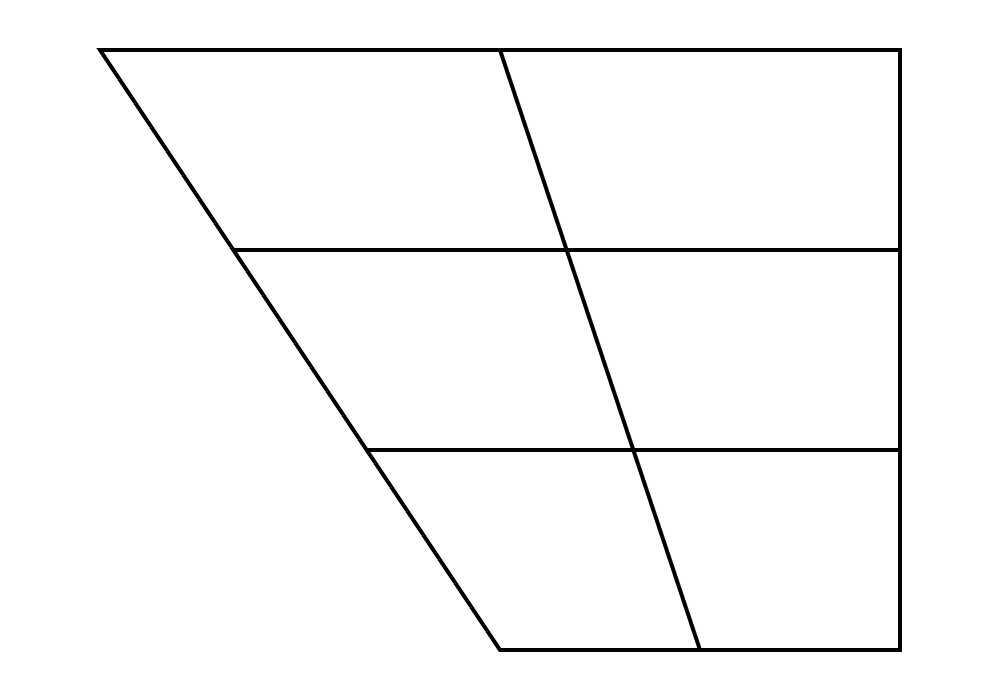
| |||||
| Near-close | ||||||
| Close-mid | ||||||
| Mid | ||||||
| Open-mid | ||||||
| Near-open | ||||||
| Open | ||||||
Vowel length in Minhast is distinctive. Devoiced vowels occur as allophones frequently, based on regular phonotactic rules:
| Short | Long | Devoiced |
|---|---|---|
| /a/ | /a:/ <ā> | [ạ] |
| /ɛ/ | /e:/ <ē> | [ẹ] |
| /ɪ/ | -- | [ị] |
| /i/ | /i:/ <ī> | -- |
| /u/ | /u:/ <ū> | [ụ] |
Stress/Accent
Stress in Minhast is syllable-timed; it is not a pitch-accent language.
Assuming a word contains at least three syllables, accent can be reliably predicted to fall on one of the last three syllables. With only a few exceptions, stress always falls on the last heavy syllable, defined as a (C)VVC or (C)VCC syllable. Otherwise, the accent falls on the antepenult. The same is true for two-syllable words: the last heavy syllable receives primary stress, otherwise stress falls on the first syllable.
One noticeable exception to this rule: the endoynm "Minhast", pronounced /'min.hast/, not the expected /min.'hast/. However, when clitics attach to the noun, stress becomes regular.
Syllabic Structure and Phonemic Interactions
Minhast words are subject to complex morphophonemic changes resulting from interactions with other morphemes occurring in the word. The verb is particularly complex in the various sound changes that may occur as a result of noun incorporation as well as the aggluginative processes involved in conjugation or other inflectional processes. These phonemic changes can be broken down according to the following classifications:
- Assimilation
- Metathesis
- Syncope
- Epenthesis
- Voicing/Devoicing
- Aspiration
These complex morphophonemic interactions operate according to the general phonological principals outlined below:
- No syllable can have a consonant cluster of more than two consonants. Syncope can be applied only if a biconsonantal cluster is formed, and the vowel is not a part of a heavy syllable (i.e. the vowel is long, or it occurs in a VCC sequence).
- No Minhast word can have an initial consonant cluster. After any initial consonant cluster results from one or more of the possible morphophonemic alternations described below, an epenthetic is automatically appended to the head of the word to form the permissible iCC- pattern.
- An epenthetic vowel is always inserted between two syllables if combining the syllables results in a triconsonantal cluster. The default epenthetic vowel is -i-, but the other 3 vowels may also be used, depending on multiple factors (e.g. vowel harmony, an underlying quiescent initial vowel as part of the attached morpheme, etc.)
- Minhast has a strong tendency to form intermedial clusters, providing that Rules #1-#3 are observed. If necessary, an epenthetic vowel may be added before or after the syllable to create these syllabic patterns, e.g. ušuntahu "You hit it." vs. ušnu "He hit it." (from the verb root ušn- "to hit").
- The tendency to form intermedial consonant clusters creates complex assimilation interactions that nevertheless are predictable and almost always regular. These interactions are illustrated in the following table:
Minhast Phonotactics Table
Initial
ConsonantFinal Consonant f p b k x g t d s š z l r m n h w y f ff pp pp fk fx fk ft ft fs ff fs fl fr fm fn ff fw fy p pp pp pp pk xp pk pt pt ps ħp ps pl pr pm pn ħp pw py b pp pp bb pk xp mg pt mb ps ħp ps bl br mb mb ħp bw by k kf kp kp kk kk kk kt kt ks kš ks kl kr km kn ħk kw ky x xf xp xp kk xx gg xt xt ss šš ss xl xr xm xn xx xw xy g kf kp gb kk kk gg kt gd ks ħk zg lg gr gm gn ħk gw gy t ft pt pt kt xt kt tt tt st št st tt rt mt nt ħt wt šš d ft pt bb kt xt gd tt dd st ħt zd ld rd mb nd ħt dw dy s sp sp sp sk šš sk st st ss šš ss sl
ssss sm sn ħs sw šš š šf šp šp šk šš šk št št ss šš ss šl
šššš šm šn ħš šw šš z sp sp zb sk ss zg st zd ss šš zz zl
zzzz zm zn ħs zw zy l lf pp lb kk xl lg tt ld sl
ssšl
ššzl
zzll rr lm
mmnn ħl lw yy r rf rp rb rk rx rg rt rd
ddrs
ssrš
ššzz ll rr rm
mmnn rħ
ħrrw ry m mf mp mb nk xn mg mt md ns šm nz lm
mlmr mm nn mh ww my n mf mp mb nk xn mg
ngnt nd sn
ss
(ns)šn
šš
(nš)nz ll rr mm nn nh nw ny
yyh ff ħp ħp ħk xx ħk ħt ħt ħs ħš ħs ħl ħr ħm ħn ħħ ħw ħħ
- Vowels are classified according to a "weak-strong" gradient, where the "strong" vowels are more resistant to syncope than neighboring "weak(er)" vowels. All long vowels are by definition "strong", so the weak-strong gradient really applies to short vowels (see table "Vowel Gradients").
- The shape of a -CVCVC- syllable may contract either to a -CCVC- or -CVCC- pattern, depending on the strength gradients of the vowels with respect to one another. The -CaCaC- syllable pattern is the only one that does not contract. Syllables consisting of the same vowels may appear in either -CCVC- or -CVCC- patterns; the pattern they resolve to is influenced by interactions from surrounding syllables. These contractions are summarized in the following table:
Vowel Gradients Initial Pattern Final Contraction -CaCaC- (no change) -CaCuC- -CaCeC-
-CaCiC-
-CaCC- -CuCaC- -CeCaC-
-CiCaC-
-CCaC- -CuCuC- -CuCeC-
-CuCiC-
-CuCC- -CuCuC- CeCuC-
-CiCuC-
-CCuC- -CeCeC- -CeCiC-
-CeCC- -CeCeC- -CiCeC-
-CCeC- -CiCiC- -CCiC- -CiCC-
- A verb root or an incorporated noun tends to lose one or more vowels to form at least one biconsonant cluster. The vowel that is lost depends on its strength gradient in relation to the noun of the neighboring syllable.
- With the exception of pattern -CaCa-, when two adjoining syllables have vowels within the same gradient, vocalic syncope resolves to CVCC.
- The pattern (C)VVCC always resolves to (C)VCC
- Compared to nominal and verbal roots, inflectional morphemes (e.g. theme, aspect, tense, person, etc) are resistant to syncope because this may lead to the inflectional morpheme to be changed beyond recognition. For example,-šp-irak- he informed (him) (lit. "he caused him to know") does not resolve to -šip-rak-, even though this would prevent the impermissible CCV pattern from occurring. Instead, an epenthetic vowel is added before the causative affix to prevent this impermissible consonant cluster from occurring.
- Although inflectional morphemes do not experience syncope, they still may experience phonological changes in the form of metathesis and devoicing.
- Vowel devoicing occurs in C'VħC, C'VxC', C'VsC', or C'VC' syllables, where C' is any of the unvoiced consonants listed in Table X.
- The initial consonant in syllables with devoiced vowels are strongly aspirated.
- Liquids and nasals devoice in the word-final syllabic patterns CVC'l, CVC'r, CVC'm, and CVC'n, where C' is any of the unvoiced consonants listed in Table X.
- Two consecutive syllables with the pattern CVħCVħ resolves to CVCCVħ, due to the difficulty of pronouncing the allophone in two consecutive closed syllables. Additionally, the vowel in the previous syllable may be devoiced if its adjacent consonants are voiceless, as in Example A, where the verb root vowel -a- which occurs the voiceless consonants -k- and -h- devoices to -ạ-. Note also the epenthetic vowel -i- appearing between the verb root and the 1st person incl. pl. affix ,-ħk- e.g.: nattiħkemkaraban >> *naħtiħkemaraban >> *naħt-hkem-ar-ab-an "We were (being) annoying" (lit.: annoying-we.and.you-[past]-[ imperf.]-[intrans]) nekạħtikemaraban >> *nekạħtịħkemaraban >> *nekạħt-ħkem-ar-ab-an "I was avoiding..."
- Dissimilation occurs in CVC-patterns involving š-Vš, resolving to s-Vš. A prime example is the number "twenty", e.g.*šan-šentāz >> *san-šentāz > > saššentāz
- Dissimilation occurs in CVC-patterns involving mVm, resolving to nVm.
Orthography
Minhast has three official writing systems, the indigenous Širkattarnaft script that predominates the country today; and the Hanzi and Hangeul scripts, which historically served for international trade and commerce, still continues that function today. A Latin-derived script, the Ammerkast system, is restricted primarily to Western audiences, particularly in academia. Recently, it has seen increasing use in popular media exported to countries using the Latin script. Other scripts, such as the Arabic and Cyrillic systems, are used only in niche areas.
Historically, the first script to be used was the Chinese Hanzi writing system, imported into the country by traders from the Ming Empire and the Kingdom of Koguryeo. The writing system was not used to transcribe the Minhast language; correspondence by Minhast writers was in conducted in Mandarin instead, as the Minhast had trouble adapting Hanzi to represent their highly polysynthetic language.
The first Austronesian traders, mainly from the Philippine kingdoms of the Rajahnate of Kirmai and the Sultunate of Daligan, brought with them their Brahmic derived script, the Baybayin. This script, an abugida, was better suited in transcribing the Minhast language, and it was adapted and modified by the Minhast to what would later become today's Širkattarnaft.
Hangul arrived considerably late after its creation by the Korean monarch King Sejong of the Joseon dynasty. It was introduced into Minhay in the early 17th century to the Gull Speakers. The Gull Speakers had been using a modified, cursive form of the Širkattarnaft for a few centuries, but it started to be used in the Gull Speaker city and principal trade center, Kissamut. Just as in the case of the Baybayin, the Hangul characters were modified by the Gull Speakers to include sounds not found in the Korean language. As the Gull Speakers wrote the Sirkattarnaft in a cursive style, the Hangul characters were likewise modified to a cursive style unique to the Gull Speakers. This script, called the Gurrēsespir (lit. "the hand of Koguryeo"), exists alongside the Širkattarnaft and enjoys great popularity in the Gull Speaker prefectures, given the Korean influence on Gull Speaker society.
Although Minhay had entered the modern era relatively late in the 1980's, the Širkattarnaft has been attributed to the high literacy rate of the people that has existed since the mid-1700's, today approaching 95% in most estimates. The retention of Hanzi and the Gull Speaker variant of Hangul is a byproduct of the era's geopolitics: the Minhast, led by both the Gull Speakers and the Salmon Speakers, wished to retain and strengthen their ties to the Sino-sphere as a counterweight to Western colonialists who had repeatedly attacked Minhay in attempt to conquer the region. Official correspondence to the Western nations, even after they ceased hostilities and expressed their desire to normalize relations with Minhay, the Minhast maintained a hostile attitude and would correspond with Western nations using only the Hanzi and Hangul scripts, sent via intermediaries from the Sino-sphere or their Austronesian trade partners.
Native Script - the Širkattarnaft
The Širkattarnaft is the official script of Minhay, used in governmental and legal documents. It is also the principal script used in media and personal correspondence throughout all the Prefectures. The following graphic shows the present-day standardized Baybayin from which the modern Širkattarnaft was derived.:
The Baybayin

Shortly after the adoption of the Baybayin, the Salmon Speakers introduced several modifications. Some of the modifications arose due to the constraints the materials for writing: wood is an abundant resource in Salmon Speaker Country, and knives and metal blades were the principal instruments available for incising the scripts onto this medium. Thus, the curved lines of the Baybayin characters were either unsuitable or inefficient in writing; the material the Salmon Speakers had favored straight and angular lines, and so they created a straight-incision style. Additionally, the Salmon Speakers added new characters to represent sounds not represented in the original orthography, such as /r/. The script was reorganized such that consonants with the same points of articulation, e.g. all labial consonants, voiced, unvoiced, stops, and fricatives, would be represented by a single character with extensions to represent the different phonemes. Another innovation the Salmon Speakers added was to retain some characters from the older ideographic-logographic script, partly due to their usefulness as a type of shorthand, or due to some conservative/traditionalist influences. These changes eventually led to what has become today's script, know as the Širkattarnaft, which literally means "that which is scratched across a surface". This script is shown in the following graphic:
The Širkattarnaft

The relationship between the glottal stop in the Baybayin and that of the Širkattarnaft is recognizable. The Širkattarnaft glyph for <d> is actually an inverted form of the Baybayin glyph for <t>. Similarly, the Širkattarnaft glyph for <z> is descended from the Baybayin glyph <s>. Other discernable similarities can be found with the glyphs <l> and <m>. Some phonemes not found in the Tagalog or Ilocano languages were innovated, but these innovations came from a method of deriving additional glyphs from a base glyph from which certain classes of phonemes could be derived.
The Širkattarnaft was modified from the original Baybayin to map a base glyph and its variants to certain related phonemes (e.g. the base glyph <b> and its variants to the labial consonants). For example, the glyphs for the labials <p> and <f> are based on the glyph <b>. Additions of dashes to the base glyph distinguish voiced, unvoiced, and fricatives. This explains why there is less variability in the Širkattarnaft script. The glyphs for the dentals /d/ and /t/ in the Baybayin are represented by two separate glyphs that have no resemblance to each other; in contrast the glyphs in the Širkattarnaft for these same phonemes differ from each other only by the addition of a dash to the base glyph <d> to derive the glyph <t> . As can be seen from the chart, the voiced consonant is assigned the base glyph, and dashes are added to this base glyph for unvoiced and fricatives for a given phonemic class (labials, dentals, aleveolars, etc).
Each glyph of the Širkattarnaft has a default underlying vowel /a/; all other vowels must be marked explicitly attached to the vowel signs (indicated in the lower right-hand corner; the box is simply a representation of where the base glyph would be located). Long vowels are represented by a vertical dash through the diamonds representing the short vowels <u> and <e>, and a horizontal one between the diamonds of the vowel <i>.
The Širkattarnaft, unlike the Baybayin, is written vertically, from right to left.
Some ideographic-logographic elements from an even older script were imported into the Širkattarnaft and include determinatives used to indicate case or even verbal tense. Glyphs for common words, such as conjunctions, connectives, existential particles, and negators were also preserved. Some of these glyphs are combinations of two glyphs, as in the glyph for hambin ("there is no X"), which is a combination of the negator hatāʔ and matti ("there is an X"). The characters for the case clitics =(a)ran (Dative), =ni (Benefactive), =yar (Ablative), =par (Instrumental), etc. can actually appear before a verb written in the Širkattarnaft, in which case these characters represent the Applicative affixes -dut-, -rak-, -raħk-, -ngar-, respectively.
To see the evolution of the Baybayin to the Širkattarnaft, the following graphic illustrates how the Širkattarnaft characters map to the corresponding Baybayin characters from which they were derived:
Mapping of Širkattarnaft to Baybayin Characters

Hanzi and Hangul Scripts
The Hangul and Hanzi scripts predominate in official correspondence with Minhay's historic allies and trade partners, the Kingdom of Goguryeo and the Ming Empire. Both are also used with other East Asian countries that use them.
The Gull Speakers are the principal group that use these East Asian scripts, as they achieved dominance in international commerce amongst all the other Minhast groups. Mandarin and Korean, and to a lesser extent, Japanese, are both widely taught in Gull Speaker schools as a second language, especially in the Gull Speaker prefectural capital Kissamut. The Salmon Speakers are the second group that use the Hanzi and Hangul systems most often; the scripts are used almost exclusively with their Ainu neighbours, who use the Japanese kana script, which is virtually unknown to the Minhast; the disastrous Tokugawa Wars, which led to the defeat, occupation, and annexation of over 90% of Honshu and significant swaths of Kyushu by the Goguryeo-Ainu alliance, cut off Minhay from Japan. The isolation of Japan by Goguryeo's effective blockade prevented the importation of the Japanese scripts into Minhay.
Ammerkast Script
A variation of the Latin script, called "Ammerkast", is used in for consumption by Western countries and non-Western countries that use a Latin-based writing system. It is derived from the Americanist system, an alternative phonetic system to the IPA, which dominates much Afro-Asiatic and Native North American linguistics. It remains predominant in linguistic publications. It is also found in foreign trade documents and correspondence with Western and Westernized countries. A recent development is its growing use in popular media exported to Western/Westernized countries.
While the Ammerkast system is an adaptation of the Americanist phonetic notation, one innovation is the grapheme <ħ>, which was adopted from IPA. Note the glottal stop <'> is usually not written unless there is a hiatus between two adjacent vowels.
| Ammerkast Characters |
|---|
| a, ā, e, ē, i, ī, u, ū, ('), b,p,f, d, t, g, k,x n, m, l,r, z, s, š,h, ħ, w,y |
Nouns
Gender, Number, and Case Marking
1) Gender: All nouns have an intrinsic gender; the majority are concordant with natural gender, but a significant percentage are discordant. Interestingly, some nouns may have multiple genders, each gender conveying different meanings; these should be considered separate lexical entities. However, nouns do not take affixes, clitics, or other morphemes to mark gender. Instead, cross-reference affixes in the verb identify the gender of the nouns that serve as core arguments of a clause; in contrast, oblique argument, however, do not receive any marking. Thus, gender of each noun must be memorized in order to choose the correct verbal affix, or to identify the gender of a noun serving as an oblique argument.
2) Number: Nouns do not inflect for number. Verbal cross-reference affixes (see section below on verbal Pronominal Affixes) can mark number on Ergative and Absolutive noun phrases, but do not provide any information about number for non-core NPs. Speakers must rely on context or use numbers in a min construction using the formula [number + min + NP], e.g. šānī min redad (lit. “two man”) to mark plurality; otherwise the default number is singular.
3) Case: Although nouns are not overtly marked for gender or number by inflection or clitics, they do take case marking clitics that attach to the end of the noun or noun phrase. There are two core nominal arguments: the Absolutive which receives zero marking, and the Ergative clitic =de. The Genitive derives from the same =de clitic as the Ergative, and in most declension tables are thus listed as the Ergative-Genitive case.
The Oblique cases are clitics indicating position or direction, or under certain circumstances, a syntactic patient derived from a valence operation. Most of these clitics have corresponding verbal applicative affixes. As they are clitics, morphophonemic alternations occur less frequently with their head NP.
The Vocative case can be divided into two subclasses, the Familiar or Intimate Vocative, and several formal vocative forms that double as honorifics. The Familiar/Intimate Vocative is an actual suffix, grammaticalized from the etymologically related vocative particle ayyak, which still exists, ironically, as a formal vocative. The Oblique cases are clitics indicating position or direction, or under certain circumstances, the semantic or derived direct object. Most of these clitics have corresponding verbal applicative affixes.
Ergative and Genitive
The Ergative case is marked with the clitic =de. The Genitive derives from the same clitic as the Ergative, and in most declension tables are thus listed as the Ergative-Genitive case. However, there are several allomorphs where the Ergative and the Genitive diverge in form, as illustrated in the following table:
| Resulting Form | ||||
|---|---|---|---|---|
| Preceding Phoneme(s) | Ergative | Genitive | Genitive + Ergative | |
| (V)V, g, z | =de | =de | =de | |
| l,r, n | =de | =t | =te | |
| f, p,k, x, s, š,h | =te | =t | =te | |
| m | =be | =t | =te | |
| b | =mbe | =pt | =pte | |
| d | =e | =te =tide |
=te =tide | |
| t | =te =tide |
=te | =te =tide | |
| C1C2 | =e =ide |
=e | =e | |
| nk ng |
=ide | =ide | =ide | |
| CC | =e =ide |
=ide | =e =ide | |
Vocative
The Vocative case, as earlier mentioned, is divided between an intimate form, and several honorific forms. The Intimate Vocative suffix is chiefly reserved to family and close friends in more traditional societies. In more urban societies, chiefly among the City Speakers, adults may use it among colleagues and coworkers. Children and teens typically employ it with same-aged or younger peers.
The Intimate Vocative has several allomorphs:
| Intimate Vocative | |
|---|---|
| -C | -Ce |
| -CC | -CCe, -CCē -CCiye |
| -a | -aye |
| -ā | -ayye |
| -e | -i, -∅ |
| -i, -ī | -iyye |
| -u, -ū | -uyye |
| -ay | -ayye |
| -ey | -eyye |
| -uy | -uyye |
The Honorific vocatives forms originated from the age-based social hierarchy in traditional societies, but in Minhay's urban areas, particularly in the capital Aškuan and the military city Yikkam min Akk, they have been re-appropriated; for example, forms originally used for older individuals are now used to de-escalate conflict between an employee and their employer, an individual interacting with law enforcement, etc. The honorific used depends on social and situational context.
The honorifics most often used are behet, used to address elders, innāt(u) (for males) and šūri (for females), both of which are used by older people to address young adults outside their social groups. These may be joined to their head nouns in a min construction, e.g. Innātu min Kawwat/Innātum Kawwat (no exact English equivalent, often translated as "Kawwat, my fine young man..."), or as clitics, =behet and =(i)nnāt(u). The clitic =behet often does not trigger morphophonemic alternations, e.g. Uryatbehet "Madame Uryat" (as opposed to expected Uryaptehet).
The honorific innātu is used exclusively by speakers of Upper Minhast, although this form is often used alongside the innāt form by speakers of the Lower Minhast dialects too. In Modern Standard Minhast, both forms are used, and the form used is based on personal preference.
The use of kazlam "friend" as an honorific among same-aged peers has arisen in the urban centers, a usage not found in the Prefectures. It is used even among strangers as a form of social courtesy.
Addressing someone by their tribal affiliation, e.g Gāl min Kirmast "Horse Speaker", Duyyi min Kirmast "Salmon Speaker", is common in the Prefectures. When used in the urban centers, especially among same-aged peers, it is used as a means of creating a polite form of social distance, or alternatively, a term of affection among friends from different tribal groups.
Oblique Cases
Marked Oblique
Position and directional information are marked on the NP by various clitics. A few clitics are used to mark an argument that has been demoted by antipassivation, or by displacement by applicative formation. Some forms are dialectal or rare, such as the Inessive =kīr/=kir. The Oblique clitics have two forms, one form with a short medial vowel, and the other with a long medial vowel. Use of both forms are acceptable, but native speakers tend to use the clitics with short vowels when the clitic is preceded by a long vowel, while the converse is true for the clitics forms with long vowels. Highly uncommon postpositions, such as the aforementioned Inessive =kīr/=kir are indicated in the following table with a double asterisk (**).
| Case | Postposition |
|---|---|
| Dative-Allative | =āran =(a)ran |
| Benefactive | =nī =ni |
| Ablative | =yār =yar |
| Locative | =kī =ki |
| Inessive ** | =kīr =kir |
| Instrumental | =pār =par |
| Comitative | =kān =kan |
| Malefactive | =daħ =dāħš =dāš |
| Vocative (Intimate) | =iyye =ē |
Unmarked Oblique
The Unmarked Oblique is in form indistinguishable from the Absolutive. However, it is identifiable in that is is always the noun phrase that lacks an agreement marker in the verb. Unmarked oblique nouns, when they appear, are usually patients of low transitivity verbs, or unindividuated patients of mid-transitivity verbs, e.g. Yak eškat pes-ek-araban "I was harvesting mushroooms". For perceptive verbs, their presence may differentiate non-volitional, unintentional, or accidental occurrences from deliberate, intentive ones, e.g. Yak kaslub šullum-ek-aran "I heard a dog", vs. Yakte kaslub šullum-ek-aru "I listened to the dog".
Unmarked obliques are often considered adjuncts, non-essential information provided only too provide more information, so it is not surprising that they are converted to antitopics via postposed wa=binding, e.g. Yakte šullum-ek-aran, wakkaslub.
Tense-Aspect Marking
Interestingly, nouns can receive the same TA marking of verbs. Minhast lacks a copula; instead, two separate NPs are simply juxtaposed, e.g. Ruggāyam kaslubekte ("Ruggāyam is my dog"). However, if the statement refers to a past or future event, simple juxtaposition cannot convey tense information. Therefore, the NP may be marked with any TA marker, in lieu of a copular verb, as in Ruggāyam kaslubekt-ar ("Ruggāyam was my dog"). The TA marker could just have easily been added to the first NP as opposed to the second, Ruggāyam-ar kaslubekt; or even both NPs could be marked, Ruggāyam-ar kaslubekt-ar.
Noun Stem Types
Nouns are divided into three types based on the syllabic pattern of the final syllable of the noun. The Type I nouns (also known as “Strong Stem” nouns) are those whose Absolutive forms end in a single consonant, or a short vowel. Additions of a short-vowel clitic do not change the noun stem's final vowel.
Type II nouns are divided into three subtypes, with Absolutive forms ending with the glides -ea, -ia, or -ua. Type II nouns undergo a morphophonemic process whereby the final -a of the noun stem is dropped and the preceding vowel is automatically lengthened when either a short or a long-vowel case clitic is attached to the noun stem. Additionally, during noun incorporation the entire glide is elided. Examples are as follows for marua, yarea, and simmia, meaning “the 'star' Venus”, “young girl”, and “moonless night”, respectively.
Type III nouns all terminate with either a consonant cluster or gemminate consonnants. If the following clitic that attaches to it has a quiescent vowel, such as the Dative clitic =(a)ran, the quiescent vowel resurfaces to prevent an impermissible CCC pattern, or the epenthetic vowels -i- or -e- is inserted. An additional feature is that these nouns will select the long-vowel forms of case clitics if they do exist.
These nouns are contrasted against the Type I noun gāl (“horse”).
| Absolutive | Pre-clitic Form | Incorporated Form | Examples | Meaning | |
|---|---|---|---|---|---|
| Type I | gāl | gal- |
-gal- |
galde, galyār | horse |
| Type II | marua | marū- |
-mar- |
marūde, marūpar | the "star" Venus |
| yarea | yarē- |
-yar- |
yarēde, yarēran | young girl | |
| simmia | simmī- |
-simm- |
simmīde, simmīkan | moonless night | |
| Type III | tipr | tipr-, tipri-, tipir- |
-tipr-, -tipir- |
tipirde, tipirkī | flesh |
| niss | niss-,nisse- |
-niss- |
nisside, nissekī | branch covered by snow |
Augmentive Nouns
Minhast has a productive system of nominal augmentation, based on CVC-reduplication of the first syllable, with the insertion of the infix -ra-, or -r- if folowed by /a/, into the second syllable resulting from the reduplication. The following example illustrates the basic process of forming the augmentive of kaslub (dog):
- kaskaraslub
/'kas'karaslub/
kas~ka~ra~slub
dog.CVC~CV~AUG~dog.C~dog
large dog; Asian mastiff
Augmentation is notoriously irregular; many patterns include applying the basic augmentation pattern with the addition of other augmentation-related suffixes. The most common suffixes are -an-, -dan-, and -am-. Other patterns include replacing the -CVC- with gemination of the medial consonant followed by the -ra-/-r-. The derivation of the augmentative from the word kunnay (sheath) illustrates this irregular pattern:
- kunnaray
/'kunnaray/
kun~n~a-r-ay
sheath~C~a-AUG-sheath
scabbard
A very rare form of augmentation, found in words with at least three syllables, is C-reduplication of the last consonant of the second syllable, followed by the remaining syllables of the word. The -r(a)- affix is absent in this type of augmentation pattern. This augmentation pattern is often, though not always, associated with deriving collective nouns. The augmentation of the Salmon Speaker dialectal word minagamāt (orca), derives a collective noun:
- minagaggamāt
/mina'gag:gamāt/
minaga~g~gamāt
orca~C~orca
orca school, pod
This pattern is not restricted to the Salmon Speaker dialect. This pattern is occasionally also found in the Horse Speaker dialectal word nakkarumāt (blood-thornbush) to derive a new word:
- nakkarurrumāt
/nak.ka'rur:uma:t/
nakkaru~r~rumāt
blood.thornbush~C~blood.thornbush
entanglement, dangerous intrigue
Diminutive Nouns
Interrogative Pronouns
| English | Minhast |
|---|---|
| Who | šikk, darad |
| What | bak |
| Which | ādan; ādan min, adānim |
| When | sippan, sippamey |
| Why | bakran, širekka |
| How | bakpār |
| Where at | nakkī |
| Where to, whither | nakran |
| Where from, whence | nakyar |
| At which location | nakkīdān |
| From which location | nakkīdanyār |
| To which location | nakkīdarrān |
| How many/how much | yuški, bitakku |
Quantifiers
| Quantifier | Substantive | Attributive |
|---|---|---|
| All | rea | rem
suppī min |
| Most | šie | šim |
| Some | rem | azarim
ikyem |
| Many | addua san (Lower Minhast) |
addum sam (Lower Minhast) |
| Both | šani | šanim |
| Each | uššumī | uššumīm |
| Few | kattua | kattum |
| Another/Other | xani
nexāni |
xanim
nexāni min |
Pronominal Forms
| Person - Number - Gender | Independant Forms | Bound Forms | ||
|---|---|---|---|---|
| Ergative | Absolutive | Oblique | Attributive | |
| 1st Sg. | yakte | yak | yak- | -ek |
| 2nd Sg. | tahte | taħ | tah- taħ- |
-taħ |
| 3rd Masculine - Common Sg. | kūde | kua | kū- | -na |
| 3rd Feminine Sg. | iššide išše |
išši | iššē- iššey- |
-šši -išši |
| 3rd Neuter Animate Sg. | šemet | šea | šē- šey- |
-šea |
| 3rd Neuter Inanimate Sg. | mēde | mea | mē- mey- |
-mea |
| Plural | ||||
| 1st Plural Inclusive | hakemt(e) | hak | hak- | -(h)akkem |
| 1st Pl Exclusive | nemt(e) | nem | nem- | -nem |
| 2nd Pl. | taħtemt(e) tahemt(e) |
taħtem tahem |
taħtem- tahem- taħm- |
-taħtem -tahem -taħm |
| 3rd Masc./Common Pl | kemt(e) | kem | kem- | -kem |
| 3rd Neut. Anim. Pl. | sešt(e) | seš | sešš(i)- | -sseš |
| 3rd Neut. Inanim Pl. | maħt(e) | maħ | mah- maħ- |
-maħ |
The attributive forms are derived from the Absolutive and are suffixed to NPs, functioning similar to copulas in other languages, as in the example below:
- Minhastek.
/'minhastɛk/
minhast-ek
minhast.person-1S.ABS
I am Minhast.
Tense, and sometime aspect markers may precede the attributive suffix:
- Annuakarabek.
/an:uwa'karabɛk/
annuak-ar-ab-ek
warrior-PST-IMPF-1S.ABS
I used to be a warrior/I was once a warrior.
Demonstrative Pronouns
Minhast demonstrative pronouns make a four-way distinction. As attributives, they precede their heads, joined by the connective min to the NP they modify. They may also be cliticized to their heads. The cliticized forms tend to be used in the Lower Minhast and City Speaker dialects, particularly in informal speech.
| Independent | Attributive | Clitic [2][3] | Comments | |||
|---|---|---|---|---|---|---|
| Absolutive | Ergative | Absolutive | Ergative | |||
| Proximal | sap | sapte | sapim, sap min | =sap =sā, =sa |
=sapte, =sapt | this one, near the speaker |
| Medio-proximal | nax | naxte | naxtim | =nax | =naxte, =naxt | this/that one near the listener |
| Distal | waššī suxta |
wašt(e) suxt(e) |
waššim suxtam |
=waš =suxta |
=wašt(e) =suxt(e) |
far from both speaker and listener |
| Invisible | suxta kiryit |
suxt(e) kirte |
suxtam kiryit min |
=suxta =kirit |
=suxt(e) =kiryit |
n/a |
The personal deictic pronouns are portmanteaus of the interjective demonstrative particles, e.g. eyha (here is), plus the verbal pronominal absolutive affixes, with the exception of the second singular and third masculine singular forms, which appear to be from the clitic stative forms. Other forms are portmanteaus of the deictic adverbs tāra (there next to you), and kāmu/aššak (over there, away from us) cliticized by a pronominal clitic. An Invisible form does not occur.
| Person | Proximal | Medio-Proximal | Distal | |
|---|---|---|---|---|
| 1st Sg. | eyhak | -- | -- | |
| 2nd Sg. | ettaħ | tartaħ | kamtaħ/aššaktaħ | |
| 3rd Masculine - Common Sg. | ennu | tārannu | kannu/aššaknu | |
| 3rd Feminine Sg. | eyhašši | tārašši | kāmul/assakkišši | |
| 3rd Neuter Animate Sg. | eyhaš | tāraš | kāmuš/assakš | |
| 3rd Neuter Inanimate Sg. | eyham | tāram | kāmum/aššakam | |
| Plural | ||||
| 1st Plural Inclusive | eħħak | --- | --- | |
| 1st Pl Exclusive | eyham | --- | --- | |
| 2nd Pl. | ettam | tartam | kamtam/aššaktam | |
| 3rd Common Pl. | eyhakm | tārakm | kāmukm/aššakukm | |
| 3rd Neut. Anim. Pl. | eyhi | tāri | kāmi/aššaki | |
| 3rd Neut. Inanim Pl. | emmaħ | tammaħ | kammaħ/aššakmaħ | |
Numbers
Cardinals and Ordinals
Cardinal and ordinal numbers are one of the [two/XX] groups of true adjectives in the Minhast language. Minhast employs a vigesimal, i.e. base-20, counting system. Numeric expressions involve binding the number and modified noun in a specific construct involving the ligature: Both cardinal and ordinal numbers can take possessive pronominal suffixes (see Part III "Syntax - Possession" for discussion of possessive constructs), which then convey "X number of..." in the case of cardinal numbers, and "the Xth one of/among..." for ordinals, e.g.:
Meneħnemš nasxēreħ inkunnuħnemaran "Four of us went out there into the forest."
Menhakkem nasxēreħ inkunnuħkēmaran "The fourth one among them went into the forest."
Numbers even have intransitive verbal forms, meaning "There were X number of us/you/them." The cardinal, ordinal, and verbal forms are summarized below:
| Number | Cardinal | Ordinal | Verbal |
|---|---|---|---|
| one | šūmi | sanannūx, manx | -šūmi-an |
| two | šānī | šānāx | -šān-an- |
| three | duxt | duxtāx | -duxut-an, -duxt-an |
| four | meneħ | menhāx | -mene-an, -menh-an |
| five | kaħtam | kaħtamāx | -katam-an |
| six | silix | silxāx | -silix-an, -silx-an |
| seven | gelix | gilxāx | -gelix-an, -gelx-an |
| eight | mun | munāx | -mun-an |
| nine | karun | karnāx | -karun-an, -karn-an |
| ten | tazem | tazmāx | -tazem-an, -tazm-an |
| eleven | šiktāz | šiktezāx | -šiktāz-an |
| twelve | sen | senāx | -sen-an |
| thirteen | halk | halkāx | -halk-an |
| fourteen | duggalk | duggalxāx | -duggalk-an |
| fifteen | āš | āšāx | ---- |
| sixteen | neš | nešāx | ---- |
| seventeen | manšat | manšatāx | ---- |
| eighteen | zenat | zenatāx | ---- |
| nineteen | zelkark | zelkarkāx | ---- |
| twenty | šentāz | šentezāx | šentāz-an |
| twenty-one | šentāz-u-šum | šentāz-u-manāx | šentāz-ammā šum-an |
| twenty-two | šentāz-u-šan | šentāz-u-šanāx | ---- |
| twenty-three | šentāz-u-duxt | šentāz-u-duxtāx | ---- |
| thirty | šentāz-u-tazem | šentāz-u-tazmāx | ---- |
| forty | saššentāz | saššentezāx | ---- |
| fifty | saššentāz-u-tazem | saššentāz-u-tazmāx | ---- |
| sixty | duššentāz | duššentezāx | ---- |
| seventy | duššentāz-u-tazem | duššentezāx-u-tazmāx | ---- |
| eighty | meneštazem | meneštazmāx | ---- |
| ninety | meneštazem-u-tazem | meneštazmāx-u-tazmāx | ---- |
| one hundred | gādi | gādyāx | ---- |
| one thousand | gaggādi | gaggadyāx | ---- |
Fractions
As in the Classical language, Modern Standard Minhast expresses fractions using the formula, X min yešpa=yar Y ikšimakman, where X represents the denominator and Y represents the numerator, a common pattern in dependent-marking languages such as Basque and Japanese. Examples include Šentaz min yešpayār duxt ikšimakman for 3/20 (lit. From twenty portions, three have come). Mathematical operations becomes tricky with fractions; adding 3/20 + 2/20 = 5/20 results in Šentaz min yešpayār duxt ikšimakman, šentaz min yešpayār šāni ikšimakman, wahēk, matti šentaz min yešpayār meneħ ikšimakman, or "From twenty portions, three have stepped forward, from twenty portions, two have stepped forward; now behold, there are from twenty portions that five have stepped forward."
However, in practice the formula for forming fractions and conducting mathematical operations has been simplified. One encounters instead truncated formulas such as Šentazešpār duxtakman for 3/20, or Šentazešpār duxtakmammā, šentazešpār šānikman; šentazešpār menekmandūr for 3/20 + 2/20 = 5/20. The latter example, in addition to demonstrating truncation, shows how clause-like constructions involving the Subordinative =mā and Resultative -dūr have replaced what was originally a large noun phrase complex. The min=construction with yešpa and the Ablative clitic =yār was itself truncated and re-analyzed as the derivational suffix -ešpār for fractions. This is a Gull Speaker innovation that has been attested as early as the 1600's, and has spread throughout the Lower Minhast dialects. It has also spread into some Upper Minhast dialectal areas, principally in Išpa, Warat, and Uħpar Prefectures in Dog Speaker Country. This innovation has also been adopted into the City Speaker dialect since it coalesced into a distinct dialect in the 1950's, via Bayburim, a Gull Speaker settlement that was incorporated into Aškuan before being returned to the Gull Speakers in 2016. However, the rest of the Upper Minhast dialects preserve the Classical format.
In both the Classical and Gull Speaker systems, the third person common plural agreement marker -km- is always used in the numerator component, regardless of the gender, number, or animacy of the NP. Kaħtamešpār duxtakman min turšatta (turšatta = corpse, 3.INAN.SG), the agreement marker disagrees with the gender, animacy, and number of its head, nevertheless is required to be well-formed.
Additionally, a secondary set of fractional numbers, albeit limited, exists and is divided into two categories, an attributive and a verbal:
| Attributive | Verbal | |
|---|---|---|
| half | kāmak | kāmakian |
| third | haddeħ | haddeħħan |
| quarter | mū | mūan |
| tenth | erritt | irtan |
Note the upper bound is "tenth" (erritt), not "twentieth", the expected form given Minhast's vegisemal system; instead, this set demonstrates a decimal pattern. The secondary fractions bear no resemblance to their primary counterparts, having originated from different roots. Additionally, the verbal forms display some irregularity, as in kāmakian vs the expected kāmakan, haddeħħan instead of the expected haddehan, and irtan instead of the expected errittan.
Verbs
Minhast verbs display a complex structure, demonstrated in particular by its elaborate polysynthetic morphology. The Minhast verb inflects not only for tense and aspect, but can inflect to indicate mood, modality, causation, potentiality, intensity, and other functions. The verb also possesses a well-developed set of pronominal affixes used to cross-reference the core arguments of a clause. These pronominal affixes indicate both gender and number of the nouns they cross-reference, an essential function as nouns themselves do not carry any case or number marking.
Additionally, the verb can alter the argument structure of a clause through noun incorporation, antipassivation, and applicative formation. These strategies are used by speakers for discourse purposes such as backgrounding previously established information, maintaining cross-reference of subjects across multiple clauses, and to employ various rhetorical effects, among others. The verb's polysynthetic feature can lead to very long verbs that can express an entire sentence, such as the following example illustrates:
- Kemaran yattah, tayentišnišpimbastannasumtittaharu.
Kem=aran yattah ta-yent-šn-šp-b-mat-sar-nasum-tittah-ar-u
3P.OBL=DAT evidence NEG-DEFFERED-CON-CAUS-RESUMP-INSTR.APPL-look.at-matter-3S.INANIM.ABS+2S.NOM-PST-TRANS
You have not tried to get them to reconsider the evidence.
The verb "tayentišnišpimbastannasumtittaharu" is an individual sentence in its own right. It encodes both subject and object, mood, tense and aspect, polarity, manner, and even case relations. Words that contain several morphemes to represent the majority if not all the arguments we would expect in a whole, felicitous sentence are said to be holophrastic, a technical term for the more informal expression, "sentence-word".
Transitivity is determined by the number of core arguments, that is Agent or Patient/Goal. Minhast verbs do not necessarily map to traditional (i.e. Indo-European) notions of transitivity. As an example, the English sentence, "He jumped on the table" is grammatically intransitive. Available to the Minhast verb are both intransitive and transitive mappings: "Zekyaškī nirriekaran" , which is grammatically intransitive, with zekyaš=kī an oblique argument. The same meaning can be expressed transitively when the verb's valence is altered when the locative applicative affix (i)-n(i)- is applied: Zekyaš in-nirrieku.
Verb Types
Minhast verbs can perform functions that are usually associated with other grammatical categories in other languages. For example, Minhast does not have a separate grammatical category for adjectives. Instead, verbs are used in place of adjectives. Verbs are divided into five broad categories:
- Interrogative
- Impersonal
- Attributive
- Stative
- Event
Interrogative Verbs
Interrogative verbs are an unusual feature of the Minhast verbal system, and are rare cross-linguistically but may be found in other languages such as Takic, a North American language from the Uto-Aztecan family. In many languages, certain interrogative words co-occur with certain verbs with high frequency. Using English as an example, the verbs in the questions "What happened?", "Where are you going?", "Why did you do it?" illustrate that certain verbs, when they take a WH-word as an argument, have a statistically higher probability of picking one or two WH-words above others. In Minhast, the Interrogative Verbs serve as a shortcut, precluding the need for constructing a whole interrogative sentence with at least two constituents, the WH-word and the verb it is serving as an argument to.
Interrogative verbs can either be zero-valent (i.e. an Impersonal Verb), as in "Innearaš?" >> *inea-ar-an=š [what.happened-PAST-INTRANS=IRREAL] ("What happened?"), univalent, e.g. "Nassuriattaharaš?" >> *nassuriat-tah-ar-an=š [what.did.do-2S.ABS-PAST=IRREAL] ("What did you do?"), or even divalent, i.e. transitive, e.g. "Išpinassuriattaharuš?" >> *šp-nassuriat-tah-u=š [CAUS-what.did.do-2S.ERG+3MS.ABS-TRANS=IRREAL] ("What did you make him do?).
Interrogative Verbs can be inflected for tense, aspect, person-number (for univalent verbs), and in some cases, theme, as illustrated in the last example. Moreover, the Irrealis marker -š is obligatory.
Where person-number marking is allowed, both second and third person singular/plural marking predominate; first person marking is infrequent. Many of these verbs appear to have a default tense, usually in the past but sometimes in the future, even though the verb has no explicit tense marking, e.g. maymaštahaš seems to have a default past tense even though the past tense affix -ar- does not appear; however if the past tense affix appears, the verb remains well-formed. Present tense meaning, if intended, is usually recoverable from context or discourse.
The following table contains the most frequently used Interrogative Verbs:
| Verb | Meaning | Valency | Gloss | Notes |
|---|---|---|---|---|
| tippakaš | “How did it happen?” | zero | tippak-an=š [happen.how-INTRANS-IRREAL] |
|
| kurraktahaš | "How many do you want?" | univalent | kurrak-tah-an=š [how.many.want-2S.ABS-INTRANS-IRREAL] |
|
| yuškiduytahaš | "How many of these fish do you want?" | univalent | yuški-dūy-tah-an=š [how.many.want-fish-2S.ABS-INTRANS-IRREAL] |
This verb requires an incorporated noun. |
| nassuriattahaš | "What did you do?" | univalent | nansuriat-tah-an=š [what.do-2S.ABS-INTRANS-IRREAL] |
|
| inneaš | "What happened?" | zero | innea-ar-an=š [what.happen-INTRANS-IRREAL] |
|
| aššanaktaš | "How much is it?" | zero | aššanakt-an=š [what.cost-INTRANS-IRREAL] |
|
| ruhāyaš | "Are you sure?" | zero | ruhāy-an=š [be.sure-INTRANS-IRREAL] |
|
| paxtamaš | "When did it happen?" | zero | paxtam-ar-an=š [when.do-INTRANS-IRREAL] |
|
| iskumattahaš | "When will you come?" | univalent | iskumat-tah-an=š [when.come-2S.ABS-INTRANS-IRREAL] |
|
| naktatintahaš | "Where are you going?" | univalent | naktatin-tah-an=š [where.are-2S.ABS-INTRANS-IRREAL] |
|
| annatimaraš | "Where did this happen?/Where was this done? Where did he do this?" |
univalent | annatim-ar-an=š [where.happen-PAST-INTRANS-IRREAL] |
|
| maymaštahaš | "Who did this?" | zero | maymaštah-an=š [who.do-INTRANS-IRREAL] |
|
| puħtakyaš | "Where is he?" | univalent | puħta-ki-an=š [sit-location-INTRANS-IRREAL] |
|
| ašiknuaš | "What are you doing/What is s/he doing?" | zero | ašiknu-an=š [what.do-INTRANS-IRREAL] |
|
| kuyyureaš | "Why is this a bad thing to say/think?" | zero | kuyyure-an=š [why.bad.thought.-INTRANS-IRREAL] |
|
| tumbehētaš? | "How long will you be there/How long will you be doing that?" | univalent | tumbehē-tah-an=š [how.long.be.there-2S.ABS-INTRANS-IRREAL] |
|
| uzurtahaš? | "What do you think?" | univalent | uzur-tah-an=š [what.think-2S.ABS-INTRANS-IRREAL] |
Phenomenological Verbs
Verb Template
The Minhast verb is divided into three major segments: the Preverb, the Verb Core, and the Terminatives. Each of these segments are divided into smaller sections or "slots", as they are termed in Minhastic linguistic literature.
| Preverb | ||||||||
|---|---|---|---|---|---|---|---|---|
| Scalar Operators | Locationals I | Mood-Aspect-Manner | Control | Applicatives | ||||
| Verb Core | ||||||||
| Root | Incorporated Noun | Prepronominals | Pronominals | Tense-Aspect | Participials | Transitivity | ||
| Terminatives | ||||||||
| Evidentials | Miratives | Locationals II | Emphatic Imperative | Subordinators | Irrealis | Nominalizer | ||
Preverb 1 Scalar Operator Affixes
The positions of these affixes in relation to each other is fixed, and are mutually exclusive, with the exception of the negation affixes. The negator ta- can be attached to all of the scalar operators with the exception of the Cautionary and Negative Cautionary affixes. The affixes in the Preverb 1 slot have wide scope at the clausal level. The forms tara-, tarra-, tabbina- are the Absolute Negation prefixes; tabbina- is quite rare and found only in some Classical Minhast texts, probably derived from hatā' hambin.
| Affix | Meaning | |
|---|---|---|
| Negation | ta- ta'- t- tara-, tarra-, tabbina- |
no, not never, never again; not at all |
| Immediacy | ussa- | now, immediately |
| Contradictory | -ps- | however, on the contrary |
| Delimited | -reħt- | until |
| Deferred | -yent- | still, yet, have yet to |
| Exclusive | -wašk- | only |
| Rhetorical | -kist- -ks- |
just, simply |
| Absolute | -sull- | anyway |
| Additive | -nuħħ- | also, even |
| Cautionary | -kur- | otherwise, lest |
| Negative Cautionary | kurħāti- | otherwise...not, lest...not |
Preverb 2 Locational Affixes
This slot contains deictic markers indicating where an event took place in relation to the speech participants. Some affixes can be traced to the independent deictic particles, e.g. -ssaha- < sappu "here", -yašša- < wašia "yon". This slot is not found in the Gull, Salmonic and Horse Speaker dialects, nor in Classical Minhast. Instead, they occur after the verb root, in the Terminatives slot. It is unclear whether the locational affixes in those dialects are older than the ones in Modern Standard Minhast and the other dialects. On the one hand, some of the Preverb 2 affixes have no obvious relationship with their independent particle counterparts, e.g. -xitta- "there" vs. naš, which would suggest the Preverb 2 variants are older, whereas their counterparts in the Terminatives slot are etymologically transparently related to the extant independent particle variants. However, it is generally agreed the Terminatives slot is older, as its affixes follow a strict templatic order, whereas the affixes in the other slots between the scalar operators (Slot 1) and applicative affixes (Slot 5) are scope ordered and their affixes apparently derived through earlier noun incorporation, verb serialization, and other accretive processes.
| Affix | Meaning | |
|---|---|---|
| Proximal, Static | -ssaha- -ssaħ- |
here, near or adjacent to speaker |
| Medio-Distal | -xitta- | nearer to listener than speaker |
| Distal | -yašša- | far from both speaker and listener |
| Invisible | -kit(t)- | beyond sight of both speaker and listener |
Preverb 3 Mood-Aspect-Manner Affixes
This slot contain numerous affixes that serve myriad functions, not just conveying mood and aspect, but also encoding manner and other adverbial semantic information. The table below lists the most common affixes, but there are close to four hundred other affixes not listed here that may occur in this slot, such as the affix -xp- (to enjoy), -ruxt- (to like), -kašk- (do well, c.f. kaškakan to do something skillfully, perform skillfully), -yunn- (to fall short, fail, c.f. yurunan to reach out to something out of reach) etc.
Unlike other verb slots, where the affixes are strictly ordered in relation to each other, the affixes in the Preverb 3 slot exhibit free order, or to be more precise, they are scope-ordered. Within this slot, a given affix exhibits scope over the element immediately to its right. With few exceptions, several affixes may occur simultaneously, limited only by whether the combination "makes sense", i.e. the resulting semantic meaning is felicitous.
The positional variability within this slot traces back to an earlier stage in the language when these affixes were originally independent words in either a preposed-wa construction, or verb-verb apposition structure. These older analytic structures were eventually reanalyzed and gramatticalized, ultimately fusing both phonetically and morphologically into the verb complex.
| Type | Affix | Meaning | Additional Notes |
|---|---|---|---|
| Expective | -naš- | supposed to expect to to wait for |
|
| Potentive | -nitt(a)- | might, possibly | |
| Necessitive | -(y)yat- | to be necessary | |
| Desiderative I (SS) | -šak- | to desire, wish (same Subject) | Used when the Controllee is the same as the Controller, e.g. Šakiknatūmanekāš "I want to go home." |
| Desiderative II (DS) | -sašp- -sassi- |
to desire, wish (different Subject) | This affix differs from the Desiderative I affix in the following ways:
The Desiderative II affix evolved from the fusion of the Desiderative I affix with the Causative during the Late Classical Minhast period or shortly after, when the Desiderative and the Causative were regularly combined to express different-subject "to want" structures; c.f. Classical Minhast Šakišpikallutekarunuš "I wanted to cause him to eat" for "I want him to eat". |
| Aversive | -nisp- -niss- -nis- |
to avoid; to dislike, hate | If the Aversive co-occurs with the Desiderative I affix, the Desiderative always precedes it, with the meaning "to wish to avoid" |
| Conative | -šn- | try | |
| Abilitative | -mar- | can, to be able to | |
| Abilitative-Cognitive | -kmiz- | know how to be/become; know how to do | Denotes knowledge of attaining a state or carrying out and action |
| Preparative | -kar(a)- | to get ready to | |
| Incipient | -ntar- | almost, about to | Denotes an action that was or is nearly to be carried out. Requires the Irrealis. |
| Causative | -šp- | to cause, bring about | When used with the Privative, become the Negative Causative |
| Permittive (Indirect Causative) | -mušk- | to allow | |
| Reversative-Privative | -mašn- | to undo or prevent | Reverses or prevents a state or action. |
| Inchoative | -saxt- -sax- |
to become | The Inchoative is primarily used to denote changes of state with stative verbs, e.g. saxpayyarkurran "He became black from the ashes", from the root -kūr- "to be black".
The form -sax- is used when followed by a stop, e.g. saxtaharran "He became green" (from tahāl- "be green"), or /h,ħ/, e.g. Saxušuran "He became blue" (from hušur- "be blue") . Voiced stops become devoiced. In some dialects this form is used whenever followed by any consonant. The Inchoative is also used to derive the middle voice from transitive verbs, e.g. Yahamb saxaradaran "The fish pot broke", c.f. Yahamb harattarru "He broke the fish pot." |
| Simulative | -šupn- -šu- (+CC) |
to resemble | When used with semantically active verbs, it conveys performing an action in the manner indicated, e.g. Šukkirmektahuš ("Speak as I do"), Šupnikirimtahaš ("Speak like this) Šupnikirimtahampiš , ("Say it like this"). With stative verbs, it conveys being in like or similar to the state indicated, e.g. Ruppumakide uryataran šupnikūran/Ruppumakte uryataran šukkūran ("His face is as black as obsidian/He is incomprehensible/inscrutable").
Often found in combination with the verb root kifrak (to be the color of) + NI, meaning "to be x-colored", e.g. šupnikifrakteslakmahan/šukkifrakteslakmahan (to be algae-colored); also appears in complex verbs signifying "to play", "to pretend", etc. When used with common food items, it derives the idiom, "To taste like", e.g. Šuttirappian "It tastes like tilapia" (also meaning, "This is boring").
|
| Qualitatives | -rur- -rr- -kašk- |
well, good, skillfully, thoroughly | |
| -yay- | badly, clumsily | ||
| -xupm(a)- | little by little | ||
| Intensive | -nt(a)- | very, extremely | |
| Mitigative | -hipsa- -psa- -ps- |
a little, somewhat; about/around (with numeric roots) | Opposite and incompatible with the Intensive |
| Excessive | -(ha)pm(a)- -ntatta- |
very, extremely, too much |
|
| Habitual | -asum- -asm- -asun- |
habitually, usually, often; always (when combined with Imperfect) |
|
| Resumptive | -b- | again | |
| Inclinative | -pniš- | tending towards, to tend to | |
| Cessative | -kš- | to cease | Indicates the cessation of an action or state |
| Completive | -šmuxt-, -šmux- -šnux- |
to finish | Indicates completion |
| Inceptive | -nd- | to begin | |
| Continuative | -xt- | to continue | |
| Iterative | -xr- | to do several times in discrete units | This affix appears in verbs that are semantically semelfactive |
| Reactive | -knak- | to immediately do the same action | This affix occurs only with semantically non-stative verbs. For transitive verbs, it means "to do something back at someone else", in which case the Reciprocal Adversarial affix must co-occur. For intransitive, agentive verbs, it means "he/she/it did the same thing too". The immediacy of the action is highly salient. |
Preverb 4 Control Affixes
The Inverse Volitional affix interacts with the semantics of the verb root. If a verb root semantically implies the Agent has no control over an event, or the event is by happenstance and not by deliberate intent, the Inverse Volitional derives a verb that implies the Agent has control of an event or is actively seeking to determine its outcome. As an illustration, the verb root -sar- (to see) implies happenstance, where as the addition of the Inverse Volitional affix, yielding the form kaħsaran < -kah-sar- changes the meaning to "to look at" or even "to stare at". In contrast, the verb root -misk- (to be ill) semantically implies lack of control. Adding the Inverse Volitional Affix plus the Reflexive-Benefactive -sakšar- to yield the form kaħmisiksakšaran < -kah-misk-sakšar changes the meaning to "to deliberately infect oneself in order to play hooky".
The Preverb 4 affixes are restricted to this position in the verb template. Other than the Verb Core, the only affixes that can follow this slot are the Applicative affixes, located in the Preverb 5 slot. Additionally, the Preverb 4 affixes usually do not occur together; when they do, the resulting verb implies a sense of sloppiness on the part of the Agent.
| Control Type | Affix |
|---|---|
| Inverse Volitional | -kah- |
| Partial Control | -šk(e)- |
Preverb 5 Applicative Affixes
The Preverb 5 slot contains exclusively the Applicative Affixes. These affixes are used to change the argument structure of a clause by increasing its valency, or by changing an oblique NP to core status as an Absolutive argument. The process of using an Applicative affix is often called "Applicative Formation", although other linguists prefer to use the term "Applicative Voice". This article will use the term "Applicative Formation" to emphasize that the argument structure of the clause is being changed by use of the Applicative affix. The Applicatives are used to promote an oblique argument to the Absolutive.
All of the Preverb 5 affixes are mutually exclusive. Moreover, they are tightly bound to the next segment of the verb complex, namely the Verb Core; no affixes may intervene between the Applicative affixes and the Verb Core. Because of this strong connection to the Verb Core, it has been argued that the Applicatives be reclassified under the Verb Core segment.
Although the Applicative Affixes encode spatial or directional information like the Oblique case clitics, they do not resemble them in form. The location and tight binding of these affixes belie their origins as the remnants of incorporated nouns from Proto-Nahenic; supporting evidence of this comes from the existence of independent cognate nouns in Nankôre, such as rahko "gift", macihi "hand", and nahko "room, enclosure", which is also cognate with the Minhast locative interrogative nakkī "where".
| Case Role | Affix | Example |
|---|---|---|
| Dative | -dut- -utt- |
|
| Benefactive | -rak- |
|
| Instrumental | -mat- | |
| Locative | -n-
-naħk- | |
| Commitative | -ngar- -ggar- | |
| Ablative | -raħk- -rak-† | |
| Malefactive | -nusk- |
†These forms are used when the following syllable starts when followed by another syllable starting with /k/
Verb Core
The verb core is diachronically the oldest part of the verb complex, containing six sub-slots. They contain the bare minimum affixes required to form a structurally complete verb (sub-slots #1, 4, 5, 6), and two additional ones sandwiched in between the obligatory affixes (sub-slots #2, 3):
- Verb Root
- Incorporated Noun
- Prepronominal Affixes
- Pronominal Affixes
- Tense-Aspect Affixes
- Transitivity Affixes
Verb Root
This is the morpheme that gives the entire verb complex its basic semantic meaning. The majority of verb roots are at most one or two syllables. Larger verb roots usually descend from compounds that became lexicalized and later phonologically eroded.
Incorporated Noun
Like many polysynthetic languages, such as Ainu and the Iroquioan languages, Minhast employs noun incorporation (NI) extensively to carry out various processes: derivation, case modification and valence operations, and discourse manipulation. The motivating factors for NI is a complex topic which is dealt separately in Noun Incorporation.
Noun incorporation is the process whereby a noun lexeme is absorbed into the verb complex. The noun is stripped of any inflectional markers and is then inserted immediately after the verb root [5]. The noun is essentially treated as a verbal affix and plays an important morphological role. The incorporated noun is subject to complex morphophonemic sandhi, as described earlier in the Phonology section; moreover, most nouns have a reduced incorporating form, as in the case of -rupmak-/-rumpak- << ruppamak (face). These reduced forms are highly irregular and must be memorized.
Not all nouns can be incorporated. Proper nouns and many kinship terms, e.g. anxea (brother) cannot be incorporated. Similarly, toponyms and demonyms cannot be incorporated. Only one lexical noun root can be incorporated at a time. Nouns functioning in most case roles can be incorporated, but such incorporation interacts with the semantics of the verb, e.g. Locatives are restricted to locomotive and positional verbs, while Datives are restricted to donor verbs. The incorporation of Instrumentals and Datives usually do not affect valency, as the Patient argument slot of the clause remains open. However, as in most incorporating languages, Agents cannot be incorporated.
Prepronominal Affixes
| Class | Affix | Additional Notes |
|---|---|---|
| Reflexive | -šar- -saššar- |
-saššar- is restricted to 3MS.PRF.REMOTE.PST (from: -šar-∅-šerr-) |
| Reflexive-Benefactive | -sakšar- | |
| Reciprocal | -šattar- -šatta- -šatt- |
|
| Reciprocal-Benefactive | -sakšatt- | |
| Reciprocal-Adversarial | -dus(s)art -dust- |
|
| Associative | -mmak- | |
| Associative-Benefactive | -sammak- | |
| Distributive | -tar- | The Distributive refers to an action or state across each Patient, and is usually translated as "each". The Distributive may also in some verbs indicate that the verbal event is spread out spatially across a surface, The Distributive has sometimes been analyzed as indicating pluractionality, but this interpretation presents problematic theoretical issues. |
| Partitive | -nesr- -ness- |
Conveys that only a portion of the argument(s) is involved in the verbal event or state, sometimes translated as "some". The Partitive does not refer to the Ergative argument of transitive clauses; for that, the appropriate Quantifier adjective/noun is used. |
The Reflexives, Reciprocals, and Associatives for the most part require plural agent marking and the Intransitive marker -an, but under certain circumstances, the verb may take a transitive structure with both agent and patient marking. For example, the Reciprocal Adversarial is required if the Reactive affix co-occurs to mean "do something back at someone". Transitivity raising via Applicatives may also trigger agent plus patient marking, with the possibility of either or both arguments being singular, as in the following example:
- Iyyamtarkarišpintasaxtinuskihuslapallustakšarekarundurkilwāš!
/ij:amtarkariʃpintasaxtinuskihuslapal:ustakʃarekarundurkil'wa:ʃ/
iyyat-mar-kar-išp-inta-saxt-nusk-huslap-allut-sakšar-ek-ar-un-dūr-kilwāš
NEC-ABIL-PREP-CAUSE-INTENS-INCHO-MAL.APPL-be.sharp-weapon-REFL.BEN-3S.ABS+1S.ERG-PST-TRANS-RSLT-MIRATIVE
Therefore it is necessary for me to ready myself thoroughly against him and make these weapons sharp, I say!
Pronominal Affixes
The pronominal affixes present one of the greatest challenges to the students of the Minhast language due to their inherent complexity in structure and morphosyntax. These affixes are agreement markers for the core arguments, i.e. the Ergative and Absolutive arguments. In addition to marking the syntactic roles of the core arguments, gender, animacy, and number are also encoded by the pronominal affixes. These affixes, along with the role affixes, also serve to identify the verb as transitive or intransitive, and thus must agree with the appropriate Transitive affix (see below). For the transitive verb, the pronominal affixes present greater complexities than those of the intransitive verb - the transitive affixes, representing both the ergative and absolutive arguments of the clause, are portmanteau affixes; although some patterns can be discerned from this fusion of the segments representing the ergative and absolutive components, the transitive pronominal affixes are mostly irregular and have to be memorized individually. As expected, the affixes may change shape due to the sound changes created by adjacent morphemes. However, many of these sound changes deviate from the normal assimilation patterns described earlier in Phonology.
Animacy marking is differentiated for the neuter genders only, as the masculine and feminine genders are inherently animate and thus require no special marking. Both the masculine and the feminine 3rd person plurals have merged into one common gender, while the gender for animate and inanimate neuter nouns are still distinguished. Remnants of a split ergativity can be found in the third person neuter animate singular, where the submorphememe of the portmenteau affix for the patient is derived from an earlier *-tir- Accusative form, as opposed to the expected form -mah-.
Due to the complexity of the transitive pronominal affixes, their full forms are summarized in the next table:
| Agent (Singular) |
Patient (Singular) | |||||
|---|---|---|---|---|---|---|
| 1st | 2nd | 3rd Masc. | 3rd Fem. | 3rd Neut. Anim. | 3rd Neut. Inanim. | |
| 1st | ---- | -tak- | -(e)k- | -kk- [6] | -k- | -tirk- |
| 2nd | -(e)ktah- | ---- | -tah- | -ššittah- | -tah- | -tittah- |
| 3rd Masc. | -(e)knen- | -nten- -ntan- |
-nn-, -Ø- | -ššenn- | -enn- | -tir-,-tirenn- |
| 3rd Fem. | -kišš- | -tašš- | -šš- | -ssišš- | -šš- | -tišš- -tašš- |
| 3rd Neut. Anim. | -(e)k- | -t- -tay- |
-Ø- | -Ø- | -s- | -t- |
| 3rd Neut. Inanim. | -(e)km- | -tam- | -m- | -mm- [7] | -m- | -timm- -tamm- |
| Agent (Plural) |
Patient (Singular) | |||||
| 1st Incl. | ---- | ---- | -(h)ak- | -ššak- | -(h)aknem- | -tirħak- |
| 1st Excl. | ---- | -ntem- -ntam- |
-nn- | -ššennem- | -ennem- | -tinnem- |
| 2nd Common | -aktahm- | ---- | -mt- | -ššettem- | -ettem- | -tittem- |
| 3rd Common | -ekken- | -takken- -takkan- |
-nk- | -ššekken- | -seššen- | -tikken- |
| 3rd Neut. Anim. | -aksen- | -tasn- | -sn- | -ššess- | -sess- | -tiss- |
| 3rd Neut. Inanim. | -akmah- | -tammah- | -mah- | -(a)mmah- | -mah- | -timmah- |
| Patient (Plural) | ||||||
|---|---|---|---|---|---|---|
| Agent (Singular) |
1st Incl. | 1st Excl. | 2nd | 3rd Common | 3rd Neut. Anim. |
3rd Neut. Inanim. |
| 1st | ---- | ---- | -mtek- | -kenk- | -sek- | -mak- |
| 2nd | -(h)ektah- | -nimtah- | ---- | -kemtah- | -sat- | -mattah- |
| 3rd Masc. | -(h)akn- | -nenn- | -tenn- | -kenn- | -sen- | -mann- |
| 3rd Fem. | -(h)ašš- | -nešš- | -tašš- | -kešš- | -sešš- | -mašš- |
| 3rd Neut. Anim. | -(h)ak- | -nem | -tahm- | -kem- | -sm- | -ma- |
| 3rd Neut. Inanim. | -(h)akm- | -nemm- | -tamm- | -kemm- | -semm- | -namm- |
| Agent (Plural) |
Patient (Plural) | |||||
| 1st Incl. | ---- | ---- | ---- | -kemhak- | -sak- | -makkak- |
| 1st Excl. | ---- | ---- | -tamme- | -kemmi- | -sn- | -manne- |
| 2nd Common | ---- | -nittam- | ---- | -kettamm- | -suttam- | -mattam- |
| 3rd Common | -(h)akkem- | -nikkem- | -takkem- | -ikkem- | -skem-,-skum- | -makkem- |
| 3rd Neut. Anim. | -(h)aks- | -niss- | -tass- | -kess | -suss- | -mass- |
| 3rd Neut. Inanim. | -(h)akmah- | -nemmah- | -tammah- | -kemmah- | -smah- | -nammah- |
In comparison to the transitive pronominal affixes, the affixes for the intransitive verb are much simpler. The forms of the Absolutive are listed below in the following table:
| Person | Absolutive |
|---|---|
| 1st Sg. | -k- |
| 2nd Sg. | -tah- -ta- -t- |
| 3rd Masculine - Common Sg. | -Ø- |
| 3rd Feminine Sg. | -šš- |
| 3rd Neuter Animate Sg. | -Ø- -s- |
| 3rd Neuter Inanimate Sg. | -m- |
| 1st Plural Inclusive | -hak- |
| 1st Pl Exclusive | -mm- |
| 2nd Pl. | -tam- |
| 3rd Common Pl. | -km- |
| 3rd Neut. Anim. Pl. | -i- |
| 3rd Neut. Inanim Pl. | -mah- -ma- |
Tense-Aspect (TA) Affixes
| Tense | Affix | Additional Notes |
|---|---|---|
| Remote Past | -šerr- | The Remote Past usually encompasses periods of decades or longer |
| Past | -ar- -r- |
The -r- allomorph often surfaces in rapid speech when the preceding syllable terminates in r, e.g. darran for expected dāraran "to recite an epic". |
| Hodiernal Past | -wax- | Past event/state that occurred no earlier than the day of the speech event. |
| Present | -Ø- | Also encompasses the immediate past, and may serve to express the gnomic aspect. |
| Future | -nes- -ness- -ness(V)- -ne- -sn(e)- |
The -nes-, -ness-, and -ness(V)- forms are preferred in Modern Standard Minhast, most Upper Minhast dialects, and the Gull Speaker dialect. These are the only forms found in Classical Minhast. -nes- is used when immediately followed by a consonant, -ness- when followed by a vowel, and -ness(V)- when followed by a consonant cluster; the epenthentic vowel in the -ness(V)- form usually echoes the vowel of the next syllable, e.g. kallutek-nessa-mpamāš iknatumanek-ness-aš "I will eat something and then return home."
The allomorph -sn(e)- is also found in Modern Standard Minhast, but is in practice rarely used. This allomorph is of Stone Speaker origin. |
| Distal Future | -(a)satt- |
| Aspect | Affix |
|---|---|
| Imperfect | -(a)b- |
| Perfect | -Ø- |
| Distributed-Periodic | -(a)x- |
| Iterative 2 | -(a)š-[8] |
| Partial Completion | -knakt- |
A few additional comments need to be made about the tense and aspect markers. The Present Tense in combination with the Imperfect Aspect is commonly used as the "narrative tense" in both traditional oral literature, and modern literature involving poetry and fiction where the author wishes to convey a sense of intimacy and immediacy in a narrative. The Present Imperfect is also used in ordinary speech to describe an action that began in the past but nevertheless is still continuing, illustrated in such sentences as the following:
- Tenkūr wandiraħħiššabu
tenkūr wa=ind-raħy-šš-ab-u
morning CONN=INCEP-cry-DISTR-3SF-IMPF-TRANS
She started crying earlier this morning and hasn't stopped since (lit. This morning she begins crying still)
Minhast does have a Continuative affix -xt-, but it occurs in the Preverb 1 slot. A different meaning would result if intervening affixes from the Preverb 1 slot surfaced. For example, the combination of the Iterative affix with the Continuative affix yields a different meaning:
- Tenkūr waxtixriraħħitaššabu.
tenkūr wa=xt-xr-raħy-tar-šš-ab-u
morning CONN=INCEP-ITER-cry-DISTR-3SF-IMPF-TRANS
She has been crying on and off since this morning and hasn't stopped (lit. This morning she begins to continue to cry on and off and is still crying)
This example implies the act of crying occurred in discrete individual events since the crying started, up until the present. The first example, however, cannot be interpreted in that manner. This example shows that Minhast speakers consider time frames as relative to each other, as opposed to typical Indo-European languages that consider time as having discrete start and end points.
The Distributed-Periodic aspect marker, often translated as "from time-to-time" or when used with discrete time references ("every Thursday") indicates that the action, event, or state occurs with some sort of periodicity. If the periodicity is predictable (e.g. "every Thursday"), it often co-occurs with the Habitual affix. The Distributed-Periodic does not indicate punctual or durative information, as they may occur ad-hoc in both telic and atelic verbs. Durative and punctual information is instead indicated by separate affixes, the Semelfective and the Durative; these affixes are derivational in nature and occur in a different slot in the verb template.
Participial
The Participial slot is a small segment of the verb template, consisting of only one affix, -x-. Past literature on the language variously placed them in the Tense-Aspect slot, whilst others placed in the Transitivity. Current practice is to place it in its own slot, as the affix can co-occur with the affixes of either slot yet does not semantically correspond to either. Its uses vary, sometimes forming an embedded clause of a causal sentence, e.g. Iknakaraxan išpisaxtikaraššaru "My departure saddened her/By departing, I saddened her", a temporal subordinator, e.g. Redaktān iknataharaxan išpiharsummektarundurkilmakš! "When you went with that man you shamed us all/In going out with that man you shamed us all!", and occasionally in Modern Standard Minhast but more often in Lower Minhast, it may convey concurrent actions, i.e. circumstantial clauses, e.g. Luktarabampi, išpisaxtikurgadešlekarbaxan "He was cooking while I concentrated on my studies" (lit. "He was cooking in the time I was causing myself to become strong in mind")[9]. It is often used in conjunction with the Habitual affix -asum- and nominalizer =naft to derive professions, as in asumišpinakkallutixnaft "chef, cook" (lit. "one who habitually causes others to eat for their benefit").
| Participial | |
|---|---|
| Affix | -x- |
The Participial also creates deverbals, which nominalizes a verb stem. This nominalization in turn may be incorporated into a matrix verb. Five requirements must be satisfied before the nominalization can be incorporated:
- All wa=-binding is stripped from the nominalization;
- Tense-Aspect markers are stripped from the verb complex;
- The affixes from the Transitivity and Terminals slots are stripped from the nominalization;
- The pronominal affixes are stripped and the nominalization inherits its polypersonal referencing from its matrix verb;
- A linker morpheme -n- in the matrix verb precedes the embedded nominalization;
- The nominalization is inserted into the NI slot of the verb template.
The following text illustrates the incorporation of a nominalization with the Participial:
- Izzesparaktirekt tankuryār išpisaxnuwassuknišpisaxxalamiħyišattixxiššaru.
izzesparak-tirek=de tankūr=yār šp-saxt-nuwassuk-n-[šp-saxt-kalam-iħy-šatt]-x-rti-ar-u
canoe.ABS-3NS.INAN.ACC+1S.NOM=GEN eels=ABL CAUS-INCH-contain-LNK-[CAUS-INCH-be.high-in.air-RFLX-PTCP]-3S.INAN.PT+3S.INDEF.AGT-PST-TRNS
My hovercraft is full of eels, lit. "My canoe, my flying one, someone filled it with eels."
Deverbals formed by the Participial can incorporate nouns, and serve as modifiers to the head of an NP. Thus, a truly complex nominal can be created, as in the following example:
- išpisaxxalamiħyišattimaxxim izzesparaktirekte
šp-saxt-kalam-iħy-šatt-mah-x=min izzesparak-tirek=de
CAUS-INCH-be.high-in.air-RFLX-3NS.INAN.NOM-PTCP=CONN canoe-3S.INAN.ACC+1S.NOM=ERG
my hovercraft (lit. my canoe, the one that makes itself high)
Notice that the pronominal -mah- resurfaces, which is allowed since this complex is not incorporated.
Interestingly, it appears that noun incorporation can occur recursively in these deverbals formed by the Participial, such as in the next example, the result of a speech game between two speakers:
- Nireppa nišwakanaft kalluntirruspanniyaxpaxinnipsaspeksespiriškissartahabuš.
Nireppa nišwak-∅-an=naft kallut-n-[[n-ruspar-niyaxpa-x]-n-[n-psa-subek-sespir-šk-x]]-x-sar-tah-ab-u=š
little.bear.ABS be.white-3MS.NOM-INTR=NMLZ eat-LNK-[[LNK-play-in.fountain.grass-PTCP]-LNK-[LNK-[MIT-hold-in.hand-PARTIAL.CTRL]-PTCP]-PTCP-look-3MS.ACC+2S.NOM-IMPF-TRNS=IRR
Watch the white cub eating playing in the grass with the stick he's barely holding onto.
As a deverbal, they can also form compounds:
- išpisaxturasmiħyišattimaššumbat
šp-saxt-urasm-iħy-šatt-mah-x-šumbat
INCH-be.high-with.star-RFLX-3NS.INAN.NOM-PTCP-arrow
the starship
Transitivity Affixes
These affixes serve to mark the verb's transitivity. There are two verbalizers[10], a Detransitivizer and a Transitivizer, and the Antipassive.
The Detransitivizer combines with other affixes, such as the Reflexive, Reciprocal, and the Antipassive. The Detransitivizer occurs oftentimes when NI has taken place, provided that the totality of the verb's valence operations did not promote a former Absolutive argument to Ergative case, which may happen if the Applicative affixes and/or the Causative surface, as in Redadde kaslub dutittaħšitipraru ("The man gave the dog some meat", lit: The man the dog he-meat-gave-towards).
| Class | Affix | Notes |
|---|---|---|
| Detransitivizer | -an- -ēn- -en + C -ean -ā -ē |
The -ēn- and -en + C forms are non-pausal forms for when the preceding vowel is -e- or -ē-. Otherwise, the combination -ean occurs if the verb is sentence-final and no other affix follows. The pausal forms -ā and -ē are seen only in the poetry of Classical Minhast and the Upper Minhast Fox Speaker dialect. |
| Transitivizer | -u- -ū- -un- |
The archaic form -un- is often seen in Salmon Speaker and Wolf Speaker speech, and frequently in Horse Speaker poetry. Moreover, the nominalizer clitic =naft triggers the -un- allomorph in all Upper Minhast dialects. When the -un- variant surfaces among MSM speakers, it occurs chiefly during nominalization among people originally hailing from the northern prefectures. The allomorph -ū- occurs when the verb root ends with an -i-, e.g. išpikaggi- (to hang on a wall or pole). The allomorph originally occurred only when there were no intervening affixes, i.e. the final vowel of the verb root immediately preceded -ū-, but now it occurs even if other affixes intervene between the root's final vowel and the transitivizer, e.g. išpinikaggi-sikyalar-ū, "He hangs up a painting/photo for him". |
| Antipassive | -pi- -pa- =pā, =pamā |
Since the Antipassive always results in a monovalent argument structure, it always occurs with the Detransitivizer affix -an-. The -pa- allomorph occurs when followed by the Nominalizer =naft, whereas the =pā/=pamā allomorphs are a portmanteau of the Antipassive and the coordinative clitic =mā. |
Terminative Affixes
These affixes occupy the final position of the verb complex, consisting of six slots. They perform a variety of functions such as marking evidentiality, conveying attitude, marking hypotheticals, and clause embedding and subordination.
Some languages with evidential verbal affixes require their appearance, but in Minhast the evidential affixes are optional. Moreover, they have corresponding particles that may appear in their place. If the evidential affixes appear at the end of the verb complex, the Irrealis marker -š- cannot appear with the any of the Hearsay or Inferential evidentials, simply because the -š- has already fused with the base morpheme. The Visual evidentials, if accompanied by -š-, convey the meaning, "It appears to be..."; without it, they convey the meaning, "I know this because you (and I) have witnessed this." If the Scriptive appears with -š-, it either indicates that the speaker does not believe what was written, or that what was written turned out to be incorrect; thus it becomes a sort of counterfactual marker. The counterfactual meaning can be reinforced if the Scriptive is followed by the Unexpected marker -kil- + -š-, e.g. Ušnaruškattekiš << *ušn-ar-u-škatte-kil-š (hit-PST-TRANS-SCRIP-UNEXP-IRREAL) "It was reported (in the newspaper) that he hit him...(but) instead...," or "Had he hit him, as was reported in the newspaper..."
| Function | Affix | Notes | |
|---|---|---|---|
| Evidentials | Factive | -∅- -ne- -št(a)- -štanne- |
Referred to as the Gnomic, Aorist, and Neutral in other comparative linguistics material, the term Factive is used due to the influence of Iroquoian linguistic literature, since early treatises of Minhast were conducted by experts in the Iroquoian languages, who noticed structural and typological similarities between the two otherwise different language groups. |
| Semblative | -sašš(a)- | Means "It seems..." or "I think..." | |
| Visual - Exclusive | -(u)kku- | ||
| Visual - Inclusive | -ha- -hāra- |
||
| Auditory | -pt- | ||
| Hearsay | -āhiš- | ||
| Hearsay - Dubitative | -harašša- | ||
| Inferential | -wašša- | ||
| Scriptive | -škatte- | ||
| Miratives | Unexpected | -kil- -kila- |
Indicates the verb is a sudden, unexpected event or state. The second form occurs in verb-final position. |
| Unexpected Negative Exclamatory |
-kilmakš- -kilmāš- |
Indicates the verb is a sudden, unexpected event or state, with strong negative connotations or disapproval. | |
| Unexpected Positive Exclamatory |
-kilwāš- | Indicates the verb is a sudden, unexpected event or state, with strong positive connotations or surprised delight | |
| Declarative/Intentive Absolute | -rawāš- -rawaš- -warāš- -waraš- -rwaš- |
Indicates the speaker is determined that the state or event shall be fulfilled; if accompanied by a negator, it conveys the meaning "never". The "-warāš-/-waraš-" forms occur when preceded by the Transitivizer -u; in the Upper Minhast dialects, excluding the Seal and Elk Speaker dialects, the underlying n-form of the Transitivizer surfaces, e.g. Ušneknesunwaraš ("I will definitely hit him!") | |
| Deictics and Locationals | |||
| Proximal | -sāhā -asāhā -ssāhā |
These forms are found only in the Salmonic and Horse Speaker dialects, and Classical Minhast. These lects do not have the deictic affixes found in the Preverb 2 slot, although the meanings and usage are virtually identical. They are listed here because of Classical Minhast's prestige status. To complicate matters further, the Gull Speaker dialect has its deictic verbal affixes in this slot too, but their forms are different. Interestingly, the Gull Speaker affixes are cognate with Nankôre deictic particles, whereas cognates with other Minhast dialects have thus far been wanting. | |
| Medio-Proximal | -naššāhā -CC-aššā | ||
| Distal | -waššāhā | ||
| Invisible | -hurtāhā | ||
| Cislocative | -sušma- | May also convey a ventive sense, e.g. "inward, inside" | |
| Translocative | -tarħa- | May also convey an andative sense, e.g. "outward, outside" | |
| Emphatic Imperative | -ška | The Emphatic Imperative is usually used in cases of urgency, such as emergencies. Outside that, it is considered course or otherwise rude. Combining it with the Declarative/Intentive Absolute -rawaš- makes it egregiously so, e.g.: Yekayektahurwaška! "Lick me!" (obsc.) | |
| Subordinative | General | -mā -pā- -pamā- -pāš- -pamāš- |
English translation: "then, and then, that". This suffix is the most commonly encountered Subordinative affix. Its primary use is to link Sequential clauses. It also interacts with other verbal affixes in clause combining operations to form conditionals, complements, and other clause types. The allomorph -pā/pamā is a fusion of the Antipassive affix -pi + -mā. The allomorph -pāš/-pamāš is a fusion of the Antipassive affix -pi + -mā + Irrealis -š. However, if any of the Evidentials, Miratives, Deictics, or Imperatives appear, the portmanteau cannot be used, as the Antipassive marker must appear immediately before the Intransitive suffix. |
| Purposive | -nimmā -pannamā- -pannamāš- |
English translation: "in order to". The Irrealis -š may cliticize to this affix under certain conditions, such as for non-past tenses, hypothetical statements, counterfactuals, and any other situation where the verb marked by =nimmā was not realized. The allomorph -pannamā is a portmanteau of the Antipassive with the Purposive, -pi + -nimmā. Similarly, the form -pannamāš- is a fusion of the Antipassive, Purposive, and Irrealis markers, -pi + -mā + -nimmā- + -š. However, if any of the Evidentials, Miratives, Deictics, or Imperatives appear, the portmanteau cannot be used. Instead, the Antipassive marker must appear immediately before the Intransitive suffix, whilst the Irrealis marker appears in verb-final position, unless the nominalizer -naft appears, in which case the Irrealis is placed before the nominalizer. | |
| Quotative | -namā | Marks the following clause as direct speech, usually translated as "saying", or "thus, he said". This affix allows for the breaking of the S/O pivot. | |
| Consequential | -dur- -dūr- |
Indicates the clause is a direct result of the preceding clause. May or may not be preceded by a -mā clause. If the Irrealis -š is attached, the affix's final consonant elides to the Irrealis, yielding the form -duš/dūš. | |
| Irrealis | -š- | This affix marks the VP as an unrealized and/or hypothetical state or event. It is used in interrogatives, hortatives, and imperatives. Additionally, this affix, combined with the Consequential affix and certain sentential particles to form hypothetical and conterfactual clauses. This affix tends to elide any consonant before it; when it does, the vowel is lengthened, although this is usually not reflected in the orthography.
| |
| Nominalizer | =naft =aft |
The =naft form is used when preceded by a vowel, otherwise either =aft is used. | |
Derivation
With the morphological complexity of the Minhast verb, capable of encoding various grammatical categories like gender, number, transitivity, tense, aspect, valence, mood, and many other functions, it is striking that derivational morphology is sparse when compared to other languages. Nevertheless, Minhast does have derivational mechanisms that vary between productive processes, as well as the remnants of older processes that have now become fossilized and are considered independent roots in their own right.
Noun Augmentation
In Modern Standard Minhast and the majority of dialects, Augmentation, along with Type I Noun Incorporation, is the most prevalent form of derivation. Augmentation, in addition to its primary function of deriving larger versions of the noun root, can derive mass or collective nouns. Apart from its use in deriving a larger version of its base noun, derivation of new, semantically different nouns via augmentation does not occur on an ad-hoc basis, as is the case in NI-derived lexical items, but where a perceived need to describe a new objects and phenomena. As a result, augmentative nouns may differ between dialects, or even between local speech communities within the same dialectal region. This is a characteristic of "institutionalized" lexification.
Besides deriving mass or collective nouns, the Augmentive is one way of creating new technological terminology, e.g.:
- arrarar telescope (lit. "big eye", from ar "eye")
- iptartaras bulldozer, backhoe (from iptas "hoe")
Augmentation is restricted in most dialects to nouns roots or in instances where the root carries a corresponding semantically nominal meaning. Otherwise, augmentation of roots that are carry strictly verbal semantics cannot be nominalized by the standard nominalizer =naft. However, some Lower Minhast dialects can derive nouns from verbal roots through the augmentation process, provided that the deverbal Participial affix -x- has been applied before augmentation.
Type I Noun Incorporation
Another major mechanism for deriving new vocabulary is through exploiting the language's extensive use of noun incorporation. A subtype of NI, called "Type I Noun Incorporation", is exploited to create verb-noun compounds to derive new vocabulary. Through this process, new verbs and nouns may be formed.
A few common Type I Noun Incorporation formations are used to derive instrumental, locative, and manner nouns:
- Instrument: Verb root + -sesp (from sepsir "hand"), e.g. kirismesp (lit. "speak-hand", i.e. "phone, cellular")
- Location: Verb root + -kia(n)/-tappe (from kian/tappe "place"), e.g. kirinkian (lit. "speak-place", i.e. "auditorium"). [11],[12]
- Manner: Verb root + -tak (from "style; way of doing something), e.g. kirimtak/kirintak (lit. "speak-way", i.e. "presentation", as in a business presentation/proposal; "delivery, oratory style")
Other Type I Noun Incorporation compound derivations:
- ittahipna - computer, derived from yittahi (to think) + tihipna (storage chest). This noun has an irregular NI form: -tahipn-
The prevalence of compounding extends to the noun phrase as well, mainly by noun-noun compounding:
- akkikruppumak - "Westerner", from akkik min ruppumak (lit. "Hairy-Face"). Irregular NI form: udak (lit: evil person)
- gubbakkūni - war chieftain, admiral, general, from gubbāt min ikkūne (lit. war leader)
- apirtammus - grenade, derived from āpir (fire) + tammus (egg). Irregular NI form: -aptammus-
- teymekšumbat - missile, derived from tayyamak (thunder) + šumbat (arrow). Irreg. NI form: -teššumbat-
Note that either one or both of the members of words derived from compounding may experience some syllabic truncation, and often have irregular NI forms, or even no NI form, as in the case of gubbakkūni. Sometimes syllabic truncation during noun-noun compounding becomes extreme to the point that the original noun becomes unrecognizable, for all intents and purpose becoming a derivational affix:
- gu-hūr "fortress; military base" (from gubbat min hūr, lit. "war mountain)"
- ittahipn-errad "computer programmer", from ittahipna + redad (lit. "computer man")
The Diminutive had been long falling out of use, but has been revived in the modern language to coin new terms as well:
- iptis forceps (also from iptas "hoe")
Gender-number Differentiation
Gender-number differentiation, the assignment of different grammatical genders and/or number to a lexical root, is exploited frequently to derive collective and mass nouns, and their corresponding count forms. Typically, a lexically collective or mass noun is assigned as a neuter inanimate singular noun, whilst their singulative forms are assigned to either to the third person masculine singular form, or the third person plural feminine form. The pluralization of the singulative forms usually involves assigning them to the neuter animate singular form.
Reduplication
Partial or full reduplication of verb roots may also derive intensive or atelic verbs. They may also create onomatopoeic verbs, or in place of the Mitigative affix, attenuate the intensity of a verb:
- yakyakan (to be stranded) < yakan (to be still, static, unmoving)
- nurruran (to pour) < nurran (to spill)
Affixal Derivation
Denominalization
Derivation by converting pre-existing words from one word class into another is a highly productive process in Minhast. Converting pre-existing nouns into verbs by appending the -an and -u (and optionally additional) suffixes is done frequently and on-the-fly in the modern language, in both the written and spoken language, and across social registers, ranging from informal and colloquial settings, to formal and academic environments. Even the classical language abounds with examples, in both prose and poetic texts. This strategy appears equally favoured across all dialects, from the conservative Salmonic dialects, through the innovative urban dialects of the City Speakers and the expatriate communities. Some simple and complex examples of denominalization include:
- tawan "song" → tawan-an "to sing, to engage in song"
- ašmukke "trap, snare" → ašmukkey-un [13] "to capture something in a trap"; ašmukke-tar-an "to lay out traps" (note Distributive -tar- affix)
- hammek "egg" → hammek-an "to clutch, lay eggs"; hammek-u "to lay (a specific egg or set of eggs)"
- gattim "worm" → šupni-gattim-an "to wriggle, squirm" (note Simulative -šupn- affix)
- akkikruppumak "foreigner" (properly: "Hairy-Face") → akkikruppumak-an "to act like an idiot"
Telicity
A process for deriving new verbs occurs via application of the Telicity affixes, the Durative -ħtaš and the Semelfactive -minn-. Technically telicity is a type of aspect, but unlike other aspect markers, which can be spontaneously employed in a single utterance, these affixes serve a more derivational purpose; their function is chiefly semantic as opposed to syntactic. For example, the verb root -dāwap- "to drip", when prefixed with the Durative, creates the derived verb -ħtaštāwap-, which means "to trickle", and the verb root -sar- (to see) becomes -ħtassar- (to watch). Examples of derivation with the Semalfactive include -minnisašši- "to sit down" from the verb root -sašši- "to sit" and -minnittaħš- "to seize (violently)" from the verb -ittaħš- "to take, to have"[14].
Other Affixes
- The Salmonic dialects retain the Classical Minhast suffix -anki for deriving locative deverbals, e.g. saranki (lit. "see-place", i.e. "observation deck"), although there is a growing preference for using Type I noun incorporation in the Salmon Speaker dialect due to Horse Speaker influence. (See earlier discussion on Type I verb-noun derivational compounding). The Wolf Speaker dialect, in contrast, overwhelmingly prefers -anki. This suffix appears rarely in Modern Standard Minhast, and only in words of Salmonic origin.
- In the Gull Speaker dialect, -ru, derives locative nouns from verbs. This suffix is the hallmark of the dialect, although the suffix has appeared in the City Speaker dialect, and its use there appears to be increasing. (See earlier discussion on Type I verb-noun derivational compounding).
- The Gerundial -x- is becoming more frequently used, particularly for forming technological terminology.
- One major derivational affix that is associated with nouns is the suffix -ast, which forms demonyms. Ironically, the word Minhast was not derived from this affix; it was derived from Proto-Minhast Nēn u θyatsə or Nēn u θyats, which means "The True People Who Use the Spear" (c.f. Nankôre nan "human", Nahónda non, nahón "the People", yatsa "spike").
Fossilized Suffixes
A few non-productive derivational suffixes occur occasionally in the standard language, with increasing frequency in the Upper Minhast dialects. These affixes are considered fossilized, but Classical Minhast texts indicate they could be generated spontaneously. The most common ones found in the standard language are:
- -(u)mbāt: found mostly in collective nouns, and some abstract nouns. These nouns come from Salmonic dialects and Classical Minhast sources;
- -ummāt, -mmāt: also found mostly in collective nouns, and some abstract nouns. These nouns come from Horse Speaker sources and are cognate with Salmonic -(u)mbāt;
- -(u)m/(u)n: derives locative nouns, e.g. aldu-m "school" (from aldu "learn" + -m) and sometimes verbal nouns. Survives with some frequency in some Salmon Speaker toponyms and a few rare instances in the Horse Speaker dialect; the Gull Speaker cities Bundarun and Bayburim are believed to be a combination of the Gullic -rū affix plus this apparently Upper Minhast-derived suffix.
- -pnis: habitual activities; words containing this suffix indicate Upper Minhast origins;
- -niwak: habitual activities that occur daily; sometimes indicates a profession. Most noticeable in the term hupniwak, tools associated with carrying out daily functions, e.g. a flint stone for lighting fire (this term has also become a derogatory term for the City Speakers, since they serve as "tools" for administering domestic policy);
- -pa: a deverbal that tends to denote abstract activities requiring several actors, e.g. nuyye- (to form an alliance), nuyye-pa (politics). C.f. Nankôre Hôkun Pe' "tribal council, meeting place" (literally "Elders-gathering").
- -uyyi/-ūy: found mostly in abstract and some place nouns. Derived respectively from Horse Speaker and Salmon Speaker sources, words containing these fossilized suffixes have not been adopted in great numbers into Modern Standard Minhast due to speakers from other dialects having pronunciation difficulties with the uy(yi) sequence.
- -a: affix for deriving concrete, usually domestic and other common items, from a stative verb root, e.g. hamašni-a "mattress/cushion", from hamašni-an, "to be comfortable to sit/lie/stand/lean/rest on"
Particles
Existentials
Minhast uses two particles in Existential clauses, matti to indicate the presence of an entity, and hambin to indicate absence. Both particles can be marked for tense. Matti is joined to its head by the connective min or one of its allomorphs, whereas hambin is not. There is a diachronic reason for hambin's deviation from using the min particle. The particle's original form originated from the Old Minhast phrase *hatāʔ mattiaʔ emin, which does contain the old form of the min connective. But by Middle Classical Minhast, the phrase had eroded to hammᵊmin, and finally became its present-day form hambin. So in a sense, the negative existential particle still has the min connective, but in a highly eroded form.
The following table shows the existential particles with their tense conjugations:
| Form | Basic | Past Tense | Immediate Future | Future |
|---|---|---|---|---|
| Positive | matti min, mattim, matti | mattarim | mattanem | massātum |
| Negative | hambin | hambarin | hambanem | hambessum hambāssatum |
The NP heads marked by matti and hambin must be in the Absolutive, as in the following examples: "Matti min redad" (There is a man, somebody is there) and "Hambin redad" (There is no man, nobody is here). The existential particles may precede a clause, in which case they are joined to the clause using the Preposed-Wa structure, as in the following example:
- Hambin redad, waššaħkurkitahuš
Hambin redad, wa=šak-hurk-tah-u=š
NEG.EXIST man CONN=DESID-harm-2S.ABS-TRANS=IRREAL
There is no man (here) who wants to harm you.
The form matti without the Connective min is common in informal speech, although this form is eschewed in the Salmonic and Horse Speaker dialects.
These structures use an S/A pivot for the coreferrent NP of each clause, rather than the expected S/O pivot. This is an example of split ergativity manifesting at the syntactic level in Minhast, which is otherwise very strict in maintaining ergativity at both the morphological and syntactic levels.
Demonstrative Particles
The demonstrative particles can be divided into two classes, a spatial class and a temporal class. Both classes, with a few exceptions, have at least three forms, an independent form, and two forms for preposed wa= and postposed wa= constructions.
The spatial class also has an Interjective form, usually best translated as "Here x is/are!", "There x is/are!" The forms that are bound by the wa= Connective always require a clause to bind to. In contrast, the Interjective forms must immediately precede standalone NPs, thus they are not bound by the wa= Connective and cannot be followed by or embedded within a clause.
Note that the Interjective forms are derived from different roots. The particle ne often follows them to provide additional reinforcement, e.g. Eyha ne. In some dialects, ne cliticizes to the Interjective form, accompanied with gemination, e.g. Eyhanne /eɪhan:'e/. Note irregular pronunciation, with stress falling on the ultimate syllable.
| Type | Independent Form | Preposed Wa= Form | Postposed Wa= Form | Interjective Form |
|---|---|---|---|---|
| Proximal | sappu | sappu wa= | wassappu | eyha |
| Medio-Proximal | naš | naš wa= | wannaši | tāra |
| Distal | wašia | wašša= | wassaše | kāmu kammu aššak |
| Invisible | hūrit | hūritta= | wahūrit | (n/a) |
Just as Minhast has an array of deictic markers that encode proximity and distance from the speaker, the language has an array of particles encoding temporal relations:
| Type | Independent Form | Preposed Wa= Form | Postposed Wa= Form | Meaning | |
|---|---|---|---|---|---|
| Present |
|
attim wa= | wattim |
| |
| Past | Proximal |
|
runa wa= | warruna |
just a while ago |
| Distal |
|
demaħte wa= | n/a |
| |
| Future | Proximal |
|
sukku wa= | wassukku |
soon |
| Distal |
|
saħrap wa | wassaħrap |
| |
As tense in Minhast is relative, all temporal particles operate under a relative time reference, a reference based not on the speech act, but on the connected discourse of the speaker's narrative.
The particle damikmān can refer to the recent past, present or future time as well, dependent on its exact semantic meaning from the tense marker in the verb, whereas the other temporal markers mark explicit time spaces independent of the verb's tense marker.
Native speakers report that damikmān conveys a hightened sense of uncertainty because of its sole reliance on the verb's tense marker, but based on both data from both recorded speech and texts, the particle oftentimes appears to mark definite endpoints in relation to a reference point that is recoverable by all speech participants.
One final note on damikmān: the particle always appears at the head of a clause and cannot be preceded by a wa-Construction, nor can it be followed by a wa-Construction.
Textual examples of the use of damikmān illustrate how the particle derives its semantic meaning in marking a time reference:
1) Example of Remote Past:
- Damikmān Anyar iknatūmašnerrannimmāš raħkibayherradikminessuš.
damikmān anyar kna-∅-šerr-an-nimm-mā-š raħk-bayhe-redad-km-ness-u-š
PTCL PN.ABS go-NOM-RMT.PST-INTR-PURP-SUB-IRR APPL.ABL-seek.help-men-3S.ACC+3P.NOM-FUT-TRN-IRR
On that day, Anyar went [to Attum Attar] to seek help from their men.
2) Example of Recent Past:
- Damikmān Izzye išpisaxlaxmakkarusašša.
damikmān izzye šp-saxt-laxmakk-ar-u-sašša
PTCL father CAUS-INCH-anger-PST-INTR-SEMB
It seems that he angered Dad a few days ago.
3) Example of Future:
- Damikmān Yešker hanessanwašša.
damikmān yešker ha-ness-an-wašša
PTCL PN come-FUT-INTR-INFER
Yešker should be arriving soon.
| Type | Independent Form | Preposed Wa= Form | Postposed Wa= Form | Meaning |
|---|---|---|---|---|
| Proximal | tūmeymasn | n/a | n/a | today |
| Medio-Proximal | ānim | n/a | n/a | yesterday |
| kēr | n/a | n/a | day before yesterday | |
| hufla | n/a | n/a | tomorrow | |
| Distal |
Discourse Particles
Minhast has a wealth of particles used to manipulate discourse, convey attitudes and expectations, express dissent, reconnect prior speech with the present discourse topic, among many other functions. Some of these particles are treated as clause-level dependents and as such are bound to their clause by a wa= construction. The rules as to whether a preposed wa= versus a postposed wa= should be used with these particles is not fully understood. Some particles appear as stand-alone adjuncts, rarely if ever being bound by a wa= construction.
| Particle | Type | Usage |
|---|---|---|
| wahēk, wahēki | Sequential/Topic Shifter | Often translated as "behold", "thus", "and then", or "after that", this particle also functions similar to the verbal affix -mā general subordinator to connect sequential clauses. However, unlike -mā, the Absolutive argument in the wahēk clause need not be correferential to that of its matrix clause; in fact, correference between the Absolutive in the wahēk clause is dispreferred. More often then not, it allows the S/O pivot to be broken and the core arguments change syntactic roles, i.e. the Absolutive argument becomes the Ergative or an oblique argument, and any Ergative argument assumes Absolutive status. The wahēk argument is also often used to introduce new topics. The wahēki form is found only in Classical Minhast, and in Salmon Speaker, Wolf Speaker, and Horse Speaker poetry. |
| e, ye | Hesitation | Usually translated as "um" |
| a, aħ | Confirmational | Confirms that the speaker has understood the immediate preceding statement made by the listener. |
| ne, neħ | Presentational | Somewhat similar to the Proximal Demonstrative particles, this particle is often used when the speaker physically presents an object for view to the listener. It may be used as an Interruptive, with the approximate meaning "hey". It is also used, especially with the verb marked with one of the Mirative affixes, to express slight exasperation, usually translated as "look", as in: Neħ, hatā' wattaksapki iknataharanaft tanusillekunkildūr "Look, I don't know why you left (the party) like that." |
| anne | Focus | Roughly equivalent to English "so". |
| še, šenek | Interruptive | Used to politely prompt the listener to let the speaker resume talking, best translated as, "Pardon me/Excuse me/Wait”. The longer form šenek is encountered in formal speech. |
| anda | Interruptive | Similar to the interruptive function of šenek, this particle is used to forcefully break a long-winded monologue by the other speech participant, with the connotation of “If you'd shut up a minute and let me speak...!” In the Horse Speaker dialect, this is actually a polite interruptive, and depending on context is synonymous with ana (see below). |
| ayyak | Formal Vocative | When spoken, said to greet and elicit a response; also often found in the greeting of formal letters. Ex: "Ayyak Miyāri, waddūy kalluħtakminessuš?" (O Miyāri, shall we eat salmon?) |
| wannā'(a) | Hortative | Particle of encouragement |
| nesukk(i) | Conjectural | Particle indicating indecision by the speaker of what the listener wants him to say |
| enna(ħ) | Concessive | Particle indicating speaker has conceded to listener's arguments |
| eyhar | Receptive-Vindicational | Particle indicating that the speaker has accepted the listener's conceding the argument, often translated as "I told you so" when used with certain pitch patterns, or simply to acknowledge that the item under contention has been resolved, and the speaker wishes to move forward, e.g. "Alright, so in any case..." |
| suakk(e) | Attitudunal | Particle indicating strong disgust, best translated as "That is is sooooo gross!", but depending on context can also convey, "I find what you are/did is totally reprehensible", or "That's stupid" |
| inna na'inna nanna' nenna' yen |
Connective | Particle recalling what the speaker immediately said previously to segue into a new statement, sometimes translated as "You know" but better "As you recall what I just said..." The first two forms are Modern Standard and Upper Minhast forms, and the latter two are from Lower Minhast. The Gull Speaker dialect uses the na'inna form exclusively, and the Stone Speaker dialect uses the cognate yen |
| heypa | Explanatory-Connective | Particle used to expand on previously mentioned statements in an attempt to convince the listenter. Usually translated as “You see...” This particle occurs in wa= structures, but it may also be inserted into the middle of a clause, without wa= binding |
| kāra | Connective | This particle is used to mark a clause as discourse material the speaker had forgotten to mentioned earlier, best translated as "Oh, by the way, I forgot to mention..." When combined with sitammā + previously mentioned discourse, the kāra-marked clause marks the location where the clause of the sub-narrative should be inserted into the discourse. In this case, the kāra-marked clause (joined to its clause by a preposed wa= construction) represents the prior event clause (PEC), and the sitammā-marked clause identifies the succeeding event clause (SEC). The submorpheme -mā, serves to mark clauses that are dependent on the clause immediately preceding it, and hence has a strong sequential quality to it. SECs in Minhast cannot precede PECs, so the kāra + [PEC] + =sitammā + [SEC] structure is used as a strategy to convey discourse where SEC + PEC sequences are allowed in other languages, such as in the English “Before he bought the wine from the store, he stopped at the ATM to withdraw some money.” In Minhast this must be rendered as illustrated in the following calque: “By the way, I forgot to mention, he stopped at the ATM then withdrew some money, then he went to the store” using the kāra + [PEC] + =sitammā + [SEC] structure. The following Minhast sentence may help clarify this further: "Rimarni išpintittaħlubaran. Kāra waknarassitammā irrixpaharammā, wassapu (Rimarni) išpintittaħlubaran." (He brought some meat for Rimar. I forgot to mention, first he went to the marketplace, then he bought the meat, then he brought the meat here (for Rimar)." |
| =sitammā | Connective | This is actually a verbal clitic, not a particle. It is always used in conjunction with kāra (see previous entry on kāra) |
| nixā' | Connective | Usually translated as "now, therefore", c.f. Italian allora, quindi. |
| šukna | Empathy | Particle used by the speaker indicating sympathy to the listener for what the listener has said |
| ahātu | Connective | Usually translated as “therefore, thus” |
| ra'e | Confirmatory - Expective | Particle indicating that the speaker expects the listener to agree what the speaker just said. Often cliticizes to wa=, which triggers lengthening of the following vowel, i.e. warrā'e |
| tāreħ | Remote Past | Similar in meaning to damikman, but requires wa-binding. Derived from the verb tārehan "to recall, recount". |
| wāš | Exclamatory Interjection | Particle indicating (usually) pleasant surprise. It also a clitic form that is affixed to a verb |
| naxt(a) | Dissent/Disagreement | Particle indicating strong disagreement; often used as a counterargument to “ra'e” |
| sarakmampš | Evaluative-Disapproval-Conclusive | Particle which summarizes the entire points of the narrative, both speaker and hearer, upon which s/he bases the final conclusion of disapproval. Often translated as "Look at all that's been said. It's ridiculous, this situation/your argument..." etc., or more colloquially, "This is just a bunch of crap." Derived from the noun sarakm (garbage).
Note that the last syllable ends in the otherwise inadmissible consonant cluster -CCC-, a hallmark of the City Speaker dialect. |
| se(ħ) | Interruptive-Disapproval | Particle indicating mild disapproval of a person's statement or behavior |
| numpa | Dismissive | Marks the hearer's statement as invalid, usually translated as "nonsense" |
| niyūšue | Dismissive | A particle with a somewhat rude tone, used to mark the hearer's statement as invalid, usually translated as "nonsense" |
| daffāk wanyūš | Dismissive | A vulgar form of niyūšue, predominant in the City Speaker dialect. |
| hamman | Dissent/Interruptive-Disapproval | Another Interruptive particle, used to convey strong dissent. |
| hayye | Prompt/Attention | Particle used to elicit a response. It is used also to prompt for the listener's attention in Classical Minhast, and in poetry in the Horse Speaker and Salmonic dialects. |
| hāše | Prompt/Attention | Like hayye, with the addition of being an aggressive challenge. |
| kay | Emphatic-Assertive | Particle indicating the speaker's statement is beyond question |
| mek | Deferential | Particle used to soften an assertion or a command Ex: "Iknatūmantaħmaš mek" (I bid thee, return back to thy abode). |
| tana | Deferential-Confirmatory | Particle of politeness, used to gently confirm that the listener agrees with what the speaker said Ex: "Tana wa'Aynuširāwaran iyyaptiaš, Ikkūne" (Yes, Eminence, he must return to the Ainu Federation). |
| suš, surušši | Connective - Dissent/Disagreement/Interruptive | Particle of contradiction, brings to the foreground what the listener had previously said, and now the speaker is presenting a rebuttal to said statement. This is both an Interruptive and Connective particle |
| rumma | Connective - Contradictory | Best translated as "however". Unlike "suš/surušši", it does not bring back to the foreground previous statements; instead, the speaker uses it introduces new information. Note that foreigners studying Minhast mistakenly use this word to calque the coordinating conjunction "but", a non-existent conjunction in Minhast which is instead represented by clausal apposition. |
| kaddāħ | Emphatic Attitudunal-Dissent/Disagreement | Particle indicating strong dislike of the listener as a result of previous statements by the listener. Oftentimes translated as “You idiot!”, or even “F*** you!”.
Be VERY careful when using this particle!!! It is still classified firstly as a discourse particle, and only secondarily as an interjection, because the particle is still highlighting speech-related events. It's more specialized than FU because of the importance of bringing back to the foreground previous statements. |
| setta | Connective | Best translated as "even though" |
| xendāš | Dissent – Incredulative - Confirmatory | Best translated as “Really? Are you sure about that?” C.f. Interrogative Verb ruhāyaš |
| ittayya | Incredulative-Confirmative – Contemptive | Best translated as “So this is what they say/believe/do!” |
| ka | Assertive | This is properly an interjection and appears at the end of the sentence without a wa= Connective. When used in conjunction with a verb marked with the Irrealis, ka transforms the sentence into the Emphatic Imperative (see below). Outside the Emphatic Imperative, this particle is otherwise rare, appearing only in Classical Minhast and some extremely conservative varieties of the Salmon Speaker dialect. The ka particle also has variants that appear as verbal affixes, e.g. -ka-,-kka and -nka. These affixes are also rare, again appearing mostly in Classical Minhast and conservative Salmon Speaker subdialects. |
| ussa | Assertive-Immediacy | Usually translated as "now", this particle differs from attim "now, just recently" in that it is restricted to hortatives or imperatives. Example: Attim wakkirišmattimmaran "We just spoke to each other", vs. Ussa kirimtahaš "Say something, now!" |
| nikā' | Assertive - Interrogative-Polarity | Derived from the Interrogative-Polarity ni and the Assertive ka, this particle indicates a yes-no question, which concurrently indicates the urgency of a response. This particle also has a verbal clitic form =(n)nikā', which must appear in the final verb of the sentence, must not be followed by a Postposed-wa= Construction, or any other particle. This rare particle is found only in Classical Minhast and the Salmonic dialects. |
| nikkēla' | Assertive - Interrogative-Positive | Similar to the paricle nikā' , which also indicates the urgency of a response, with the expectation of a "yes"-answer. Like nikā ', this particle also has a verbal clitic form, =(n)nikkēla ', and is affixed according to the same rules that govern nikā' . This rare particle, like nikā', is found only in Classical Minhast, and in the Salmonic dialects. |
| nikkāta' | Assertive - Interrogative-Negative | Like the particle nikkēla' , except the expectation is for a "no" answer". It also has a verbal clitic form, =(n)nikkāta' , and is affixed according to the same rules that govern both =(n)nikā' and =(n)nikkēla' . As in those two particles, this particle is also rare, found only in Classical Minhast and the Salmonic dialects. |
| yattax | Contemptive | This is often translated either as "you fool", "that's a stupid idea", but it may also mean "I challenge you to prove me wrong". The most accurate description is that this is a particle that sets up in the discourse an adversarial situation or reaffirms it, whether it be in a heated argument between friends, or two people about to engage in a duel, or by a lawyer in a courtroom. |
| ni, nī | Interrogative-Polarity | Used for yes-no interrogative sentences, this particle is not bound in wa= Connective structures, and can appear anywhere in a clause; the appearance of the ni particle is governed by scopal considerations, governing all elements, including clauses, to its left. This is a rare particle, appearing in:
|
| ana | Interruptive-Deferred | Originally restricted to the Horse Speaker dialect, it has now been adopted into the City Speaker dialect; usually translated as, "wait a minute", "not now". Etymologically derived from anda. |
Other Particles
Minhast has several other particles which defy classification, and oftentimes, translation. Here are the most common ones:
Sukkādi
The particle sukkādi has often been classified as an interjection that conveys the speaker's determination to carry out an act, but is always accompanied by a verb marked with either the -kilwāš-, -kilmakš- or -rawāš- Mirative affixes. Since -rawāš- is itself a Mirative that indicates the speaker's determination, sukkādi would seem to be an intensifier. However, this interpretation is problematic as the Mirative affix is obligatory; the absence of the Mirative makes the statement ungrammatical. Native speakers who are fluent in foreign languages have difficulty explaining the meaning or role of the particle or come up with contradictory answers. It is interesting that the particle is observed among speakers of high status, so there appears to be sociolinguistic factors involved in its usage, but the exact nature has yet to be determined.
Sukkādi does not require binding by the wa= clitic; in fact wa-binding is rare in spoken speech; even in Classical Minhast literature, wa- binding is quite infrequent, if not as rare. The particle is quite mobile and can be inserted between any of the constituents of a clause. Its position in a clause appears to be totally independent of scopal considerations:
- Uššutirennide sukkādi ittaħšeknesurawāš!
/uʃ:uti'rɛn:idɛ suk:'a:di it:aħʃɛknɛsura'wa:ʃ/
uššua-tirenn=de sukkādi ittaħš-ek-nes-u-rawāš
head-3S.INAN+3MS=ERG verily take-1S.ERG-FUT-MIR
I swear, I will have his head!
Wēš
Wēš cannot be bound by the wa- Construction. In terms of syntax, its position is quite free as sukkādi and has the same scopal qualities. Wēš is often translated as "well then", "come on", "therefore", or sometimes "we'll see". In some cases it appears to be mild hortative particle, but more often it seems to be an acknowledge that the topic of discussion remains unresolved, inevitable, or to indicate even resignation. This might explain why it is often translated as the conjunction "but" by native speakers:
- Karħawwaksakšarħakabampi wēš Ikkūne yentikarakyamikminesampiš
/karhaw:aksakʃarhakab'ampi weʃ ɪk:'u:nɛ yɛntɪkarakyamikminɛs'ampiʃ/
kara-hawwak-sakšar-hak-ab-an-pi wēš Ikkūne yent-kara-kyam-km-nes-an-pi
PREP-confront-BEN.REFL-1P.INCL.ABS-IMPF-INTRANS-ANTI wēš leader still-PREP-aim.and.strike-3P.ABS-FUT-INTRANS-ANTI-IRREAL
We prepare the Resistance, but the Ikkūne still plan to strike OR We prepare the Resistance; I expect them to strike nonetheless.
Notice that wēš, like wahēk, appears to be a topic switcher and can invert the roles of the core arguments.
Morphosyntax
Word Order
Minhast is an SOV language, but within a clause, constituent order is quite free, although there are certain trends as well as restrictions. One noticeable trend is that core NPs as arguments tend to be adjacent to each other. Oblique arguments tend to be placed after the core NPs but before, so that unmarked word order is SOXV (where X stands for the OBL argument). This observation can be verified statistically by reviewing of the corpus of texts and spoken speech, and this observation holds for almost 60%, close to one standard deviation of all text and recorded speech sampled. XSOV order is the second most common arrangement found, accounting for close to 20% of all observations. This order is typically used to introduce new information into the discourse. OSV and OSXV are used to emphasize the absolutive argument, accounting for 15%. OXSV orders tend to make speakers from the more conservative dialects in Upper Minhay cringe, although they will concede that those arrangements are grammatical. These arrangements account for the remaining 5% of observations.
What is almost inviolable,at least in multi-clausal sentences, is the position of the verb's clause-final position. The main reason for this restriction is most likely because the verb, being extremely suffix-laden, includes clause-linking and coordinating affixes which occur in the Terminatives slot of the Minhast verb template. Thus, the verb serves to mark clause boundaries and coordinate compound and complex sentences, hence the predominance of the verb's clause-final position. Nevertheless, verbs do occur in non-final position under the following circumstances:
- In monoclausal sentences, the verb may be placed as the first constituent of the clause. In the sample sentence Rassibararu Anyarde suharak >> rassibar-ar-u anyar=de suharak (reach.for-PAST-TRANS [proper.noun]=ERG book) ",Anyar reached for the book" is well-formed, even though the verb occurs in sentence-initial position. Here, the reaching for the book rassibar has been fronted, thereby raising its saliency in the discourse.
- When the clause (always either an independent sentence, or the final clause in a clause chain) is joined to a sentence-final particle by a Postposed-Wa Construction. The following sentence, containing a sequential clause followed by the final clause of the sentence is well-formed: Sayyumperan iknitaharammā, kalluttaharaš wabbāk? >> sayyumpe=aran ikn-tah-ar-an=mā, kallut-tah-ar-an=š wa=bāk ([proper.noun=DAT go-2S.ABS-PAST-INTRANS=SUB eat-2S-PAST-INTRANS=IRREAL CONN=what) "You went to Sayyumpe['s house] and ate what???".
- When followed by antitopics, often derogatory in nature, or interjections, e.g. Ussar tūmantirektaran hāran, wakkuhakna! >> ussar tūman-tirek=de=aran hā-ra-an, wa=kuhakna ([proper.noun] house-3S.NEUT.ABS+1S.ERG=ERG=DAT come-PAST-TRANS, CONN=idiot) "Ussar came to my house, the fool!". Again, this can occur only if the clause is an independent sentence or the final clause in a clause chain.
In Minhast, the language is predominantly head-final: dependents precede their heads, e.g. numbers and demonstratives precede their head, Sap min redad (this man), and postpositions rather than prepositions cliticize to their NPs.
Negation
Minhast has a standard negator particle hatā' ("no", "not") that comes clause-initially. It may be joined to the clause via preposed-wa= binding, or it may remain independent. The verbal prefix ta- is also used to negate clauses. Hatā' typically appears as a response to yes-no questions. Hatā' may co-occur with the ta- marked verb; if so hatā' is followed by a pause, unless it is joined to the clause via wa= binding.
Additionally, the negative existential particle hambin may be used to negate the clause, in which case it must be bound to the clause by wa=, and the verb must be marked by the prefix ta-. The hambin-construction is particularly emphatic, and is best translated as "There is no one who..." or "There is nothing that...". An interesting thing to note is that the hambin-construction operates on an S/A pivot, demonstrating split ergativity at the syntactic level. The positive counterpart of the hambin-construction, i.e. the matti-construction, also demonstrates syntactic split ergativity as it too operates on an S/A pivot.
The following examples illustrate the usage of hatā', ta-, and hambin for negation:
- Hatā' ušnekaru ("I did not hit him").
- Hatā wa'ušnekaru ("I did not hit him").
- Hatā', hata' ušnekaru ("No, I did not hit him").
- Hatā', ta'ušnekaru ("No, I did not hit him").
- Hatā' watta'ušnekaru ("No, I definitely did not hit him"). This Wa-structure is called the Absolute Negation construction.
- Ta'ušnekaru ("I did not hit him").
- Hambin watta'ušnaru ("There was no one who hit him", not "There was no one whom he hit", which represents the expected S/O pivot). This Wa-structure is called the Absolute Negative Existential construction.
Minhast has an emphatic form hattāsi/huttāsi/hittāsi, which is usually translated as "never". This particle licenses both negative concord and the Irrealis -š- verbal conjugation, e.g. Huttāsi Magastāran takneknenessa-š-kilmakš! "I will never go to Magastan!", or Hittāsi Kaslub min Kirmastim tuhurtirikte takalluttirkaru-š "I have never eaten Dog Speaker food!"
Conjunctions and Connectives
Minhast has two classes of morphemes for joining two or more NPs into a larger phrase, one set being conjunctions, and another set called either ligatures or connectives which bind either mutually interdependent NPs (e.g. possessive phrases), or particles to the nuclear clause. Most of the Minhast linguistic literature uses the latter term connectives, as in this article. The purpose of both conjunctions and connectives is to link two or more entities or structures together to form a cohesive unit. However, there are major differences between the two. Conjunctions simply link a series of NPs with no implication that the individual NP units are interdependent. The connectives, on the other hand, are required for interdependent NPs or other particles (e.g. evidential particles), otherwise the phrase would be ungrammatical when the connective is omitted. An example would be a possessive construction; omission of the connective min renders the sentence ungrammatical because two NPs, namely the possessor and possessum, are “stranded”, and a possessive relationship cannot be inferred from the stranded NPs, being indistinguishable from nouns in an appositional relationship.
Conjunctions
Unlike many other languages, such as English, Minhast has only a few independent particles that serve as conjunctions, and these join only NPs; they never join clauses, simply because the highly polysynthetic verb possesses a flexible, robust array of tools for joining clauses (e.g. pseudo-adverbial affixes, valence operators, the S/O pivot, verb serialization, nominalization, etc) to perform the operations that prototypical conjunctions do. Since the Minhast NP is barely developed compared to the VP, it is not surprising that there are few function particles available to the NP.
For joining two or more clauses, simple apposition of the clauses is used to signify "and" as well as "but"; the distinction between the two depends on context, although the Horse Speaker and Salmonic dialects, and Classical Minhast also employ preposed wa= constructions. The Horse Speaker dialect uses the wa= forms rarely though, and even in the Salmonic dialects it is rather uncommon. These wa= constructions are used to join separate clauses where a =mā subordinator, which also conveys temporal sequencing, would be undesirable. However, since these conjunctions originate from adverbs, the clause-clause binding should be really seen as VP + AdvP-VP constructions, with an intervening adverbial particle has been fronted from the succeeding clause. Moreover, since preposed wa- constructions have a tendency to serve as topic or reference shifters, these adverbial phrase constructions may invert the roles of the core arguments.
| Meaning | Noun Phrase | Clause Apposition and Sentential Wa= Structure |
|---|---|---|
| and | suttu/sut [NP]=s + [NP] [NP]1=s + ...[NP]n + suttu |
[Clause] 1+ [Clause]2 [Nominalized clause]1 + suttu wa=[Clause]2 |
| but | kan |
[Clause] 1+ [Clause]2 [Clause]1 + kan wa=[Clause]2 |
| or | xan xandaš |
[Nominalized clause]1 + xan wa=[Nominalized clause]2 |
A note about the conjunction suttu: if one of the NPs being referred to is the ABS argument of a preceding nominalized clause, suttu or one of its allomorphs surfaces between the nominalization and the second NP argument before the Associative verb may be elided. As an alternative to Alan suttu Yešker wassakikmanaft, Ru'awwankan intasilapimmakikminesankilwašša!, a suttu + wa= joined to the next clause containing the Associative verb structure may be used, as in the following example:
- Alan wassakikmanaft, Ru'awwankan suttu wantaslapimmakikminesankilwašša
Alan wassaki-km-an-aft, Ru'awwam=kan suttu wa=nt-silap-mmak-km-nes-an-kilwaš=š
PN fell.dead.to.the.ground-3P.ABS-INTR-NMLZ PN=COMM and CONN=INTENS-ride-ASSOC-3P.ABS-FUT-INTR-MIR=IRREAL
Alan (and Yešker) who were slain (that day), together may they ride hard with the Black Horse! ("Rest in peace")'
The Preposed wa-structure usually cliticizes directly to the Associative verb; adjunct particles or phrases rarely come in between the wa-bound modifier and the verb of its head.
Connectives
There are two major connectives. One binds only NPs together, while the other binds a NP or particles (e.g. evidentials) and a clause together. The first type of connective, called the min-connective, is used most notably for creating possessive phrases, although it is involved in the formation of other NP-NP structures . The other is called the wa-connective and is used to bind particles, and NPs or AdvPs and similar phrases that serve as modifiers to their heads, i.e. the clause they are bound to by the wa= clitic. The two connectives are described in further detail below.
Min Constructions
In addition to creating possessive noun phrases, the other functions of min are demonstrated in the following table:
| Phrase Type | Format | Example and Translation |
|---|---|---|
| Possessive NPs | NP[possessor] + min + NP[possessum] + GEN | tazer min erakmast >> tazer min erak-mass=de (the birds' feathers) |
| Demonym NPs | NP=DEMONYM + min + NP | Canadastim rakne>> kanada=ast min rakne (Canadian tourists) |
| Cardinal Numeric NPs | [Cardinal Number] + min + NP | karum Canadast >> karun min kanad=ast (nine Canadians) |
| Ordinal Numeric NPs | [Cardinal Number] + min + NP | karnāxim Canadast >> karnāx min kanadast (the ninth Canadian) |
| Quantifier NPs | [Quantifier] + min + NP | wakkī min redad (some men) |
| Constituent NPs | NP[constituent] + min + NP | wakuk min hattewak =a ring made of/consisting of gold (wakuk=gold, hattewak=ring) |
| Demonstrative NPs | [Deictic] + min + NP | sapim redad >> sap=im redad >> sap min redad (this man) |
| Interrogative Partitive NPs | [Interrogative Partitive] + min + NP | adam redad >> adan min redad (which man) |
| Positive Existential NPs | [Existential] + min + NP | mattim redad >> matti min redad (there is a man/there are men) |
| Proper Names | [Surname] + min + [Given Name] | Uheyr min Iskarrit (Scarlett O'Hare) |
| Attributives | NP+min+NP | Birīħ min Hūr (Lion Mountain, The Mountain of Lions) |
Min has several allomorphs. These forms are conditioned on by neighboring phonemes:
| Preceding Phoneme | Final Form | Notes |
|---|---|---|
| f,g,h,k,m,p,r,s, š,(w),y,z | min | |
| (V)V | =m | Long vowels are retracted to short vowels |
| b,d | =mbin | Preceding -b is metethasized, -d is elided |
| l | =nnim | Preceding l is elided |
| -in | num | |
| -an, -en, -un | =im, num | The clitic form =im is preferred over num in most of Minhay, although num appears with roughly equal frequency in the Horse Speaker, Wolf Speaker, and Salmon Speaker dialects. |
| CC | =im | |
| C1C2 | =im |
Wa= Constructions
The Wa-Connective clitic appears either at the head of a clause, or at the end of a final clause, usually doubling any consonant that follows. The Wa-connective is therefore divided into two classes of constructions, based on the location of the particle in the sentential complex. The first classification is known as the Preposed Wa-Construction” in which the Wa= clitic appears at the head of a clause, and the second classification is called the Postposed Wa-Construction, because it appears in the final position of the last clause of a sentential complex. Their structures are therefore different, as illustrated in the following table:
| Position | Format |
|---|---|
| Preposed | [Particle/NP] + wa=[Clause] |
| Postposed | [Clause] + wa=[Particle/NP] |
The Preposed Wa-Construction performs the following functions:
- To introduce a topic, e.g. Nammakt wassikkur asmurīyaku >> Nammakt wa=sikkur asm-rīyak-Ø-u, i.e. As for Namakt, he hates Sikkur.
- To bind evidential and modal particles to a clause, e.g. Kaš wassuyyeknapār harran >> Kaš wa=suyyekna=pār ha-ar-an, i.e. It is said, dubiously, that he came with good intentions (came with good intentions == came using a [good] heart).
- To bind existential particles to clauses for creating transitive clauses with an unknown agent, e.g. Matti waħħurkintesnattuš >> *Matti wa=ħurk-nten-satt-u=š, i.e. There is someone who will hurt you (lit: There is a who/something which will hurt you).
- To bind demonstrative adverbs to their head clause, e.g. Sappu wamminhast kirmennemu >> Sappu wa=Minhast kirim-ennem-u We speak Minhast here.
- To form the absolute negation structure with the negation particle hatā' and the verb of the bound clause in the negative (essentially creating a double negative), e.g. Hatā' watteškīkaš >> Hatā' wa=ta-eški-ek-an=š, i.e. I will absolutely not follow.
- To optionally bind stranded nominals that arise due to verbal valence operations, particularly to disambiguate situations where the stranded nominal may be mistaken for the actual Absolutive argument when both have the same gender and number. See section on Nominal Stranding [TBD]
- To create idiomatic expressions, e.g. Hambim bak uwašnaru >> hambin bak wa=ušn-ar-u, i.e. It is no business of yours...that he hit him (lit. There is no what [that] he hit him), Hambin wattahittahaš >> hambin wa=ta-hitt-tah-an=š, i.e It doesn't belong to you, it's not yours for the taking (lit. There is no and not you shall take).
The Postposed Wa-Construction performs the following functions:
- To mark the conclusive NP of a ditransitive clause, e.g. Išpiħyinnaru wakkarkarabawā >> šp-iħy-nn-ar-u wa=karkarabawā, i.e. We selected him as war captain (lit. we raised him high, a great water buffalo)
- To bind the preceding clause to the Reason particle mīn, e.g. Ušnekaru naħtaraban wammīn >> ušn-ek-ar-u naħt-ar-ab-an wa=mīn, i.e. I hit him - he was annoying, that's why
- To allow inversion of an Interrogative pronoun/particle to final position, e.g. Kalluttaharaš wabbāk? >> kallut-tah-ar-an=š wa=bāk? i.e You ate what?
- To provide an alternative to Preposed Wa- constructions in binding evidential and modal particles to their head clause, e.g. Suyyeknapār harran wattušmat >> Suyyekna=pār ha-ar-an wattušmat, i.e. He (supposedly) came with good intentions, it is said (came with good intentions == came using a [good] heart).
- Like Preposed-Wa structures, to bind demonstrative adverbs to their head clause, e.g. Minhast kirmennemu wassappu >> Minhast kirim-ennem-u wa=sappu, i.e. We speak Minhast here.
Although both the Preposed and Postposed-Wa structures bind clause-level particles to their heads, an important determiner for the speaker in selecting which structure to use is the issue of scope. The Preposed-Wa structure has narrow scope, and governs only its particle and the clause immediately following it, whereas the Postposed-Wa structure has wide scope, governing not just its particle and the clause immediately preceding it; its scope governs all the clauses of a sentence. This difference is why the majority of evidential and modal particles are sentence-final; evidentials and modals are in the majority of cases used to cover the speaker's beliefs and attitudes and trustworthiness of the source, which applies to whole statements, but rarely for just individual segments of a given statement. Another important difference is that the Preposed-Wa structure can be preceded by a verb marked with =mā or other subordinating clitic. This means that the number of Preposed-Wa structures can occur for each and every clause in a sentence. Such is not the case with Postposed-Wa structures; only one Postposed-Wa structure can occur for a given sentence.
Possession
Nominal Possession
To express possessive phrases, Minhast uses the ligature particle min to link possessors with their dependent arguments, the possessum. Additionally, portmanteau pronominal affixes, identical in form to the verbal pronominal affixes, cliticize to the possessum. The Ergative clitic =de, or more often its allomorphs =te or =t, is the final element that binds to the NP, as depicted in the following template:
The phrase tazer min erakmasside, literally "a/the bird - its feathers", can be analyzed thus:
- Tazer min erakmasside
/'tazer mɪn ɛrakmasside/
tazer min erak-mass=de
bird CONN feather-3S.NEUT.INAN.ACC+3S.NEUT.ANIM.NOM=ERG
The bird's feathers
The portmanteau pronoun, -mass-, simultaneously refers to the possessor head noun tazer "bird", marking it as singular and animate, and the possessum erak "feather" as plural and inanimate. Additional case clitics may attach to the ergative clitic to specify the word's grammatical role, e.g. tazer min erak-mass=de=kī (on the bird's feathers).
The portmanteau affixes are also used in expressing direct pronominal possession:
- iššūtirekte
/ɪʃ:u:tɪ'rɛktɛ/
iššū-tirek=de
head-3S.NEUT.INAN.ACC+1S.NOM=ERG
My head
- sayyeššite
/saj:ɛʃ:'ɪtɛ/
sayyet-šši=de
sister-3FS.ACC+3MS.NOM=ERG
His sister
Possession may additionally be marked for distributed, distinct ownership, in which case the verbal Distributive affix -tar- is added to the NP:
- kamaktariskemt
/kamaktarɪs'kɛmt/
kamak-tar-skem=de
sword-DISTR-3S.NEUT.INAN.ACC+3P.NOM=ERG
their swords, one sword per person
In contrast, shared ownership is indicated with the verbal Reciprocal affix -šatt-:
- balašmattirħakt
/balaʃmat:ɪrħakt/
balam-šatt-tirħak=de
land-RECIP-3S.NEUT.INAN.ACC+1P.INCL.NOM=ERG
our and your lands that you, I and others share
In cases where a possessum occurs among two 3rd person NPs with the same gender, number, and animacy, the reflexive affix -šar- can be used to disambiguate which NP is the possessor. Hence, the sentence "Xaniš and Yuttam dropped their pencils. Xaniš reached down and retrieve his own pencil" would be rendered as Xaniš sut Yuttam irriyetaran rassibaru. Xaniš irriyet-šar-tirenn=aran, as opposed to Xaniš irriyet-0-tirenn=aran would imply that Xaniš reached for Yuttam's pencil.
As expected, possessive NPs can mark tense and aspect. Tense and aspect markers come before the Ergative marker =de.
- asunkasakšariskennessište
/asunkas:asakʃarɪskɛn:ɛs:a's:ɪ'ʃtɛ/
asum-kar-sakšar-skem-ness=š=de
HAB-wheel-RFLX.BEN-3S.NEUT.INAN.NOM-FUT=IRR=ERG
the car which they will be owning together
- asunkassakšariskemarte
/asunkassakʃarɪskɛmartɛ/
asum-kar-sakšar-skem-ar=de
HAB-wheel-RFLX.BEN-3S.NEUT.INAN.NOM-PST=ERG
their former car, the car that had once been theirs
In the case of nouns derived from nominalized VPs, the situation becomes even more complex. In particular, nominalized transitive verbs, which are able to encode agent-patient relationships, can secondarily express possessive relationships. An example would be astekkenarunaft, literally "they that begat me", a formal term for "my father". Here, the portmanteau affix -ekken- denoting the 3P.ERG and the 1S.ABS, paraphrases the possessive relationship using verbal syntax to describe agent-patient relations.
To express "to have", one uses a matti + NP + wa= + ABS+ERG=de construction, e.g. matti kaslub wa=ttaħt "You have a dog". Similarly, for deprivation, one uses the exact construction, replacing matti with hambin e.g. matti kaslub wa=ttaħt "You have no dog."
(Note to author/collaborators: Use gloss templates for the examples in this section)
Verbal Possession
In addition to the matti construction, two verbs, subek- and wanket-, both meaning "to hold in the hand", are used secondarily to mean "to have". The possessor is typically expressed with Absolutive affixes, and the possessum is expressed as an incorporated noun. There appears to be a restriction with these verbs, in that the possessum must either be inanimate, or an animate noun of low sentience. Thus, of the following examples, the first two are felicitous but the third is rejected by native speakers:
- Subekyetteħkan "My bowl" (lit. "I hold a bowl")
- Wankettuytahan "Your salmon"
- *Wakektaltahan (Intended: "Your horse")
In Modern Standard Minhast, the verb ittaħšu "to take" can secondarily mean "to have". Amongst younger speakers, the secondary meaning has actually eclipsed the original meaning. Because of this semantic bleaching, the Durative affix is now added to the verb stem to convey the meaning "to have", as in iħtašittaħšu, whilst the Semelfactive, as in minnittaħšu, is used by these speakers too convey "to take", displacing its original meaning, "to seize".
For animate possessa, the verb rununk- (to guide, to command) is used, but there is a noticeable avoidance of it for humans or other high agency nouns:
- Rununkigalkan "My horse" (lit. I command a horse)
- ?Rununkizāzakan (Intended: "My father")
- ?Rununkiminagamatekan (Intended: "My Orca Guardian Spirit"; Actual: "My orca slave")
The S/O Pivot
The S/O Pivot pervades Minhast's clause combining syntax. It is an underlying representation of ergativity at the syntactic level, in distinction to morphological ergativity. Like morphological ergativity, syntactic ergativity groups S and O together and A separately. The Absolutive NP of the initial clause in a clause chain serves as the underlying NP that is co-referent with the Absolutive NPs of the succeeding clauses. Since Minhast is a pro-drop language, the Absolutive argument of succeeding clauses can be dropped without any risk for causing ambiguity: the dropped arguments are understood to be the same as the first overtly mentioned Absolutive NP in the clause chain. This is unlike more familiar languages like the Indo-European languages, which group S and A together and O separately; this type of syntactic pivot is called an S/A Pivot.
Degrees of Comparison
In contrast to many languages, particularly the Indo-European languages, Minhast does not have a specific nominal affix to mark a NP in comparison phrases. As an example, there is no equivalent to Englsh -er or -est which are attached to nouns. Before continuing on the structure of Minhast comparative and superlative structures, a set of definitions is required (taken from Carsten Becker's LCC4 presentation "Comparison in Ayeri"):
- Comparee: The entity subject to comparison;
- Quality: The property being compared. In English, this is typically the base adjective, e.g. big, small, quick, slow, etc.
- Marker: Indicates the level of comparison. In English, this is typically the suffix -er attached to the adjective that serves as the Quality.
- Standard: The entity that is being compared to.
An example can be illustrated using the English sentence "The dog is bigger than the cat". Here, the Comparee is dog, because it is the entity being compared. The adjective big is the property that is used for implementing the comparison. The suffix -er, attached to the adjective big, is the Marker. Finally, the role of cat is that of the Standard; it is the entity that is being compared to.
To express the Comparative, Minhast employs a very different structure than English. Minhast uses a two-clause construction. The Comparee occurs in the first clause and is in the Absolutive, with the Standard expressed as an oblique Dative argument. The verb for that clause is an intransitive attributive verb. This verb serves as the Quality and is linked to the second clause with the General Subordinative clitic =mā. The second clause of the construction contains either the verb annuk-an-pi (to have the greater portion) or isp-an-pi (to have the lesser portion). These are the Marker verbs, and are detransitivized with the Antipassive marker -pi- in order to match the valency of the Quality verb.
The following example demonstrates a comparative clause construction:
- Anyar Narramitaran šimūzabammā annukabampi
Anyar Narramit=aran šimūz-ab-an=mā annuk-ab-an-pi
Anyar=ABS Narramit=DAT to.be.hungry-IMPF-INTRANS=SUB have.greater.share-IMPF-INTRANS-ANTI
Anyar is hungrier than Narramit (lit. "Anyar compared to Narramit is hungry, he has the greater share").
The formation of the Superlative is rather straightforward in Minhast. It is similar to the Comparative clause structure, with few modifications. First, the Standard is dropped. The Dative oblique argument also dropped from the clause, and the Distributive affix is appended to both the Quality and the Marker verbs to indicate that the Quality extends across an entire set that implicitly represents the Standard, as in the sentence following sentence:
- Anyar redadaran sararampā, paħpartarabammā annuktararan
Anyar redad=aran sar-ar-an-pi=mā paħpār-tar-ab-an=mā annuk-tar-ar-an
Anyar.ABS men=DAT see-PAST-INTRANS-ANTI=SUB to.be.tall-DISTR-IMPF-INTRANS
Anyar saw (some) men, he was strong than them (lit. "Anyar saw some men, he was strong across (each one)").
Notice that the agreement of transitivity between both the Quality and Marker verbs follow the standard rules of creating an S/O pivot to indicate that both Standard and Quality verbs refer to the same Absolutive argument. As far as Minhast is concerned, formation of a Comparative or Superlative phrase structure is simply another instance of valence operations that the language regularly employs. Thus, the Minhast structure for both Comparatives and Superlatives can be compared vis-a-vis English as follows:
- Comparee: The entity subject to comparison is cast as an Absolutive argument.
- Quality: The property being compared is called the Quality verb, and is a stative verb, resulting in an intransitive sentence. If the structure is for a Superlative construction, it must appear with the Distributive affix -tar-.
- Marker: A verb that indicates the level of comparison involves one of two Marker verbs, either anuk- (having the greater portion) or isp- (having the lesser portion). They must match the Quality verb in terms of transitivity, i.e. the Marker verbs must be marked by the Antipassive affix since they are both semantically transitive. As in the Quality verb, if the structure is for a Superlative construction, it too must appear with the Distributive affix -tar-.
- Standard: The entity that is being compared to, cast as an oblique Dative argument.
Clause Types
Copula
Minhast is a zero-copula language and thus lacks the verb "to be". Instead, a NP and its predicate argument are simply juxtaposed, as in "Anyar Minhast" ("Anyar is Minhast"). The NP may precede or follow its predicate, but generally the unmarked word order is NP + Predicate.
Copular clauses are negated with the negation particle hatā' (no, not). This particle can either precede or follow its argument; both "Hatā' kaslub" and "Kaslub hatā'" ("It is not a dog") are correct; however the first construction occurs with greater frequency than the latter, which conveys greater emphasis. Nouns can take tense markers. Thus, if tense needs to be indicated, the appropriate verbal tense marker is suffixed to the predicate, as in "Keslib-ar, attim wakkaslub" ("He was a puppy, now he's an adult dog"). Pronominal affixes are suffixed to their predicates, as in "Minhast-ek" ("I am Minhast"). Tense markers, when they appear, come before the pronominal affix, as in "Yaduk-ar-ek" ("I was a child").
Coordinate
Relative
Minhast relative clauses use an S/O pivot to link a noun with its antecedent, meaning that an antecedent and its noun must be both in the Absolutive case. Moreover, the boundary between the relative clause and the matrix clause is marked by the clitic =(n)aft In the following example, redad (man) is the antecedent of kua (him) in the matrix clause. Both are in the Absolutive case to indicate they are co-referent with each other. In the first clause, the antecedent is the single core argument (S) of the intransitive verb iknatūmanaran, and the Patient (O) in the matrix clause:
- Redad iknatūmanaranaft Annūde kua sararu.
Redad ikna-tūman-ar-an=aft Annu=de kua sar-Ø-ar-u
man.ABS go-home-PST-INTRANS=NMLZ proper.noun=ERG 3S.ABS see-PST-3S.ABS+3S.ERG-PST-TRANS
Annu saw the man who went home. (lit. "The man who went home Annu saw him")
If an antecedent's co-referent noun is a semantic Agent in the matrix clause, the verb in the matrix clause must be Antipassivized in order for the co-referent semantic Agent to occupy the Absolutive position. This process ensures that the antecedent and its co-referent proform agree in case. The next example shows the verb of the matrix clause undergoing Antipassivation to move the semantic Agent from Ergative to Absolutive position:
- Redad iknatūmanaranaft Annuaran sararampi.
Redad kna-tūman-ar-an=aft Annu-aran sar-ar-an-pi
man.ABS go-home-PST-INTRANS=NMLZ proper.noun=DAT see-PST-INTRANS-ANTI
The man who went home saw Annu.
If the verb in the relative clause happens to be semantically transitive, once again, Antipassivation is used to ensure that the antecedent remains in the Absolutive:
- Redad Annuaran sararampanaft iknatūmanaran.
Redad Annu=aran sar-ar-an-pi=naft kna-tūman-ar-an
man.ABS proper.noun=DAT see-PST-INTRANS-ANTI=NMLZ go-home-PST-INTRANS
The man who saw Annu went home.
Note that in the previous two examples where Antipassivation took place, the semantic Patient (Annu) was demoted from Absolutive to an oblique argument, namely the Dative. Arguments demoted by Antipassivation may be omitted, just as in languages with a Passive voice may omit the demoted Agent.
If an antecedent and its co-referent noun is the semantic Agent in both the relative and matrix clause, Antipassivation will still occur to ensure that they remain in the Absolutive. Note that the demoted semantic Patient in the matrix clause (Annu) was deleted.
- Redad Annuaran sararampanaft ušnarampi.
Redad Annu=aran sar-ar-an-pi=naft ušn-ar-an-pi
man.ABS proper.noun=DAT see-PST-INTRANS-ANTI=NMLZ hit-PST-INTRANS-ANTI
The man who saw Annu hit him. (lit. "The man who saw Annu hit")
Applicative Formation may be employed if the argument being relativized is in an oblique argument in the matrix clause. In the following example, kua is semantically an oblique Comitative argument. To make it agree with its antecedent redad, it must be promoted to the Absolutive argument. This is done by adding the Applicative marker -ngar- to the semantically intransitive verb -kna-, thereby increasing the valency of the matrix clause:
- Redad asunkalluttūyanaft Annūde kua ingariknatūmanaru.
Redad asum-kallut-dūy-an=aft Annu=de kua ngar-kna-tūman-ar-u
man.ABS HAB-eat-salmon-INTRANS=NMLZ proper.noun=ERG 3S.ABS COM.APPL-go-home-PST-TRANS
Annu went with the man who eats salmon.
Note that Noun Incorporation was also employed in the relative clause in the previous example. Antipassivation, Applicative Formation, and Noun Incorporation, all of which alter the valency and argument structure of a clause, may be employed in either the relative clause or the matrix clause, or both clauses as necessary to ensure that the antecedent and its co-referent proform are both Absolutive arguments.
Complement
Subordinate
- Sequential
- Purposive
- Resultative
- Causal
Temporal
- Anterior and Posterior ("Before", "After")
- Circumstantial/Simultaneous ("While")
Circumstantial clauses, also known as Simultaneous clauses or Concurrent clauses, involve a clause chain of at least two separate clauses where the events, actions, or states of the verbs involved occur at the same moment. According to the Minhast Language Academy, which oversees the standardization of Modern Standard Minhast, the clauses that make up the Circumstantial clause require that the first clause is followed by another clause marked with a Preposed-wa construction, consisting of the particle šian + wa= + the following clause containing the simultaneous event or state which is also marked with the Preposed šian + wa= structure.
- Šian wakkaħtisartahipnarabammā, šian wakkallutarabampi
Šian wa=kaħt-sar-tahipna-ar-ab-an-mā, šian wa=kallut-ar-ab-an-pi
CIRC CONN=INVERSE.VOL-see-box-PST-IMPF-INTRANS-SUBORD CIRC CONN=eat-PST-IMPF-INTRANS-ANTI
While he watched tv, he ate.
This structure is governed by the S/O pivot, so if 3rd person arguments with the same gender and number serve as core arguments for both clauses but are not co-referent and context cannot disambiguate the roles of the core arguments, the latter clause must explicitly indicate that, either by mentioning the core arguments by name, by a proxy noun, or the pronoun xān "the other". Only if context allows disambiguation can the non-coreferent arguments be dropped.
- Šian wakkaħtisartahipnarabammā, šian waxxān kallutarabampi
Šian wa=kaħt-sar-tahipna-ar-ab-an-mā, šian wa=xān kallut-ar-ab-an-pi
CIRC CONN=INVERSE.VOL-see-box-PST-IMPF-INTRANS-SUBORD CIRC CONN=other.person eat-PST-IMPF-INTRANS-ANTI
While he watched tv, the other ate.
However, outside MSM the šian + wa= structure is found only in the Stone Speaker dialect, which the Minhast Language Academy incorporated in formulating the standardized language. The urban City Speaker dialect adopted this structure, presumably to distinguish themselves from the Speakers of the other Prefectures.
The other dialects simply use clause-clause apposition when S and O are coreferrent:
- Kaħtisartahipnaraban, kallutarabampi
kaħt-sar-tahipna-ar-ab-an, ħtaš-kallut-ar-ab-an-pi
INVERSE.VOL-see-box-PST-IMPF-INTRANS eat-PST-IMPF-INTRANS-ANTI
He watched tv, he ate.
For non-coreferent arguments as the O-argument, the other dialects nominalize the non-focus clause (the clause containing the secondary core argument of the entire discourse unit[16]) embedded in the matrix clause, which corresponds to focus clause. The verb of the non-focus clause must also be transitivized by the Comitative Applicative -ngar-. Other valence operations, such as NI and AF take place as necessary to maintain the S/O pivot which corresponds to the focus clause.
- Ingarkallutarabunaft, kaħtisartahipnaraban.
ingar-kallut-ar-ab-u=naft, kaħt-sar-tahipna-ar-ab-an.
COM.APPL-eat-PST-IMPF-TRANS-NMLZ INVERSE.VOL-see-box-PST-IMPF-INTRANS
While the other one ate, he watched tv. (lit. "The one (non-focus) who ate beside him (focus), he (focus) tv-watched.")
The Participial may also be used to create circumstantial clauses. This construction appears more often in Lower Minhast dialects.
Purposive
Adjunct
Causal
Minor Phrase Types
Temporal Expressions
To express terms such as "ago", "during", and "from now" (e.g. "three days ago", "during those three days", "three days from now", Minhast uses a cardinal noun joined to a temporal noun with a min phrase, followed by either the Ablative (for "ago" and "from now" expressions), or the Locative (for "during" expressions):
Cardinal numeral + CONN + NPtemporal=ABL
[DEM +] CONN + Cardinal numeral + CONN + NPtemporal=LOC
Some examples of these expressions are as follows:
- "ago":
- Duxtim nukarpiyar ikšākekarampanamā ruwassektaharuš.
duxt=min nukarpi=yar ikšāk-ek-ar-an-pi-namā ruwas-ektah-ar-u=š
three=CONN day=ABL request-1S.ABS-PST-INTRANS-QUOT help-1S.ABS+2S.ERG-PST-TRANS=IRRREAL
Three days ago I asked you for help. (lit: "From three days I asked, 'You help me'").
- "from now":
- Duxtim nukarpiyar hakminesaš.
duxt=min nukarpi=yar ha-km-nes-an=š
three=CONN day=ABL come-3P.ABS-FUT-INTRANS=IRREAL
Three days from now they will have arrived. (lit: "From three days they will come")
- "during":
- Sapim duxt min nukarpiki intarsattabedustimmaraš.
Sap=im duxt min nukarpi=ki ntar-sattabe-dust-mm-ar-an=š
this=CONN three CONN day=LOC APPROX-kill-RECIP.ADVERS-1P.EXCL-PST-INTRANS=IRREAL
During those three days we nearly killed each other. (lit: "In those three days we almost killed each other")
Note that the only differentiation between "ago" and "from now" is the verb tense. For "during", the demonstrative may be omitted, but in actual speech and texts the demonstrative appears more frequently than in the omitted construction.
Special Topics
This article is a broad description of the Minhast language, but there are special topics that deserve their own article. Minhast morphosyntax especially is described in even finer detail.
Idiomatic Phrases
- Ettam ne! (Ašiknuaš?) Hey you!/Hey there! (What are you doing?)
- Satteak! Here I am!
- Eyhak! Here I am!
- Hambin bakim kāra wattaħš! It's no business how old I am! (lit. "There is no what age, thus you"). Said when someone asks you how old you are and you don't want to divulge that information. Note the Irrealis =š in wattaħš, present in the standard language, but absent in Classical Minhast, and the Salmon, Wolf, and Horse Speaker dialects.
- Saššiammāš ikassuaš! Welcome! (lit. "Sit down and rest!")
- Sasmakš! Yo! (City Speaker slang, contraction of Saššiammāš ikassuaš!
- Kibbankilwāš! Cool! Groovy! (lit. "How sweet it is!")
- Mattim bakš? What is it? What's wrong? What's going on?"
- Bak wattāħ? What's wrong with you?
- Hambin bāk wa=... It's none of your business (that)...
- Hambin bak wattāħ! It's none of your business!
- Hambakkattāħ!/Hambaktaħ! It's none of your business! (City Speaker slang, contraction of Hambin bak wattāħ)
- Ēlā hatā' min ādan? You can't make up your mind, can you? (lit. "The yes and no of which?", the rational deriving from "Yes? No? Which one?"
- Lātimbān? You can't make up your mind, can you? (City Speaker slang, contraction of Ēlā hatā' min ādan)
- Matti wabbakš? And your point is?
- Humme wattāħ/wattaħtem! Hail!!
- Matti wassuttan... Moreover (lit. "There is and one adds to it")
- Maštūmī... Uh, um, eh; that whatchamacallit
- Maš... Uh, um, eh; that whatchamacallit (City Speaker slang, contraction of maštūmī)
- Mattīkilmakšāyaš! Lit "Lest it be(come) the case that...therefore do not do/be this way!" (This is an archaic expression of extreme disapproval with an implicit warning, can be considered an indirect command). Gloss: mattī-kilmakš-āya=š There.exists-disapproval.affix-FORMAL.VOC=IRR
- Aktamtamaš! Bon appetit (lit. "Enjoy the taste of your food, y'all")
- Saššattarħaknessāš Good bye (lit. "We shall see each other soon.")
- Āš min nayafnayār... Five years ago (lit. "From five years")
Texts
The Tower of Babel
- Now the whole earth had one language and the same words.
- And as people migrated from the east, they found a plain in the land of Shinar and settled there.
- And they said to one another, "Come, let us make bricks, and burn them thoroughly." And they had brick for stone, and bitumen for mortar.
- Then they said, "Come, let us build ourselves a city and a tower with its top in the heavens, and let us make a name for ourselves, lest we be dispersed over the face of the whole earth."
- And the Lord came down to see the city and the tower, which the children of man had built.
- And the Lord said, "Behold, they are one people, and they have all one language, and this is only the beginning of what they will do. And nothing that they propose to do will now be impossible for them.
- Come, let us go down and there confuse their language, so that they may not understand one another's speech."
- So the Lord dispersed them from there over the face of all the earth, and they left off building the city.
- Therefore its name was called Babel, because there the Lord confused the language of all the earth. And from there the Lord dispersed them over the face of all the earth.
- Mattim šūmī min kirim šarraktī, irriyērum kastarmaharaban.
matti=min šūmī=min kirim šarrat=kī, irriyērum kas-tar-mah-ar-ab-an - Wahēk, redad wayyaħna min ambunistikī yalkikmiraban, Šinarkī takušš naħkisaššiatikkenaru, sappu.
wahēk redad wayyaħna=min ambunisti=kī yalki-km-ar-ab-an šinar=kī takušš naħk-saššia-tikken-ar-u sappu - Indikirišmattararannamā: "Iggar išpisaxtakyatapirmannēruš." Mattim iggar, hambin banak. Mattim issik, hambin nayyapi.
nd-kirim-šattar-ar-an=namā iggar šp-saxt-akyat-āpir-manne-ar-u=š, matti=min iggar hambi=min banak, matti=min issik, hambi=min nayyapi. - Indikirišmattararannamā: "Hawassabummurratħakaš, šuxtānaran tuyye amandimahampinaft hawassaptirħakuš. Hintirissakšarmakkakannimmāš šarratim suharaktikī tandikaħsaħpitarikmaš."
nd-kirim-šattar-ar-an=namā, hawassab-ummurrat-ħak-an=š, šuxtān=aran tuyye amandi-mahan-pi=naft hawassab-tirħak-u=š, <hintiris>-sakšar-makkak-an=nimmā=š šarrat=min suharak=de=kī ta=nd-kaħ-saħp-tar-km-an=š. - Wahēk, Šuxtānim Ikkūne hārannimā, ummurrat sut tuyyēran sararampi, išpiħyimannarunaft sarmannaru.
- Wahēk, Šuxtānim Ikkūne kirimarannamā: "Sapim redad šūmikman, šūmī min kirimaran ittaħšikman, indikanawikmabampi, rearan markanawikminesampiš."
- "Wahēk, iknahakmannimāš, kirinseššente haradaknesunimmāš, kirimtarseššentēran ikšempihikminesampiš."
- Wahēk, Šuxtānim Ikkūnē išpiknatarkennarunimmā ummurratiyār iknikmaran.
- Attim waggabgabalaram hittinristirħaku, Šuxtānim Ikkūnē kirimseššente išpikšempiharu, šarrat min suharaktillidēran išpiknatarkennaru.
Kaymawākan
This epic Wolf Speaker song tells the story of Kaymawākan, the Ghost Deer. He died many years ago, when he was a doe who had given birth to a fawn. A hunter slew her daughter, an egregious act of innūy. She died of heartbreak, but rather than returning to the Turħatūman, the Spirit World, she roamed the earth in mourning. One day she vowed revenge, and she twisted the smoke[17] and transformed into a mighty buck. From that point on, he pursued hunters who intruded into his realm, the mighty mountains of the Kilmay Rī. To this day, Wolf Speakers come upon frozen corpses with multiple stab wounds, the snow around them stained with bloody hoof prints.
Sappim birīh suttu yiptikī asumambunekan; Kimalaški asumambunekan Wakpe intasuntakkimannaft Naħkasumambunku Wayhekī Šarrat tarampilaban.
Wahek, matti makkutirtaħte, Sappu waamburrunataharan Saxtidutyatawamtaħkaru, "Bakran tamaškektahabu?" Kirišmararannamā, "Nakkitaħš?" Hambin xānim kayyūn marišpinušillekmahu
Išpihipsalasibbatittaharu Kiantittaħte dustindirupputahekaru Kianki šullumtahekaru, Mattitittaħte amandisiħtirkaru Tamarsartakaru, Wahek mattitittaħte amandisiħtirkaru
Išpikyamšarekaran, Bastetallutsakšarekaran. Išpintahuslapallutsakšarekaran, Bašbayāk bastetallutsakšarekaran Wahek, marwastanaft Tarasmanesaššawaš
Tuytahatahanaft, Išpisaššarankilwāš Kimalaš tatannuykiwataħpitahan Sap ambunkimalaštahaban Nuskikungaħtakkultasnabu Eyha, wahek kadduttahan!
Rubwakankilwāš, Hittitittaharu wammīn Kahallatalluttartaharan Yiptia naħkkahallatalluttartaharu Išnittaħšimattahabu Yusnakarrawaš.
Inditamaškataku, Hatā' martubbataban Wahek, yiptiki kaddutahan Eyhak, nirraktaku, Waheki umyasalluttakukilwāš Suyyeknataħte kuddumtaku
Šandaħtahan, Eyha, wastane dawapabammā, Išpiskaħyiptian... Bisiraztakummā, Waheki mattuyekammā, Iħtaššarekan.
Sappu wahunnetirekte, Naš waššumbattaħte. Waheki iħtaħšittallutekaban, Kuttariyekaban, Waheki hištarkeħretahaban, Huttuytirekte dāwapwastanemahabanaft, sartirtahabu.
Translation
Among these mountains I walk this path In the deep snow In the depths of the forest Where the pines grow thick; The land sleeps Under this white blanket.
Then I see your tracks, You walked this path not long ago; You strike my curiosity; Why are you following me? I ask myself where you are, A question only these trees can answer.
A rustle alerts me, I turn in the direction Where I first heard you; I sense your presence Although I cannot see you, I know you are here.
I ready myself I ready my weapons; I have honed them meticulously, I have honed each their killing edge; That which bleeds shall not survive These sharpened edges.
In your overconfidence You foolishly reveal yourself, But you walk these woods Not knowing the dangers That await you in the forest, Thus you slip on the ice.
I seize this opportune advantage You foolishly granted me, Your weapons are now scattered Spread across the snow; You run to reclaim them But it is too late for you.
I give chase, You cannot outrun me; You stumble and fall, Now I stand over you; I plunge down my weapons, They pierce your heart.
You crawl away, Your blood spills, It colors the snow red; I charge at you again, I stab you once again, Then I step back and watch.
Your bow lies here And your arrows lie there, But I still hold onto my weapons; I shake them at you As you give me the deathstare; My antlers dripping with your blood are the last thing you see.
Urasmaran Niniwāzintaheknesuš - "I Will Shoot the Stars for You"
This Horse Speaker song, beloved by many Speakers across Minhay, has many variations, but this Wolf Speaker rendition is the most popular one.
Yaxna išpiduħtawassapsespirekaran
Išpikmizekabunimmā silapkālampiš
Yakaran unnuzarampi, takki amandirumpakaran.
Ittašširedadeknenaru, ittašširedadekaru.
Ezyatarnesrikemmikte tahaswattehakkemaru,
Gāl min Kirmastek, suttu Dūy min Kirmast wammīn.
Wahēk, yattušattarammabammā, tazem aydakyukkuraraban.
Gālinnaran rununkarabampi, reyriktaran beytāksabbiekarampi.
Wahēk, sisiblūlaran durdakimmaran, karaktirimmideki raknetaraban,
Intapayradnennaru, utumtakaraban.
Išpiyašekarumā, wahēk iħmatekte kirinnamā, "Henkutaharaš?"
Wahēk, rakne Hanim kirim indikirimaraban,
Intasunikmiskirimimman;
Irriyērummannide tarak,
Bitummakimmandūr.
Wahēk, indeškiabaran, innuntuannimannarabammā,
Kirkarimabannamā: "Hatā' warredad tanakkurikmabaškilmakš!
"Hatā' warredad tapuħtatakimmakikmabaškilmakš!"
"Sapim kayhata tartararak suttu kuldukuradak! Wahēk, marrattanessaš, warrā'e!
"Iknapirtannessaš!"
Wahēk, iħmatekte neššimaran tamarkirimrērum wakkeyl;
Ittaħšikunnarayarammā ušinnassadarampikilwāš!
Indihayrahabammā, indiniššukaraban, haznam gubburād wayyattax!
Wahēk, iħmatekte biarammā kirimnamā, "Ayayakiššultahaš, ayayahunnetahaš wammek
"Sisiblūl muškiniššukhakuš."
Baxtutekaran, duštullumekaru.
Muntehimmaran, wahēk kirimnamā, "Gālekte, karurasmeknesuš?"
Wahēk, išpikaħmadruppumakeknenumā nakkureknaru.
Kirmekarunamā: "Urasmaran niniwāzintaheknesuš!"
Wahēk, Minhayki tasungesmeku haznam gubburād taktirt.
Sapim Tayatta ("This Poison")
This is a Horse Speaker poem, also known as “The Shaman Answers the Friar”
Matti waddanua hittimtaru,
Tayatta min dannua išpisassambelampi.
Sakuki tanessatayattamminesaš,
Naššiyekitturħamminesašaft taklahwinittamumāš
Uggunki bastettayattatittemumāš, nuskikakkuneknesumāš,
Harattayatteknesunimmāš nurrekeknesuš.
Matti wayyuhar hittimtaru,
Tayatta min yuhar išpisaxtisassambelan.
Yuhar wattakalluttayattamminesaš,
Naššiyekitturħamminesašaft taklahwinittamumāš;
Uggunki bastettayattatittemumāš, āpirki yippehetireknesunimmāš,
Siyyekimtahaš, tayatta min yuhar saxtisassamaħnesaš
Matti wasattawa hittimtaru,
Suruššis kay awwakukmaħ, tanakkurennennesuš!
Tadutyattunnemumāš,
Naššiyekitturħamminesašaft taklahwinittamumāš;
Uggunki bastettayattatittemumāš, āpirki yippehetireknesunimmāš,
Aškunnesammāš, turħamte keħrinesaš .
Matti wašširkat tašširkamtattamaru,
Širkat dutyattutamabu.
Taxrikaħsašširkattarmannenesumāš tasuyyekna’ennemki ittahišširkatmakkaknesuš,
Wahēk naššiyekitturħamminesašaft taklaħwinittamumāš;
Uggunki bastettayattatittemumāš, āpirki yippehetireknesunimmāš,
Āpirki saxtipayyakminesmāš, yurrudatarminesuš.
Sap min turħa ittaħšittūmanšaranaft išpissiblultireknesuš,
Turħa taħlimmatišan, intakwasktireknesumāš išpissiblultireknesuš.
Hatā tartarrak išpirakne’ennennesumāš tašpiħyennesuš
Naššiyekitturħamminesašaft taklaħwinittamumāš;
Tūmantinnemte išpintettennesumāš, intakwasktireknesuš.
Urruħyaknagikkitireknesumāš, intaharattireknesuš.
Turħa taħlimmatišanaft hittettemunaft, wassap min hukkemp,
Taħtemaran intattaħšisakšarampamā tukkišampamā inturruttaršampi;
Inturrustuyyeknaštaršaban, inturruddeltaršaban,
Tayatta hittitamannamā, “Sappu tektušmia”;
Sapim tayatta, wahatā’a nessannennesuš,
Išpikeħreammā, siyekkitennesumaš nistennesuš.
Iknitamaš, kurtamammā, naš wa’asmuyyakkāhaltamanaft, iknitamaš!
Dūy min Kirimastaran iknitamanimmāš, tabbuktartakkemaš!
Kan wassappu immattannesammāš sirastammenesuš,
Immattannesammāš, galkemmipār daššilaptammenesuš;
Immattannesammāš, šarrakti daššilaptammenesuš,
Gāl min Kirimastaran bitamammāš, nistirasmatannesaš.
This is the water you offer us,
This is the poison that has rotted your minds.
Do not tell us that our spirits will burn,
If we do not drink it from its cup;
Place it on the table and I shall draw my sword out,
Thus shall I shatter its goblet, thus it shall spill onto the ground;
This is the circle you give us,
It has a poison that has rotted your minds.
Do not tell us that our spirits will burn,
If we do not eat this circle you have given;
Place it on the table and I shall cast it into the fire,
Thus it will burn in the fire, the poison will burn and die.
This is the jewelry you give us,
Though it is embossed in fine gold, we will not kiss it;
Do not tell us that our spirits will burn,
If we do not bow low before it;
Place it on the table and I shall cast it into the fire,
There it will melt, and its spirit shall die.
These are the writings you have written,
These are the writings you give obeisance to;
Do not tell us that our spirits will burn,
If we do not read it and take it into our hearts;
Place it on the table and I shall cast it into the fire,
Into ashes it shall burn, and then the wind shall take it away.
The spirit that resides in it, I shall drive out,
This is a vile spirit, I will destroy it and cast it out.
Do not tell us that our spirits will burn,
If we do not accept this abomination and raise it high;
Bring it into our abode and I shall destroy it,
I will grind it under my foot, I will crush it with all my might.
This evil spirit you offer us, the one that has seized you tightly,
Like a viper it has bitten you, and it has wrapped itself tightly;
It wraps itself tight around your heart and your mind,
You offer us its venom, you say it is a gift;
We will not drink this poison you give us,
It is a dangerous thing, so we will burn it and cast it outside.
Get away from us, you who are dressed in black robes,
Go to the Salmon Speakers, so they can cut you to pieces;
Else if you remain here, we shall ride you down;
Stay here and we will take to our horses,
Stay here and we will run you into the ground;
Return to Horse Speaker Country, and you forfeit your lives.
Šānī min Kuhakna Annamikmanaft Laxmakkikman - "Two Cranky Old Men"
The Vadi texts from the Kalapái Scriptum consist of correspondence involving two Vadi-speaking farmers who were embroiled in a boundary dispute between their neighboring properties near the end of the nineteenth century. The majority of the texts consist of letters laced with insults and ad-hominems between the neighbors, Sorvin and Éro, with increasing pettiness and immaturity as their lawsuit dragged on. Another set consist of correspondence to Dog Speaker neighbors who could translate Vadi to Minhast. These letters were appeals to the prefect, accompanied with maps and other documentation supporting their territorial claims, in hopes that the prefect would issue a judgment to the respective plaintiff.
The prefect, Baraz min Annu, found himself unwillingly dragged into the fray, as the dispute was causing havoc in Sakkeb Prefecture, his childhood home. The prefect finally intervened after a forest fire, purportedly caused by arson by one of the litigants, broke out and spread to the outskirts of Reštem Township before being put out by a fortuitous rainstorm.
Prefect Annu was known as a fair and progressive leader of his day, but the squabble aggravated him immensely, as his nephew Taššir recorded in his unfinished satirical novel. The Minhast texts from the prefectural records and Taššir's writings did not provide any direct linguistic information on the now-extinct language, but are valuable in their own right as historical material of Dog Speaker Country from the pre-Unification era.
Hayyur's Complaint
Hayyur, a Dog Speaker from Sakkeb Prefecture, wrote a letter to his Prefect, begging to be released from his service as a courier between the Vadi litigants quarreling in a land dispute in the late 19th century. The following text is from a passage indicating his increasing frustration with his Vadi neighbors:
- Sapim naridim kuhakna, bakran iyyatixrisipsapsuħraktartirkabukilmaksaš?
sap=im narid=im kuhakna bakran yyat-xr-sipsab-suħrak-tar-tirek-ab-u-kilmaksa=š
PROX.DEM=CONN old.men=CONN fool why NEC-ITER-transport-paper.item-DISTR-3S.INAN.ACC+1S.NOM-IMPF-TRNS-MIR.FRUSTRATION=IRR
These stupid old men, why must I keep on going back on forth bringing them their letters?
Prefect Baraz min Annu Berating Sorvin
Baraz min Taššir, the nephew of Prefect Annu, upon hearing his uncle complain on multiple times of the troublesome Vadi litigants, became quite fascinated about the farmers' dispute and their subsequent machinations. In one of the chapters of his unpublished novel, he confessed of eavesdropping on various meetings between the prefect and the two litigants. The following passage is an excerpt from his book "Two Cranky Old Farmers":
- Tašpintaknataheknessuš, tašpintaknaknessuš. Marentaħmankilmakš, yattax! Ikšitamaškidustitahemāš!
ta-šp-nt-kna-tahek-ness-u=š ta-šp-nt-kna-k-ness-u=š maren-taħm-an-kilmakš yattax kš-tamašk-dust-tahem-an=š
NEG-CAUS-INT-go-2S.ACC+1S.NOM-FUT-TRNS=IRR NEG-CAUS-INT-go-3S.ACC+1S.NOM-TRNS=IRR be.pest-2P.NOM-INTR-MIR.FRUSTRATION DEPR CESS-stalk.and.hunt-REC.ADVERS-2P.NOM-INTR=IRR
I don't plan on throwing you off your land, and I'm not planning on throwing him off his land. You two pests should leave each other alone!
Ikkūne Mikayayya min Nattaxxawan's Jest
Ikkūne Nattaxxawan, the supreme leader of Salmon Speaker Country, was on his way to Prefect Annu's office to discuss the events of the Hara Incident. He and his entourage had to take a detour from the main road, which had been washed out by a typhoon. They encountered Sorvin, as the path from his farm intersected the narrow road Nattaxxawan's party had taken. Nattaxxawan and his entourage ultimately ignored Sorvin and continued on their way to Biktāt, the prefectural capital.
While having dinner with Annu, he spoke of Sorvin's tenaciousness, which included a pile of letters awaiting him in his guest quarters. Again, Taššir recorded the lawsuit-related events that transpired, this time between the Ikkūne of Salmon Speaker Country and the troublesome Vadi farmer:
- Wahēki ambuntirtaħtemidde asuħmipsayalkimakkemunaft attiaħtimmahabu.
Eyhā, redad saxtuxtikuldarabasaššinaft hanarammā, nembāħš kassirazarampisaššimā,
intariknaksiraššumbatinnaru, intariknaksiraššuhapinnaru.
Tayentisirazimmarummā, intaxrigabgabalaranaft sapim kuhakna šullumirrērumimmarunnamā:
Ēru min nirzennide min uyākašire iyyatišpinuskikaddaramtuš mek, nesit min akkikī.
Sassiduktirinnennuwaššanamā: sattabemtuška.
Tašakšullumrrērummarampā, kibbutimmarammā, išpiyašnennarummā, intašmuzimmaran, wammīn.
Wahēk, Biktātaran hammaran, eyhā addum suharakaran intaduštirkaktarukil dustaššakmarabukil.
Surfun min sespirennide širkatennarunamāš:
Irriyērum išpihepraħtahuš, Nankikkūnēran, mek.
Kirimtahannamāš: Ēru nehiktahunnimmāš,
tasummakidde sespirkiddeki išpitirtahudūš.
Kaslub min Kirmastim Karak min redad šarkirimarabannamā
sisiblūl min ikkūne nankikkūnedaħš marsakkēdarrērunnessaš!
wahēki ambun-tirtaħtem=de asum-hipsa-yalk-makkem-u=naft attiaħ-timmah-ab-u
saxt-tuxtikuld-ar-ab-an-sašš=naft han-ar-an-mā nem=dāħš kar-siraz-ar-an-pi-sašš-mā
ntar-knak-siraz-šumbat-nn-ar-u ntar-knak-siraz-šuhap-nn-ar-u
ta-yent-siraz-mm-ar-u-mā nt-xr-gabgabal-ar-an=naft sap=min kuhakna šullum-irrērum-mm-ar-u-namā
Ēru min uyākašire min niriz=enn=de yyat-šp-nusk-kaddara-mt-u=š mek nesit min akk=ki
sassi-dut-kirim-nenn-u-wašša=namā sattabe-mt-u-ška
ta-šak-šullum-irrērum-mm-ar-an-pi-mā kibbut-mm-ar-an-mā šp-yaš-nenn-ar-u-mā nt-šimūz-mm-ar-an wammīn
wahēk biktāt hā-mm-ar-an eyhā addua min suharak=aran nt-dut-širkat-ek-ar-u dut-sašši-ar-ab-u-kil
surfun min sespir-enn-de širkat-enn-ar-u=namā=š
irriyērum šp-hepraħ-tah-u=š nankikkūne=aran mek
kirim-tah-an-namā=š ēru mek neħk-tah-u-nimmā=š tasum=mak=de sespir=k=de=ki šp-bi-tirtah-u-dūr=š
kaslub min kirim=ast=min karak min redad šar-kirim-ar-ab-an-namā
sisiblūl min ikkūne nankikkūne=daħš mar-sakkēda-rrērum-ness-an=š
so road-2S.ACC+3P.NOM=ERG HAB-MITG-walk-3P.ACC+3P.NOM-TRN=NMZ be.burden.upon-3P.INAN.ACC+3P.INAN.NOM-IMPF-TRN
behold man INCH-bite.disease-INTR-SEMBL=NMZ come-PST-INTR-SUBORD 1P.EXCL=MAL PREP-attack-PST-INTR-ANTI-SEMBL-SUBORD
INCIP-REACT-attack-arrow-3MS.ACC+1P.EXCL.NOM-PST-TRN INCIP-REACT-attack-sword-3MS.ACC+1P.EXCL.NOM-PST-TRN
NEG=however-attack-3MS.ACC+1P.EXCL.NOM-PST-TRN-SUBORD INT-ITER-babble-IMPF-PST-INTR=NMZ DEM.PROX=CONN fool hear-words-3MS.ACC+1P.EXCL.NOM-IMPF-TRN=QUOT PN CONN name=3S.ANIM.ACC+3MS.NOM=ERG CONN
bandit NEC-CAUS-MAL.APPL-happen-3MS.ACC+2P.NOM-TRN=IRR please
brook CONN river.intersection=LOC DESID2-DAT.APPL-say-1S.ACC+3MS.NOM-PST-TR-INFER=QUOT kill-3MS.ACC+2P.NOM=TRN=EMPH.IMP
NEG-DESID-hear-word-1P.EXCL.NOM-PST-INTR-ANTI-SUBORD
pass.through-1P.EXCL.NOM-PST-INTR-SUBORD CAUS-stop-1P.EXCL.ACC+3MS.NOM-PST-TRN-SUBORD INT-hungry-1P.EXCL.NOM-PST-INTR that.is.why
behold place.name COMPL-come-1P.EXCL.NOM-PST
behold place.name=DAT come-1P.EXCL.NOM-PST-INTR behold many CONN letter=DAT INT-DAT.APPL-wrote-1S.ACC+3MS.NOM-PST-TRN-MIR.UNEXPECTED
DAT.APPL-sit-1S.ACC+3P.INAN-PST-IMPF-TRN-MIR.UNEXPECTED
PN CONN hand-3S.ANIM.ACC+3MS.NOM=ERG write-3S.ANIM.ACC+3MS.NOM-PST-TRN=QUOT
word CAUS-good-3S.INAN.ACC+2S.NOM-TRN-SUBORD=IRR prefect PN=DAT please
say-2S.NOM-INTR=QUOT=IRR PN please throw.away-3MS.ACC+2S.NOM-TRN-PURP=IRR field-3P.INAN.ACC+1S.NOM=ERG hand-3P.ANIM.ACC+1S.NOM=ERG=LOC CAUS-return-3P.INAN.ACC+2P.NOM-TRN-RSLT-IRR
dog CONN speak=DNYM=CONN tribal.territory CONN man RFLX-says-3S.NOM-PST-IMPF-INTR=QUOT
foreigner CONN regional.leader district.leader=MAL ABIL-win-word-FUT-INTR=IRR
I see you have a problem of lawlessness in some of your less travelled roads. A man, apparently suffering from a rabid dog bite, ambushed my party. Some of us nearly shot him full of arrows, and others nearly ran him through with their šuhapna. But we held fast and listened to this yapping fool tell us to do something about a dangerous bandit named Eró lurking just beyond the crossing at the brook. I imagine he wanted me to have him put to death. We ignored him, as we were very hungry and were already impatient with this delay.
Strange then it is when after we arrived here safely at Biktāt, I find a pile of letters waiting for me. Letters from a man named Sorvin pleading me to "put in a kind word to Prefect Annu" to have Éro "disposed of", and that the lands that Éro had stolen be returned back to him. Apparently this citizen of Dog Speaker Country thinks that the authority of his own Prefect can be overriden by the word of a foreign Ikkūne!
Dūy Yakmani "Salmon for Yakma Soup"
Early in the morning, I was fishing and caught a salmon in the Kashmak River. It was a big, fat one, and I knew it would make good yakma soup for dinner. So I killed it and put it in my basket, and I began my journey home, heading up the mountain carrying the salmon over my shoulder, but then I saw storm-clouds and soon the rains began to pelt me. I found a small cave and took shelter in it, and then I took out the salmon and lay it aside so I could make a fire. I took the salmon out and began to clean it, it was a female and filled with roe.
Ayakna ubarrāsekabampamā, dūyaran ehahekampi, kašmakki ehaheku, arruššan sakwaštan, yakmaran saxtihayyuštinesaš, saxtimurrešnesašnaft irraktuyeku, wahēk intušindūyekan, ayayadūyekan, indiknatūmanekammā, hūraran indiħyekan, reyriaktipār sipsambuyekammā, iyuššitaran sarekampamā, intadutyusapakmahummā, dumyaharan sarekampi, yapkekan, uzzattuyekan, bastettuyekanimmā, isangarekan. Wahēk, uzzatekunimmā, inditayyisakšareku, alluakan.
Addenda
Footnotes
- ^ The overwhelming majority of ergative languages display some nominative-accusative characteristics. This feature is called split ergativity. Minhast is unusual from a morphological standpoint in that the split seems to be absent throughout its grammar, save for a split appearing in the third person inaniminate pronominal affixes in transitive verbs, and in possessive constructions. However, looking more closely at the rest of the pronominal agreement affixes, the segment corresponding to agents/possessors shows no difference with that of the absolutive pronominal affixes for intransitive verbs. This provides evidence that Minhast does possess split ergativity, the split manifesting in the pronominal agreement affixes. Splits in ergative languages are language-specific: some languages display nominative-accusative alignment based on tense-aspect features, others in the semantics of the NP (particularly along animacy lines), and others in pronominal agreement markers, as in the case of Minhast.
Classical Minhast provides the most conclusive evidence that split ergativity was prevalent in the pronominal agreement markers; a submorpheme -i- is consistently found in the agent segment of the portmanteau affixes throughout the majority of first and second persons, with a couple exhibiting tripartite alignment. This submorpheme originally occurred in the patient segment in Old Minhast inscriptions, but this submorpheme migrated to the agent segment due to various sound changes, transforming the formerly unmarked agent segment into a marked nominative. The marked nominative form also occurred in intransitive verbs, thus split ergativity in Minhast can be ultimately traced to the agreement affixes, even though the submorpheme was lost due to further phonological reductions by the end of Early Modern Period. - ^ In the Upper Minhast dialects, the Attributive forms are used more often than the clitic forms.
- ^ Although demonstrative clitics usually displace postpositional clitics from their noun head, postpositional clitics may remain attached to their noun heads, followed by the postpositional clitic, e.g. takkisap, vs. taksapki "in this way; like that".
- ^ This variant, originally from the Salmonic and Osprey dialects in the Nammawet region, has rapidly spread in the expatriate communities and now has gained popularity amongst Millennials in the Urban Colloquial dialect. The -tuCC- allophone surfaces a geminate voiceless stop, whereas the -tuCt- form surfaces with a preceding fricative or sonorant, per Minhast's overall tendency to devoice consonants. C.f Nammawet Salmonic Tukkirmekarun vs. Iskamharat Salmonic Duktirmekarun, both meaning "I spoke to him"; Nammawet Osprey Speaker Tuštinnanku vs. Dayyat Prefecture Osprey Speaker Duštinnanku, both meaning "I spread it before him."
- ^ Minhast is unusual in its placement of the incorporated noun, as most SOV languages place the incorporated noun prior to the verb root. Minhast, although classified as an SOV language, may have developed from an earlier verb-initial stage. Post-verbal NI languages statistically occur more frequently in VSO languages, although they are still in the minority.
- ^ Note difference from expected -ššik-. This is due to the original Proto-Nahenic /ɫ/ falling in coda position to form CVCC syllable /ɫk/.
- ^ Note difference from expected -ššim-. This is due to the original Proto-Nahenic /ɫ/ falling in coda position to form CVCC syllable /ɫm/.
- ^ For numeric roots only
- ^ Notice that the Participial affix allows breaking the S/O pivot, as demonstrated in the two preceding examples.
- ^ The transitive and intransitiver suffixes are descended from Old Minhast participle affixes, *-ɪ'nun and *-ɪ'nan, respectively, which in turn are ultimately derived from the Proto-Nahenic auxiliaries, *ne'nok "do", and *ya'na:ʔ "be"
- ^ The Salmonic dialects have an alternative suffix, -anki, for deriving locative nouns, e.g. , saranki (lit. "see-place", i.e. "observation deck"). This suffix also appears in eastern varieties of the Horse Speaker dialect, an apparent development from dialectal mixing.
- ^ In the Gull Speaker dialect, Locative nouns are derived by adding the suffix -ru which elides with any preceding consonant and triggers gemination, e.g. kirirru. The Gull Speaker -ru is not derived from Type I incorporation but is instead a bonafide affix that may have come from a substratum language.
- ^ The -un morph belies this example's Salmonic origins.
- ^ Semantically, "to take" is a semelfactive verb, but semantic bleaching of -ittaħš- has occurred with this root, originally meaning "to take" in Classical Minhast. Classical Minhast used the verb root -kta- (properly, "to own") to secondarily express "to have". In the modern dialects where -kta- survives, it either retains its original meaning, or "to steal" (Osprey Speaker dialect), "to pick up from the ground" (Salmonic and Horse Speaker dialects), and "to gain, to come into possession (usually by purchase, barter, or other form of trade)" (Gull Speaker dialect).
- ^ C.f. Classical Minhast dam-km-ar-an (lit. they fell to the ground, spilled, scattered on the floor)
- ^ A discourse unit is defined as a series of contiguous sentences where a clearly identifiable Subject is coreferential across all clauses in the sentence series.
- ^ A shamanic ritual whereby the shaman lights a fire and moves their hand through the smoke as if weaving.
Table of Abbreviations
| Abbreviation | Meaning |
|---|---|
| C | Single Consonant |
| C 1 C 2 | Consonant Cluster, Non-geminate |
| CC | Geminate Consonant |
| V | Single Vowel |
| VV | Long/Geminate Vowel |
| (V) | Quiescent Vowel |
| PN | Proper Noun |
| NP | Noun Phrase |
| VP | Verb Phrase |
| OBL | Oblique argument |
| NOM | Nominative |
| ACC | Accusative |
| ERG | Ergative |
| ABS | Absolutive |
| DAT | Dative |
| INSTR | Instrumental |
| CONN | Connective |
| NEG | Negator |
| CAUS | Causative |
| INCH | Inchoative |
| INCIP | Incipient |
| SIM | Simulative |
| INV.VOL | Inverse Volitional |
| DUR | Durative |
| RES | Resumptive |
| RSLT | Resultative |
| DISTR | Distributive |
| PART | Partitive |
| REFL | Reflexive |
| RECIP | Reciprocal |
| NI | Noun Incorporation |
| APPL | Applicative (generic) |
| AF | Applicative Formation |
| DAT.APPL | Dative Applicative |
| BEN.APPL | Benefactive Applicative |
| INSTR.APPL | Instrumental Applicative |
| S | Singular |
| P | Plural |
| M | Masculine |
| F | Feminine |
| ANIM.NEUT | Animate Neuter |
| INAN.NEUT | Inanimate Neuter |
| 1P.INCL | First Person Inclusive |
| 1P.EXCL | First Person Exclusive |
| REM.PAST | Remote Past Tense |
| PST | Past Tense |
| PRES | Present Tense |
| IMM.FUT | Immediate Future Tense |
| FUT | Future Tense |
| IMPF | Imperfect Aspect |
| PERF | Perfect Aspect |
| TRNS | Transitive marker |
| INTR | Intransitive marker |
| ANTI | Antipassive |
| SUB | General Subordinator |
| PURP | Purposive |
| IRR | Irrealis |
| NMLZ | Nominalizer |
Credits
I would like to thank Nicolás Straccia for providing me inspiration and help on developing the Minhast dialectology.
External Websites
Future Official Website at Conlangs.org (a work in progress): https://minhast.conlang.org/
YouTube
Music Videos:
- Urasmaran Niniwāzintaheknesuš "I Will Shoot Even the Stars For You" (cc)
- Kaymawākanim Lahasmeššente "Kaymawākan's Song"
- Yusap min Laham "Rain Song" (cc)
Sound Cloud
- The Black Horse Carries My Beloved
- Gaggādi min Sumbātide "A Thousand Arrows"
- Menā' min Darattillide[1] "A Mother's Tale"
Blogs
Tumblr: Suyampamit
Mirrors
The Minhast language is mirrored at these other sites
- Minhast - Geopoeia: http://www.geopoeia.net/wiki/Minhast
- Minhast - Frathwiki: http://www.frathwiki.com/minhast
- The Minhast Language Page: http://www.freewebs.com/nickcamporillo/ (NB: This is very old stuff)
- ^ On 1/2023, the 3NEUT.INAMIM + 3FS affix was changed to '-tišš-' to create a diachronic link with Nankôre, via the Nankôre-Minhast sound correspondence -r-/-šš- . So the realised form is "Darrattiššide"